The Kravis Center: Protecting Our Guests, the Experience, and Customer Service

Ask any senior executive in charge of a public venue what keeps them up at night and one of their top answers is likely to be “security.” The sad reality of our modern society is that popular venues of all kinds – concert halls, stadiums, schools, places of worship – have emerged as potential targets for terrorists and active shooters.

At the Kravis Center, like every performing arts venue, we’re focused on proactively addressing these security threats to ensure our audiences, artists and staff members remain safe. At the same time, we’re committed to providing the best customer experience possible to our patrons.

Security and the customer experience can sometimes be at odds. Making everyone line up single file and go through a metal detector, empty their pockets and take off their belts isn’t exactly good customer service, but many venues have been conditioned to think this is the only approach.

This is why we’re working to transform how we scan and identify deadly threats while ensuring that our patrons are provided a fast and secure entry.

We have a new approach to screening for weapons and explosives that provides significantly better detection rates than metal detectors while allowing for mass scanning of crowds – speeding up the security process.

Here are a few reasons why we implemented the Evolv Edge® and what it means for our customers:

Non-Intrusive Screening

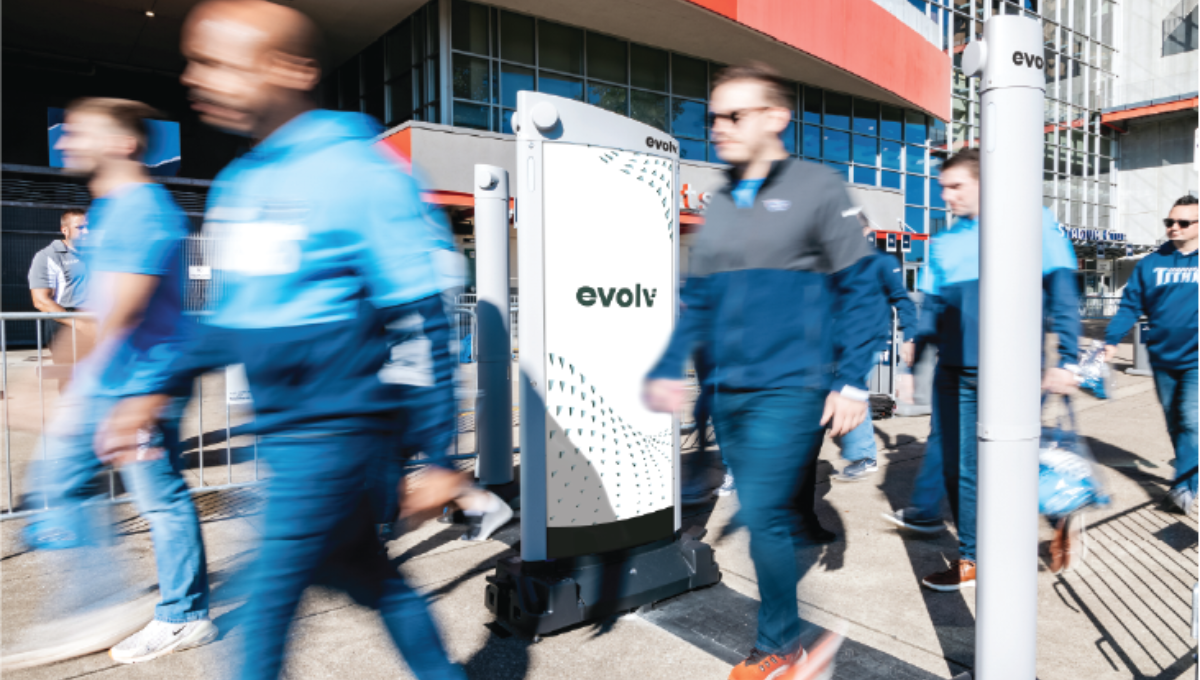
Unlike traditional screening solutions, the Evolv Edge allows our guests, artists and staff members to enter and exit the venue without the need to stop, pose, or empty their pockets.

Optimized Traffic Flow

By eliminating the need to stop each individual guest as they enter, the Evolv Edge enables us to provide a quicker and seamless guest experience, preventing bottlenecks and long lines from occurring.

Advanced Detection Abilities

Today’s threats are no longer limited to firearms and we wanted to make sure our security measures weren’t either. With the Evolv Edge we detect explosives and other weapons concealed on an individual, including fully non-metallic explosives. It even offers multiple sensitivity settings to respond to different threat scenarios should our risk-based security policies change.

Lifetime Evolution

Because threats, technology and security are constantly changing, we wanted to identify a partner that would help us keep pace with those changes and ensure we evolve with the industry. Evolv’s industry pedigree, paired with its multi-disciplinary team of experts are keeping us on the front-lines of performing arts security today and in the future.

While all of these advanced capabilities have significantly improved our security measures, we strongly believe that good communication and training for our security team members, staff and ticket holders are key pieces of our security puzzle. By pairing the Evolv Edge with our high-quality customer service, we can be confident in our ability to provide high-quality security and guest experiences.

After working with Evolv and the Evolv Edge for over a year now, we’ve been nothing but thrilled with the results. We even have patrons regularly approach our staff to express their appreciation for the increased security measures. We look forward to continuing our partnership with Evolv to bring our guests, staff and artists safe and enjoyable experiences.

Judy Mitchell is CEO of The Kravis Center for the Performing Arts, a professional performing arts center in downtown West Palm Beach, Florida. Read more about the “Five Steps to Implementing a Balanced Security Plan at Performing Arts Venues” by Anil Chitkara, president of Evolv Technology. 

Photo Credit: Nick Juhasz.

Relying on 100-Year-Old Technology is Not the Answer to Stop Today’s Active Shooter

One of the indelible lessons seared into our consciousness over the last 20 years is that every public gathering and event is now a soft target. From concerts to prayers – there are few places that would be considered sanctuary against the evils perpetrated by mass shooters.

According to the Gun Violence archive, there were more than 340 mass shootings in the U.S. alone in 2018 – nearly one a day. While there remains disagreement on a legislative solution to the mass shooting problem, one thing has become clear – facilities that have a high degree of visible security measures are less likely to become a target.

Visual deterrents, like metal detectors, can be incredibly effective in preventing attacks from occurring, but the technology has had minimal improvement since the walkthrough metal detector was invented more than 90 years ago.

Doesn’t our modern problem deserve a more modern solution? It should be possible to deter and prevent mass casualty events like what happened in Las Vegas without requiring every single person to take off their belt and take out their keys before entering a building?

According to a recent report, organizations will spend more than $1.5 Billion on metal detectors in the next five years. This doesn’t even account for the massive labor costs required to adequately staff these devices to ensure heightened security. Nor does it account for the impact on visitor experience – at some point, your patrons will grow tired of having to wait in line to then strip down and hold their hands in the air to show that their phone isn’t a weapon.

Metal detectors represent the security approach of the past – the future of prevention is a combination of better sensors, AI and biometrics that helps immediately identify all manner of threats without compromising visitor convenience.

As today’s threats grow more menacing, the technologies preventing the next tragedy need to evolve as well. Here are four primary ways that the we can improve upon the metal detector:

Superior Detection at the Speed of Life

Metal detectors are pretty descriptive – they detect metal objects.  Determining whether the objects present a threat requires additional layers of screening – and more importantly, they don’t account for newer threats that have emerged in recent years, including explosives, plastic weapons, and more.

Using a combination of active millimeter wave and electromagnetic sensors, solutions such as the Evolv Edge® are able to detect both weapons and explosives, while avoiding the nuisance alarms that make lines slow down so people can remove keys from their pockets.

People and Bags; Bags and People

While security and prevention should stand alone, the reality is that each needs to be balanced with customer convenience. Stringent requirements to enter a public facility may increase security, but if the approach is too onerous, there may not be an event to protect as the customers stay at home.

Metal detectors are often accompanied by ancillary screening measures – like X-Rays or even hand searches – to account for bags and other items.  We want a facility to allow people to be people – so they can walk through the checkpoint at a regular pace without pausing, stopping or posing.  They can even walk through with their bags and are not required to remove materials from bags or their person.

Individual Screening – Eliminating Single File Requirements 

One of the biggest detriments of the walk through metal detector is that crowds need to line up and filter through in single file. If the person in front of you triggers an alert, then the entire line slows down as that person receives secondary screening.

It needs to be possible to screen individuals within crowds, pinpointing individual threats within a free-flow environment. This allows for screening on a more natural basis for crowds entering a facility, improving customer satisfaction while ensuring that everyone is vetted for weapons of all kinds.

Improving Guard Effectiveness 

As we discussed above, the walk through metal detector requires significant human intervention – each alert requires physical intervention for additional screening.  Whether it’s a pat down, or the use of wand technology guards need to manually vet persons of interest after each alert.

Solutions exist that are designed to help guards do their job more effectively – which is protect the customers of the facility they’re guarding. Potential threats are identified with a picture of the person who set off the alert, as well as a clear indication of where the threat exists on the body. This expedites secondary searches, while providing guards with actionable intelligence that could be the difference in preventing a mass casualty event.

The technologies used to try to detect and prevent the next mass casualty event are outdated.  Metal detectors were not designed to handle modern facilities or crowds. Security investment needs to be focused on more capable security systems that allow for fluid detection and a better visitor experience.

Learn more about Evolv Edge here.

Biometrics To Improve Terminal Side Security And Employee Screening

Innovations at airports have historically focused on one or both of the following primary factors: improving the customer experience, and securing passengers from ‘terminal to the plane.’

For example, the ‘Automated Screening Lane,’ originally proven to be successful in many European airports, have been widely adopted by U.S. airports in the past two years. In addition, new scanning technologies are making it possible to rapidly detect explosives, firearms and other weapons hidden on a person, without requiring them to remove layers.

On the customer experience front, more than 15 airports started testing and using biometrics to dramatically improve the customer experience. Airports are using advanced facial recognition to make it much easier for travelers to check-in at self-service kiosks, drop their luggage off at counters, and board planes – all without showing passports, IDs or other credentials.

While many airports are still in trial phases for these technologies, early results of reduced wait times and improved service levels are encouraging.

Despite these advancements, there has been little innovation in two critical areas: terminal-side security and employee screening to protect against the insider threat. Though some airports actively identify new technologies to improve these areas, many play a game of ‘wait and see’ to find out what the TSA will support or mandate.

Based on my experience, the airports that are proactive with their technology are the ones that set the future trends. When projects are successful, the TSA embraces those airports as models.

Security has traditionally been separate from the customer experience, but based on the early success of biometrics, we’ll see a big shift on this front in 2019. Airports will increasingly leverage successful customer technologies to improve their security apparatuses as well. This will set the trend for what airport security will look like for terminal side and employee screening in 2019 and beyond.

Here are two big ways we expect to see the combination of biometrics and security deployed this year.

Battling the Insider Threat – Improving Employee Screening

According to a recent economic impact study conducted for Airports Council International – North America, about 1.2 million people work at 485 commercial airports in the U.S.

In a risk-based security model, airport employees don’t require the same level of scrutiny as passengers, but they still need to be screened. Because there are no TSA mandates of physical screening for employees, many airports  deploy new security programs only after several noteworthy incidents have occurred, including the Horizon Air worker who stole and flew a commercial aircraft over the Seattle area, and the multiple smuggling-case/PN2GK4BkeWZ1AZZShFaTsL/’>arrests for various smuggling charges.

These incidents have put many aviation security veterans, including myself, on high alert and increased the possibility of a mass casualty act conducted by a disgruntled or radicalized employee. While many airports have added physical screening procedures for employees, the use of biometrics for employee screening for employee screening will start to explode in 2019.

Here’s why. Security and customer convenience are constantly at odds in traditional airports. Adding additional physical security procedures for employees can be cumbersome and cause delays for travelers because the employees are held-up at security checkpoints. This is why biometrics, combined with the power of new physical threat detection systems like Evolv Edge®, will become the defacto standard for employee screening.

The early success of biometrics from a customer satisfaction standpoint will crossover to the security side as more airports employ biometrics at security checkpoints for another layer of security for passenger identification.

In fact, the TSA recently announced their roadmap for expanding the use of biometrics to improve passenger identify verification. This will be a departure from the current process of examining physical documents and processing biographical information on every traveler.

But, by adding biometrics scanners at security points like TSA Pre-Check, U.S. Customs and Border Protection points, and more, the TSA and the airports will be able to improve the customer experience, while strengthening their ability to verify each passenger.

These advances in technology will allow airports to treat security and the customer experience in the same way, while improving both at the same time. The combination of biometric identification, along with the ability to rapidly scan travelers for weapons and explosive materials without requiring them to take off layers of clothes, shoes, belts and more, will result in more secure, more convenient travel.

Why I Started Evolv: A Q+A with Co-Founder and CEO, Mike Ellenbogen

I recently sat down with Mike Ellenbogen, our CEO and co-founder. We discussed his career path, what’s to come in the security industry in 2019 and Mike’s advice for aspiring entrepreneurs. See what Mike had to say.

Melissa Cohen: Mike, you have a lot of experience launching new companies and building something from the ground up based on a new idea. You did this with both Evolv and your previous company. Can you tell us about an accomplishment that shaped your career?

Mike Ellenbogen: Absolutely. I love building things and always have. I had a eureka moment that triggered the inception of my first company, Reveal Imaging. After new legislative requirements for airport security screening were put in place following September 11, I realized it made sense to employ smaller, less expensive systems and connect them together via a network of PCs. We rethought the way checked baggage was screened in the U.S., considering the total cost of the systems as opposed to just the cost of the technology. Ultimately, Reveal Imaging was acquired by Science Applications International Corporation (SAIC) in August 2010. I’m immensely proud of the work that team did and grateful for the experience – it’s really helped shape who I am today and is what motivated me to keep going and start Evolv.

MC: Based on your extensive experience in the security business, what do you think makes a good CEO in the industry?

ME: There needs to be an inclination to push beyond the conservative approach that is so common in the security industry. There are plenty of businesses out there with the “same old” security technology that’s been around for decades. I like to push the envelop and ensure that my company is offering something that solves a problem while also surprising and delighting. I think it’s important that a security industry CEO sees the world that can be rather than replicating what’s already out there or being happy with the status quo.

MC: What’s the biggest challenge you’ve faced in building either of these businesses and how did you overcome it?

ME: The core technology at both companies was/is really complicated – millimeter wave imaging is a challenging field, so is Artificial Intelligence (AI). Of course, you have to have technology that works in order to have repeatable and reliable customers that you can pursue. Leading an emerging technology company and inventing fundamentally new technology, there’s inherently a lot of pieces you have to glue together. It’s daunting and the success of the company is reliant on a deep understanding of the physics of the real world and how to appropriately push the boundaries of electronics and processing.

With any new technology or applications, there is also a steep learning curve among your teams. An engineer may be familiar with the technology, but not with the application. On that note, another challenge is finding the kind of people that can help move the physical security technology industry forward. We look for people with credibility, who have energy and creativity, and can also help move the needle.

MC: What are some of the biggest trends and themes you’ll be watching for in the security industry in 2019?

ME: We’ll definitely see further integration of AI and facial recognition into more security technologies and applications. Disparate AI capabilities will need to be packaged in a way that is more useful for customers in 2019. We’ll also see an increase in compute power at the edge, for example, more compute power within security cameras rather than via a central/integrated service. And, I know people have been saying this outside of the security industry for years, but we’re going to see expanded use of the cloud and Software as a Service (SaaS) within security technologies. While this has already started, some major shifts in this space are coming.

MC: Let’s do some rapid-fire, fun questions. How would you describe your leadership style?

ME: I like to think I present a vision of what could be to get people behind that vision – you need people to believe in the vision to engage them in getting there. Considering I’m focused on solving problems in a new way, I also recognize that it’s important for me to surround myself with people who are optimistic but real.

MC: What is your top productivity hack?

ME: I live my life multi-threaded, which I think is just another way of saying that I’m always trying to be efficient. I do a lot of different things in parallel. For example, I turn the coffee pot on before I get ready for work so that it’s ready when I leave. I take pride in maximizing my time like this.

MC: What piece of advice would you give your younger self?

ME: I always wanted to run a company and invent something – this desire was within me from a very young age. I would tell myself you need time to see the opportunities in the market, so find an industry you really love, make it your own, and word incredibly hard at it.

MC: What motivates you?

ME: Every day I’m motivated by the vision that the technology we’re working on is important and helping to save lives. As I mentioned before, I also love building new things and, in doing so, helping to bring success to the people around me.

MC: What best practices can you share for future leaders who are looking to start a business?

ME: It’s all about the people. Whatever your path, you’ll be spending a lot of time in the trenches with them, so you better like them. And of course, expect the unexpected!