Too many mass shootings.
Too many venues without security checkpoints.
Too few technology solutions identifying the individuals who require a closer look.
Too many conversations with security professionals and venue operators asking for something better.
At Evolv, we have had enough. The “new normal,” as some have called it, is unacceptable. We’ve dedicated ourselves to keeping people safe by using technology to stop active shooters. The safer world we envision should be something that everyone simply expects without having to think about it.
Six years ago, Mike Ellenbogen and I started Evolv Technology with a mission to save lives.
Prior to the founding of Evolv, we spent more than two yearsconducting research. We met with security professionals across the globe anddeveloped a deep understanding of modern threats and what security professionalsneed to prevent mass casualty events. We visited university labs and small techcompanies to understand the latest innovations in sensors, data synthesis,image reconstruction, machine learning, and design thinking. Then, leveragingour combined 40+ years of experience using technology to solve critical,complex problems, we started Evolv.
At Evolv, we set out to solve a very tough problem: how do you recognize that the vast majority of people pose no threat, while simultaneously identifying those few who may be a threat and require a closer look. It’s a simple problem statement, but a difficult question to answer.
We launched the Evolv Edge system in 2017, after about 3 ½ years of research and development. Evolv Edge is one of a kind. It’s the first product in the industry to screen people and their belongings at high speed without requiring them to stop or remove items from their pockets and bags. From a technology perspective, Edge’s combination of sensors, signal processing, detection algorithms, and user-centered design is like nothing else on the market. Gone are the white bowls for your keys, coins, wallets, belts and cell phones; gone is the need to stop and put your hands in the air. There is no need to place your bag on a table for a guard to search prior to walking through the Edge. With the Edge, you just walk through.
Since its launch, the Edge has screened more than 25 million people around the world, primarily at entertainment venues, sports stadiums, tourist locations, workplaces, hospitals, and housesof worship. In that time, the Edge has detected more than 5,000 weapons. Priorto selecting the Edge, many of these venues tried walk through metal detectors,but found the experience for their visitors to be too slow and cumbersome. These outdated pieces of equipment also resulted in long lines, creating a potentially new security target and concern.
Feedback on the Evolv Edge has been very positive. We’ve seen first-hand the reactions of visitors going through the system and guards operating it. The most common question we are asked is “Why don’t they have these everywhere?”
What We’ve Learned
As we deployed the Edge and spoke to thousands of security professionals and venue operators, we again asked how we could advance screening technology to make many more venues even safer, while continuing to deliver a positive visitor experience. These conversations were enlightening. We heard significant concern about several different scenarios:
- Workplace Violence Prevention:
One of the biggest areas of concern was the proliferation of workplace violence. People should not be concerned for their safety while at work. Many employers, however, are not willing to put a traditional checkpoint in place. They are looking for a system that screens people with little-to-no inconvenience.
- Event Screening:
Another scenario we heard was about screening large crowds for events. The shootings in Las Vegas, Gilroy and Jacksonville Landing highlight the need to screen large numbers of people at special events.
- Tourist Screening:
The third scenario we continued to hear was around screening at tourist locations. Many of these locations, whether an observation deck, museum, or landmark, carry their own unique complexities. Many visitors are carrying food, clothing, cameras, and a host of other personal items for a day’s outing. Often there are international visitors speaking a range of languages.
These three scenarios were just a few of the many that were highlighted.
In many cases, security teams had tried traditional checkpoints with walk through metal detectors and found them to be unsustainable solutions. Traditional screening created massive lines, frustrating visitors or employees, and resulted in an unacceptable overall experience. These stories, which we continue to hear on a daily basis, inspired the design for our newest product.
Introducing Evolv Express
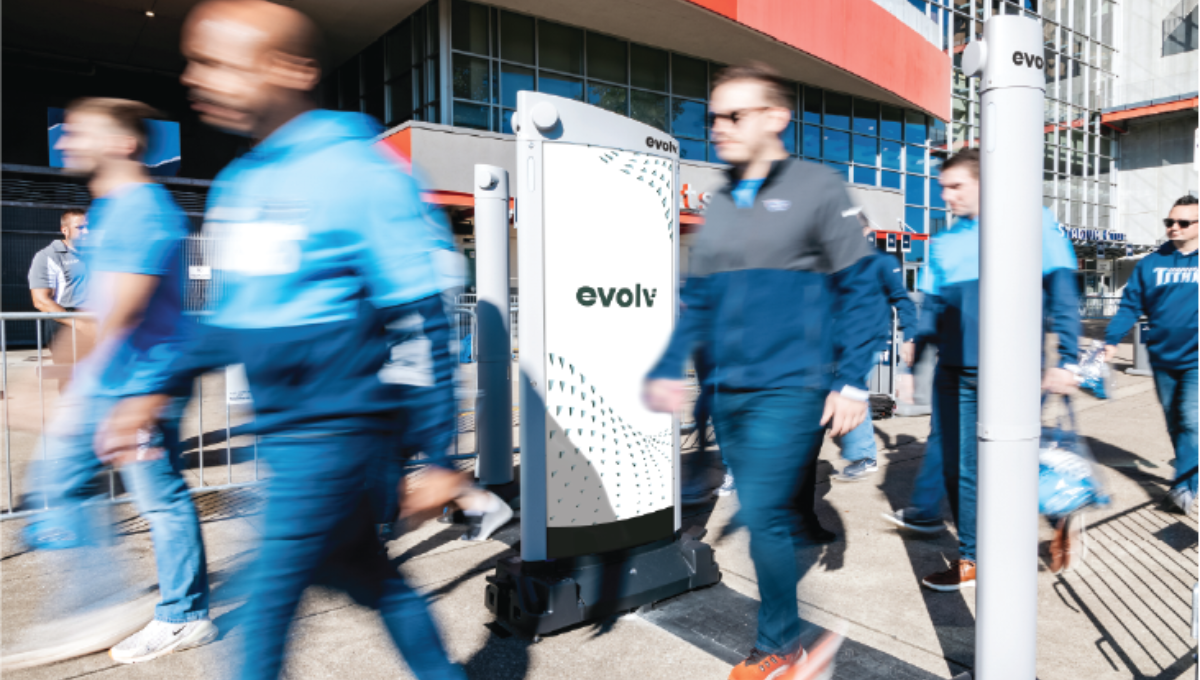
We’re now launching our second product, Evolv Express®. Whereas the Edge screens individuals one-at-a-time as they pass through the system for venues who want a control point, Express screens large groups of people at a time with no stopping, no emptying of pockets or removing bags. After eighteen months of development, we’re now releasing Express, the fastest threat screening product on the market that ensures every individual and their belongings are screened as they pass through without even breaking stride. We have incorporated the latest high-speed sensors that move data in real time to a detection algorithm that renders a decision as people pass through; with Express, 60 people can be screened every minute, that’s 3,600 per hour. The system screened more than 250,000 individuals during our pilot testing this spring and summer. As with the Edge, Express detects those individuals who require a closer look, and automatically alerts guards and security personnel to confirm those individuals are not a threat.
How Express Works
Evolv Express combines the latest technologies and user-driven design principles to provide this high throughput, truly frictionless approach to screening thousands of people per hour. It all starts with the brains of our system, the Evolv Cortex AI™ Software Platform. This isa machine learning-based AI system that uses data sets we have generated from the system to train the algorithm. The training is conducted on a methodicalbasis, starting with a designated threat set, such as firearms. A range of threats is scanned, and classifiers are developed, refined, tested, tuned, and hardened to detect the threat set. Similarly, a range of non-threatening items such as cell phones is scanned through the system. A similar approach is undertaken to create classifiers. As the range of threats and non-threats are analyzed by our development team, the algorithm is continually refined. Over time, as newthreats emerge and data is collected, the algorithm will continue to berefined. This process is done in our labs in a controlled manner. Once we are confident in the performance of each new algorithm, it will be released and upgraded to Express systems operating at customer sites.
A key Express component is the sensors that collect data to drive the algorithm. These sensors were designed by Evolv to optimize the separationof the signals for both threat and non-threat items. After scanning millions of people with the Evolv Edge system, we had developed a tremendous body of knowledge regarding sensors as well as the typical items that are carried by visitors through our systems. This body of data informed the design for the Express sensor set.
We have also optimized the data flow through our system. For each individual screened, the Edge system moves nearly 1 million data points to the algorithm, with a resulting red light / green light decision as the person exits. For Express, this ultra-high speed data-processing engine has been further optimized to render a decision in less than one second from the time a person starts walking through.
A significant amount of time was spent on the Express user experience. The UX has a number of components: the industrial design of the system, the interaction with visitors being screened, the operator interaction with the system, and the people moving and setting up the system. Each of these elements has been carefully thought through and tested with the respective user group.
- Industrial Design:
The Edge was a significant step forward in designing a system that is welcoming to people passing through it. We have taken some of those key design elements and made improvements to streamline the look even further. Additionally, we recognize these systems need to visually fit into the environment, so we added the ability for users to add custom branding or signage on a key component of the system.
- We widened the overall design to make it easier for people to pass through with minimal disruption.
- Operator Experience:
Our focus on the operator experience has resulted in a system that is easy to operate as thousands of people pass through each hour. There are a mix of audio and visual cues for the operator. If an individual alarms, there is a picture of the person alarming, with the alarm location clearly outlined for further evaluation.
- Ease of Deployment:
Finally, a key element of the system is the ability to move it around to enable screening at different locations. The system has built-in mobility capability, for easy breakdown, movement, and set-up. When the system is powered on, an automatic software calibration routine runs through diagnostics, resulting in the system being up and operational in two minutes.
We are starting a roadshow to preview the Express to security professionals around the U.S. Next week we will be unveiling at the ASIS GSX Security Show in Chicago. After that, we will be in major cities around the U.S. And, you will start to see the Express working at venues around the country keeping people safe.
Our Mission
We set out to solve a very tough problem: how do yourecognize that the vast majority of people pose no threat, while simultaneouslyidentifying those few who may be a threat and require a closer look; how do youimprove public security without disrupting the public? Over the past 6 years we’ve dedicated our resources and our expertise to answering these questions.
We’re humbled to have the opportunity to ‘make our dent’ in the universe and couldn’t be more excited to launch Evolv Express.