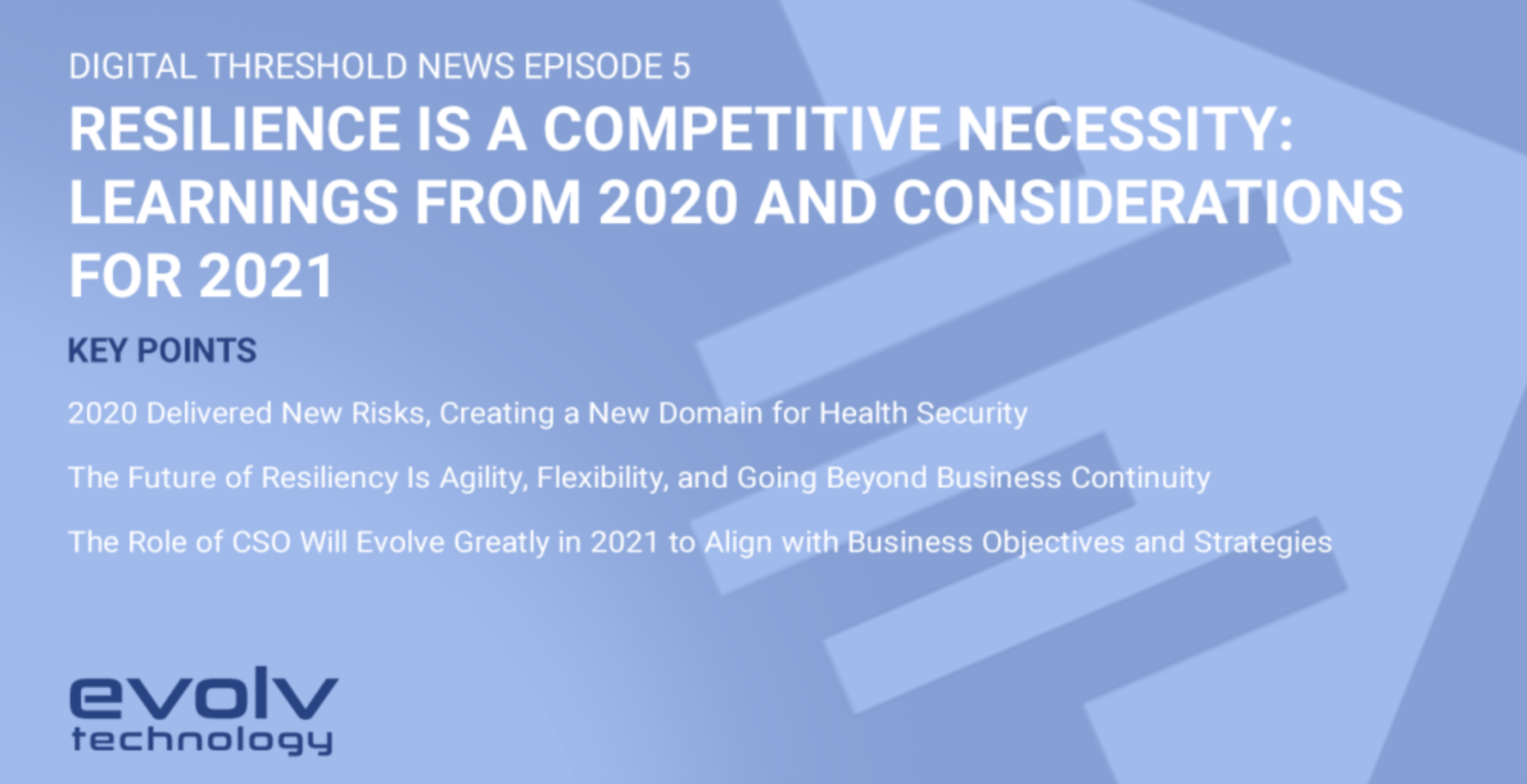
Digital Threshold News: Episode 5 – Resilience is a Competitive Necessity: Learnings from 2020 and Considerations for 2021

2020 was a year of learning for security and risk practitioners, in fact, the blueprints they started the year with quickly became obsolete. At the end of the year, it’s time to look back on what the industry learned and what 2021 will bring with the final episode of the year of Digital Threshold Live.

Host Anil Chitkara, Evolv Technology Co-founder and Head of Corporate Development, welcomed two guests from Teneo, a global CEO consulting and advisory firm, Courtney Adante, President and Security Risk Advisor, and Jonathan Wackrow, Managing Director and Global Head of Security. Adante and Wackrow shared what they learned during this unexpected year and how that will shape risk and security postures in 2021. 

2020: New and Emerging Risk Required Agility and Creative Solutions

No matter what industry, size, or level of success, most organizations were not prepared for a pandemic. Even when more information about COVID-19 became available, and there were shifts in work, Adante commented, “We were building solutions on the fly. This mode of operating will likely continue into 2021.”

Wackrow agreed, “Everyone has a plan until they’re punched in the face, and everyone got punched in the face. Those that have been successful, identified threats with the virus and pivoted quickly with a model of resilience and flexibility.”

COVID-19 wasn’t the only risk in 2020. Civil unrest around social and criminal justice reform, a faltering economy, rising crime rates, mental health issues, cyber-attacks, and natural disasters also commanded attention in 2020. Those same challenges will carry into 2021. 

How Do Organizations Move Forward with Risk Management?

Adante and Wackrow discussed risk monitoring and intelligence, and their importance. They are leveraging data analysis and expert critiques to add context while concurrently teaching their clients how to do this.  

Wackrow said, “In thinking about threat domains and how they impact your organization, it’s not only about consequences and severity, but how are you going to respond? You don’t want to be in a reactive model.”

A New Domain for Security: Health Security

In the realm of security, prior to a pandemic, the branches were physical and cyber. Now companies realize that health security also has to be part of that conversation. It becomes a new pillar requiring subject matter expertise, and is not something traditionally part of the security component. “We’re seeing hiring of chief medical officers outside of healthcare, in airlines and real estate developers. Businesses are now prioritizing this expertise,” Adante added. 

This new part of security is changing the role of the Chief Security Officer (CSO).

The New CSO

Traditionally, a CSO has been about gates, guards, and guns. 2020 has disrupted this idea, and the role will never be the same. The CSO has three areas now: physical, cyber, and health. The CSO isn’t necessarily the expert on all these things, so that’s causing three shifts.

First, CSOs will have to think about risk management and strategy, along with its alignment with business operations and strategy. 

Second, they’ll need to form collaborative relationships with leaders in HR, information security, and operations. 

Third, there are now new issues on the plate, with physical locations mostly being empty. “New issues in security are now part of the story with the ‘work-from-home’ model. Those aren’t going away and may become bigger,” Adante said. 

Resiliency: What Does That Mean in 2021?

The last question for security and risk leaders is to think about what resiliency means in 2021. It’s not about business continuity. Most businesses had those before the pandemic. They were very IT-focused. Companies need to integrate the three pillars of security — physical, cyber, and health to create a more sustainable version of resiliency. 

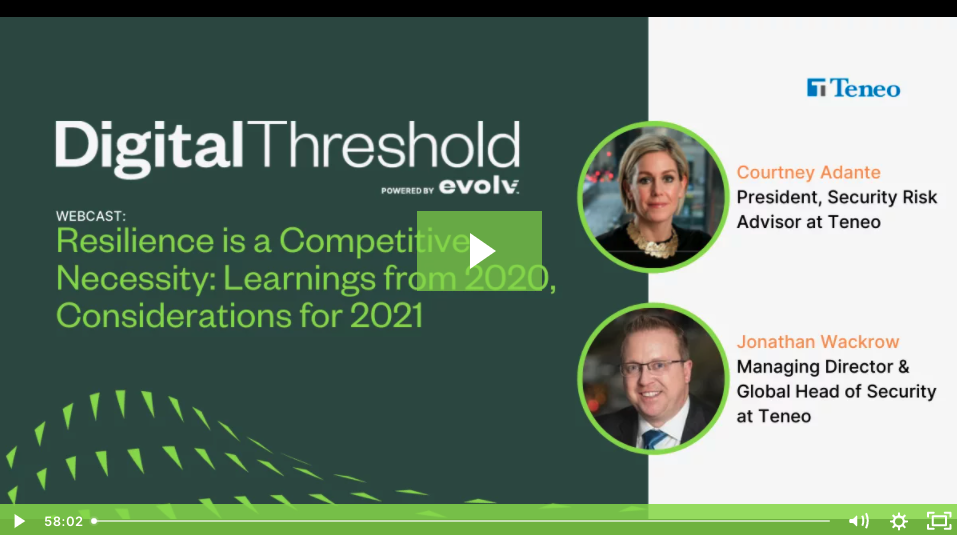
You can view the OnDemand version of the webcast by clicking on the video below.
On January 14, 2021, we’ll host the sixth episode Post-CES Retrospective: Breaking it Down – The Hits, the Misses and the Seminal Moments with Bilal Zuber, Partner at Lux Capital and Evolv Investor, register here. We hope to “see” you there. In the meantime, consider us as a security resource, click here to contact us.

To view our OnDemand version of Episode 5 or register for future episodes of Digital Threshold Live, click here.

Don’t have time to watch? Click here to listen to the podcast.
Resilience is a Competitive Necessity: Learnings from 2020, Considerations for 2021

On this fifth episode of Digital Threshold, host Anil Chitakara brought together two industry experts to help him break down the state of risk assessment and security heading into 2021. Courtney Adante, President of Security Risk Advisor at Teneo, and Jonathan Wackrow, Managing Director & Global Head of Security at Teneo, spoke about how 2020 changed the landscape of workplace and venue security and how these changes would impact security plans and strategies for 2021.

Adante believes how security professionals worked, and the methods and solutions they provided in 2020 will continue to benefit clients in 2021. “Throughout the pandemic, day to day, week to week, we spent our time figuring out what our clients were going to need in terms of security advisory services,” Adante said. “We were learning every day based on public health guides and new developments with the pandemic.” Adante also said it was beneficial to have two pandemic experts on her team to help navigate Teneo’s clients’ best solutions.

“All risk practitioners, at the close of 2019, as they started planning for 2020, had a blueprint laid out in front of them and how they were going to execute on that,” Wackrow said. Those plans were quickly thrown out the window as the pandemic began to take hold. “Those who were successful were those who were good at identifying the threats now facing their organizations and being able to pivot quickly into putting in short-term and long-term mitigation within their organization.”

While 2020 may be over, that doesn’t mean the problems and challenges are. The pandemic is still here, and there are myriad residual issues for businesses and organizations to contend. As these businesses begin to open back up, the additional risks before the pandemic are ones risk practitioners must also manage.

About Evolv Technology

Founded in 2013, Evolv Technology is the leader in human security solving the security screening problems of today with the most innovative technology and thinking. Evolv makes it possible for venues of all kinds to keep visitors and employees safe from concealed weapons, pandemic health threats and intruders. 

Digital transformation is unlocking efficiency and value everywhere as organizations reimagine archaic processes and technology, better equipping themselves with interoperable and flexible capabilities. Within the Digital Threshold vision, venues and facilities can intelligently use data to create a frictionless experience for guests and employees. The result is an entry process that enhances the overall experience instead of diminishing it as it so often does today. Making weapons screening faster and more precise is part of the Digital Threshold vision, but it’s just the beginning.

Resilience is a Competitive Necessity: Learnings from 2020, Considerations for 2021

On this fifth episode of Digital Threshold, host Anil Chitakara brought together two industry experts to help him break down the state of risk assessment and security heading into 2021. Courtney Adante, President of Security Risk Advisor at Teneo, and Jonathan Wackrow, Managing Director & Global Head of Security at Teneo, spoke about how 2020 changed the landscape of workplace and venue security and how these changes would impact security plans and strategies for 2021.

>>

Digital Threshold Live Episode 4 Blog – Why Technology Convergence in the Digital Threshold Matters

The continued acceleration of the digital transformation has unleashed seemingly limitless possibilities for technological applications, from the widespread global standpoint all the way down to the personal level. The emergence of artificial intelligence (AI) presents incredible opportunities in many arenas, including the practical application of physical security.

Anil Chitkara, Evolv Technology Co-founder and host of Digital Threshold Live, was joined by Mahesh Saptharishi during episode No. 4 to discuss the technological possibilities at the intersection of sensors and AI. Saptharishi is the CTO of Motorola Solutions and leads innovation of mission-critical communications, as well as video and command center software.

Saptharishi provided a detailed and thorough perspective on the synergies of machine learning, AI, big data and analytics and how each plays a necessary part in the digital threshold and the creation of state-of-the-art physical security systems.

“Machine learning are the core algorithmic capabilities that power AI,” Saptharishi said. With regards to physical security, “when cameras, or when systems, see things, detect objects or respond to what the objects are doing in the scene, that is artificial intelligence, but that ability to detect and the ability for that system to adapt to the environment is powered by machine learning algorithms.”

Episode 4 Highlights and Provides Insights on the Security Threshold

Saptharishi explained that AI has come a long way in the past 10 years as computing power and speed have taken major strides – in large part due to the evolution of gaming GPUs. 

“I think storage becoming cheaper, network bandwidth becoming cheaper, the ability to collect data becoming more practical – that acted as a fuel that powered all these algorithms to develop further and actually reach their performance potential and become practical through the processor technology that has come out,“ Saptharishi said.

This has been instrumental in AI development. One such real world application is AI understanding audio and speech patterns, as well as analyzing video. Utilizing improved GPU technology, these computations can now be done in real time. What once was done with multiple computers can now be done from your phone.

Chitkara asked about the human impacts of AI and whether this technology is replacing people or helping them.

To a degree, AI can replace or augment existing jobs done by humans. 

“But, that said, humans are not static entities in terms of how we apply our intelligence,” Saptharishi said. When AI replaces certain tasks, people can focus on other areas where AI does not apply presently or perhaps cannot perform in the same way a human would. 

For example, AI can assist law enforcement by helping search for people on video or by calling the attention of the officer to a particular situation that would require human judgement on whether or not intervention is applicable.

Saptharishi also explained the process of developing AI for particular applications. It starts by identifying the human factor opportunities. By shadowing individuals as they progress through their normal tasks, the development team can determine tasks that can be automated or assisted through technology. 

This can greatly increase the productivity of the individual. With the automation of sensory actions, people can do things earlier, faster and also allow for more response time to particular situations, as technology has assisted in collecting information in an expedited manner.

In terms of security and technology, Saptharishi noted some key trends that have emerged.  One trend is the combination of sensing modalities to create more powerful solutions. Other trends are the increased utilization of cloud connectivity and the integration of public safety, private security and enterprise security.

Chitkara and Saptharishi also discussed the security threshold and the factors that make AI successful for this application.

“Along with this notion that you need a high throughput solution, the threshold cannot become a bottleneck,” Saptharishi said. 

The technology threshold needs to be as seamless as possible and not become an overwhelming burden to the flow of people. Secondly, the threshold needs to identify a person along with the right context. Is this person permitted to enter? Along with that identity permission, is this person bringing along something that is not permitted, such as a weapon or an illness?

“The days of somebody sitting in front of a security operations center, watching a video wall, hoping that they can detect something that is potentially suspicious or requires attention – I think those days are starting to reduce,” Saptharishi said.

You can view the OnDemand version of the webcast by clicking on the video below.

On October 17, 2020, we’ll host the fifth episode, Resilience is a Competitive Necessity: Learnings from 2020, Considerations for 2021 with Courtney Adante, President of Security Risk Advisor, and Jonathan Wackrow, Managing Director & Global Head of Security at Teneo; register here. We hope to “see” you there. In the meantime, consider us as a security resource, click here to contact us.

To view our OnDemand version of Episode 4 or register for future episodes of Digital Threshold Live, click here.

Don’t have time to watch? Click here to listen to the podcast.

Evolv Technology Honored with 2020 ‘ASTORS’ Homeland Security Award

Groundbreaking Touchless Security Screening System Earns Platinum Status, Named the “Best Weapons Detection Solution”

WALTHAM, MA, Dec. 17, 2020 — Evolv Technology, the human security pioneer, today announced it is the recipient of a coveted 2020 ‘ASTORS’ Homeland Security Award from American Security Today for its touchless security screening solution, Evolv Express®, in the “Best Weapons Detection Solution” category.

The Annual ‘ASTORS’ Awards, now in its fifth year, is the preeminent U.S. Homeland Security Awards Program, highlighting the most cutting-edge and forward-thinking security solutions coming onto the market today. The program is specifically designed to honor distinguished government and vendor solutions that deliver enhanced value, benefit and intelligence to end users in a variety of government, homeland security, enterprise, and public safety vertical markets.

Evolv is a three-time ASTORS winner, receiving the Homeland Security Award badge in 2018, 2019 and now 2020. ASTORS’ nominations are evaluated on their technical innovation, interoperability, specific impact within the category, overall impact to the industry, relatability to other industry technologies, and application feasibility outside of the industry.

“The pandemic has brought significant challenges to our nation and across the world as priorities have shifted and we’ve all had to adapt,” said Evolv Chief Executive Officer Peter George. “As the world re-opens, health and physical security have become increasingly more critical. Organizations must now conduct security screening at entries that’s efficient, allows for social distancing and is touchless.  Evolv continues to stay focused on delivering a best-in-class security screening solution while staying at the forefront of all emerging threats. We’re honored to be taking home a Platinum Award in American Security Today’s distinguished 2020 ‘ASTORS’ Awards Program.”

Evolv is leading the digital transformation of physical security, one that is touchless and addresses the ‘new normal’ threat of pandemic viruses as well as concealed weapons. Evolv Express™ uses AI software and powerful sensors that can screen up to 3,600 people per hour – 10 times faster than legacy approaches such as metal detectors, hand wands and manual inspections. The system enables social distancing at entrances and other security checkpoints while minimizing person-to-person interaction—requiring no stopping, no emptying of pockets or removing bags. People simply walk through naturally, alleviating potential crowding and long lines while greatly reducing contact between guests, employees and security staff. By using Evolv Express, organizations have been able to optimize the performance of their security teams while reducing screening expenses by as much as 70%.

Second only to the TSA, organizations using Evolv’s systems have screened more than 50 million people in an expedient and undisruptive manner. Evolv is used for visitor and employee screening at top entertainment venues, schools, international airports, stadiums, corporations, hospitals, large-scale events and national landmarks worldwide. Customers include Six Flags Entertainment Corporation, L.L. Bean, Wynn Las Vegas, Oakland International Airport, two South Carolina school districts, Hersheypark, Set Jet, the Biltmore Estate, Pittsburgh Symphony Orchestra and hundreds of others.


About Evolv Technology

Evolv Technology provides touchless security screening systems that ensure safety without sacrificing the visitor experience. The company’s latest product, coupled with a thermal imaging package, spots concealed weapons and potential virus infection threats using advanced digital sensors and artificial intelligence that is incredibly accurate, discreet and delivers significantly more throughput than older technologies. Evolv Express® has earned industry accolades such as the 2020 Edison Awards™, two Campus Safety 2020 BEST Awards, and Campus Security & Life Safety magazine’s Secure Campus 2020 Awards. Evolv’s customers include hundreds of outdoor entertainment venues, stadiums, large-scale events, cultural landmarks, corporations and warehouses, schools and hospitals around the globe. Led by a team of security industry thought leaders with a track record for delivering first-to-market products, the company holds more than 100 patents. Evolv’s investors include Bill Gates, Florida Governor Jeb Bush’s firm, Finback Investment Partners, DCVC (Data Collective), General Catalyst Partners, Lux Capital, SineWave Ventures and STANLEY Ventures. The company’s partners include STANLEY Security and Johnson Controls. For more information, visit https://evolvtechnology.com.


####

PR Contacts:
CHEN PR for Evolv
Jennifer Torode
jtorode@chenpr.com
(781) 672-3119

Evolv Technology Named One of Boston’s Hottest Startups by BostInno

Rapidly Expanding Touchless Security Screening, Evolv also Lauded as One of Just Eleven Winners to Earn Inno On Fire “Blazer” Status

WALTHAM, MA, December 14, 2020 – Evolv Technology, the human security pioneer, today announced it has been selected as a winner of BostInno’s Inno On Fire for 2020 awards, earning “Blazer” status in the Security Tech category.

Inno on Fire, formerly known as 50 on Fire, looked a bit different this year due to COVID-19. The qualifications for winning the award followed suit. For many Boston-based startups, the pandemic threatened their futures, making growth more challenging. For others, it created opportunity.

In October, BostInno announced 50 honorees spanning 11 categories—from Cleantech to Biotech to Software to Security Tech. Recognizing those business leaders and innovators who have blazed a path forward in 2020, the award this year acknowledged the unique difficulty of that achievement. In early December, a panel of elite judges selected one “Blazer” per category, bestowing that award upon Evolv Technology and the other winners during a virtual ceremony.

“We’re honored to be named a ‘Blazer’ by BostInno’s On Fire,” said Evolv Co-founder and Head of Advanced Technology Michael Ellenbogen. “This year has proven incredibly challenging for so many businesses due to the pandemic. I’m enormously grateful to work with an all-star team that is amazingly agile, innovative and committed to helping to keep people safe from the continuously changing threat landscape. It’s that kind of talent that enabled us to record our best year ever.”

Evolv is leading the digital transformation of physical security, one that is touchless and addresses the ‘new normal’ threat of pandemic viruses as well as concealed weapons. Using AI software and powerful sensors, Evolv Express™ can screen up to 3,600 people per hour – 10 times faster than legacy approaches such as metal detectors, hand wands and manual inspections. The system enables social distancing at entrances and other security checkpoints while minimizing person-to-person interaction—requiring no stopping, no emptying of pockets or removing bags. People simply walk through naturally, alleviating potential crowding and long lines while greatly reducing contact between guests, employees and security staff.

Evolv’s touchless security screening systems have been used to screen more than 50 million individuals in an expedient, respectful manner. Customers include Six Flags Entertainment Corporation, L.L. Bean, Wynn Las Vegas, Oakland International Airport, two South Carolina school districts, Hersheypark, Set Jet, the Biltmore Estate, Pittsburgh Symphony Orchestra and hundreds of others. By using Evolv Express, organizations optimize the performance of their security teams while reducing screening expenses by as much as 70%.


About Evolv Technology  

Evolv Technology provides touchless security screening systems that ensure safety without sacrificing the visitor experience. The company’s latest product, coupled with a thermal imaging package, spots concealed weapons and potential virus infection threats using advanced digital sensors and artificial intelligence that is incredibly accurate, discreet and delivers significantly more throughput than older technologies. Evolv Express® has earned industry accolades such as the 2020 Edison Awards™, two Campus Safety 2020 BEST Awards, and Campus Security & Life Safety magazine’s Secure Campus 2020 Awards. Evolv’s customers include hundreds of outdoor entertainment venues, stadiums, large-scale events, cultural landmarks, corporations and warehouses, schools and hospitals around the globe. Led by a team of security industry thought leaders with a track record for delivering first-to-market products, the company holds more than 100 patents. Evolv’s investors include Bill Gates, Florida Governor Jeb Bush’s firm, Finback Investment Partners, DCVC (Data Collective), General Catalyst Partners, Lux Capital, SineWave Ventures and STANLEY Ventures. The company’s partners include STANLEY Security and Johnson Controls. For more information, visit https://evolvtechnology.com.


-###-


PR Contact:

CHEN PR for Evolv
Jennifer Torode
jtorode@chenpr.com
(781) 672-3119

The Role of AI in the Future of Experiences and Security

The potential of machine learning and artificial intelligence in helping organizations and spaces reconsider their entry experience is vast – but it’s important to dive into exactly how those innovative solutions fit into the process of design and into real, actionable technology ready to make good on that promise.

On this episode of Digital Threshold Live, Dr. Mahesh Saptharishi, CTO, Motorola Solutions, joined host and Evolv Technology Co-founder Anil Chitkara to explore how AI is set to transform the future of experience and security.

First, it’s helpful to define some terms. As Saptharishi put it, machine learning encompasses the core, algorithmic capabilities that power AI, with AI being the resulting execution. “Big data” can be thought of as the volume, velocity, and variety of data that hits an AI system, while analytics is the outcome of that data and its use to answer some fundamental questions.

In terms of entrance control and security, AI can excel in the same capacity it does across many applications – in doing mechanical tasks in a more efficient manner.

“What AI today is very good at is taking mechanical tasks that are perhaps complex in and of themselves, but really mechanical in nature, and being able to do it in a way that is more efficient than humans would be able to do,” Saptharishi said. “Think of it as counting the number of people who enter a building. It used to be that someone at the door stood with a clicker and kept clicking, counting the number of people who came in. That is something that’s perhaps done more effectively by a sensor plus an AI solution of some sort.”

In optimizing the use of AI, humans can be freed up to accomplish more innovative and creative tasks, all while processes and operations become more efficient. It begins, Saptharishi, with “what-if” questions.

“Identify the bottlenecks, identify the inefficiencies in what is done today, take that customer journey, and optimize the job to be done through the course of design,” he said. “And, through the course of design, ask a set of what-if problems.”

About Evolv Technology

Founded in 2013, Evolv Technology is the leader in human security solving the security screening problems of today with the most innovative technology and thinking. Evolv makes it possible for venues of all kinds to keep visitors and employees safe from concealed weapons, pandemic health threats and intruders.

Digital transformation is unlocking efficiency and value everywhere as organizations reimagine archaic processes and technology, better equipping themselves with interoperable and flexible capabilities. Within the Digital Threshold vision, venues and facilities can intelligently use data to create a frictionless experience for guests and employees. The result is an entry process that enhances the overall experience instead of diminishing it as it so often does today. Making weapons screening faster and more precise is part of the Digital Threshold vision, but it’s just the beginning.

The Role of AI in the Future of Experiences and Security

The potential of machine learning and artificial intelligence in helping organizations and spaces reconsider their entry experience is vast – but it’s important to dive into exactly how those innovative solutions fit into the process of design and into real, actionable technology ready to make good on that promise.

>>

Harris Poll Shows Physical Security is Crucial to Getting Kids Back in School

Parents are equally concerned about mass shootings and COVID; the majority want weapons screening in place.

While effectively dealing with COVID-19 is top-of-mind for facilities managers as they work toward getting students back to school full-time, a recent Harris Poll we commissioned indicates there’s significant concern over violence and crime to be overcome as well. And in the COVID era, traditional screening methods that create lines and crowding will no longer be acceptable as a mitigation measure.

For the poll, more than 700 parents of K-12 school-aged children were surveyed in Sept. and Oct. 2020. It found 87% of the parents were either very or somewhat concerned about their kids contacting COVID upon returning to school. But concern over their physical security was a close second, at 81%. Although parents in urban areas were more likely to be somewhat or very concerned than their suburban counterparts, over half of suburban parents are concerned about the physical security of their children, 74% vs. 54%, respectively.

Eight out of ten parents are concerned about the physical security of their school age children.

COVID measures yes, but physical security, too

It’s a similar story when looking at COVID-19 prevention protocols and measures to ensure physical safety.

Having schools follow federal Centers for Disease Control and Prevention (CDC) protocols is important to parents feeling safe about their kids. More than 90% of parents say it’s important for schools to ensure frequent handwashing and sanitizing, increased cleaning, mask wearing, social distancing and temperature screening (see Figure 1). 

Figure 1

null

While that is certainly understandable, what may be surprising is that parents are nearly as concerned over physical security measures intended to keep students safe. More than 9 in 10 parents said it was somewhat or very important that each of the following measures be in place:

  • Locked doors and visitors showing ID: 92%
  • Presence of law enforcement: 92%
  • All classrooms have door locks: 91%
  • Metal detector for screening: 91%

Over 90% of parents say it is important to have a metal detector to screen for weapons coming into schools.

Part of the reason for concern over physical security measures is a fear of violence in public spaces. Sadly, school safety has been an issue for decades now. But concern seems to be growing, as the poll found 68% of parents think the risk is higher now than a year ago. Perhaps even more concerning, more than a third (31%) say going out in public is “mostly” or “very” unsafe.

Almost 90% of parents are concerned about a mass shooting in schools, matching the same level of concern about COVID.

In fact, parents are just as concerned over the risk of various sorts of physical violence as they are of COVID. Indeed, 88% of parents are somewhat or very concerned about COVID, the exact same number as for mass shootings. The numbers are similar for other forms of threats:

  • Protest-related civil unrest/violence: 86%
  • Street crime: 83%
  • Terrorism: 76%

COVID-related issues with metal detectors

So, it’s clear schools will have to take steps to assuage parents’ concerns over various physical threats. But the poll makes clear the pandemic is making that more challenging.

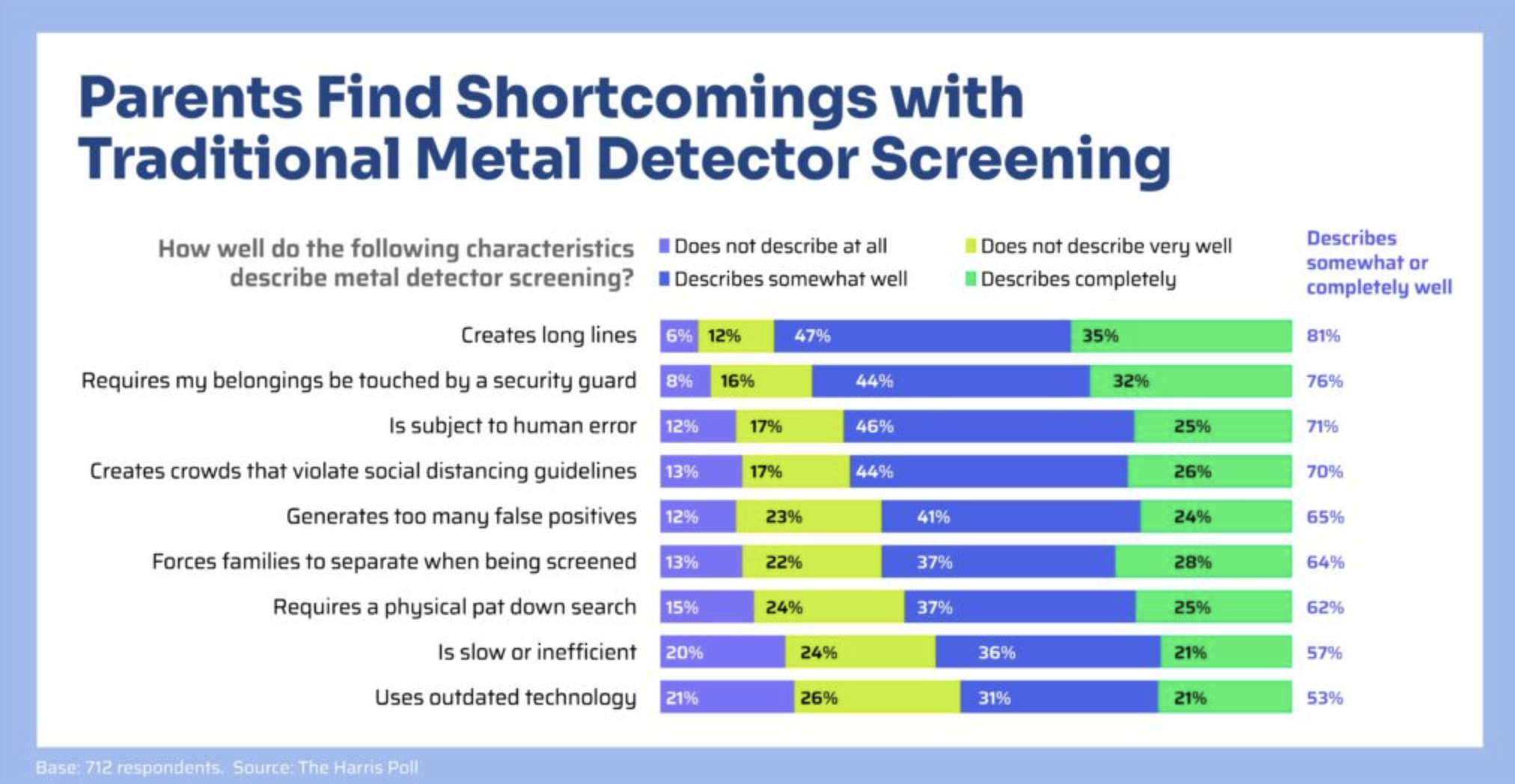
Parents now see issues with traditional metal detector screening. More than three quarters of parents are concerned that screening can create long lines and requires a student’s belongings to be touched by a security guard (see Figure 2). Fewer but still significant numbers of parents cite issues such as the possibility for human error, creating crowds that violate social distancing guidelines, and the need for physical pat-downs and searches.

Figure 2

null

The poll makes clear any schools using traditional metal detector screening are in for some backlash from parents. In the COVID era, at least half of parents are not willing to accept many of the problems associated with traditional metal detectors, including:

  • Crowds that violate social distancing guidelines
  • Use of outdated technology
  • False positives
  • Slow or inefficient processes
  • Physical pat down searches

Three out of four parents are concerned that security screening creates lines, and two thirds of them would not join a line that lacked social distancing.

Here’s another stat from the poll that I found fairly astounding: When parents were asked what they would do if they saw a security line in which people were not socially distancing, nearly two-thirds (65%) said they would not join the line. This inclination was far more pronounced in urban (73%) and suburban (64%) areas than rural (43%). 

A touchless screening experience

I discussed this issue, along with many others, in a webinar with Erica Parker, Managing Director at The Harris Poll. “When you think about the intersection of COVID and metal detector screening, and the fact that it can create long security lines, [parents are] not interested in that,” she said. Newer technology can make a difference, though. “We find that 87% are likely to return to facilities and venues if there was a touchless security screening,” she said.

The vast majority of parents (87%) say they are likely to return to facilities and venues if touchless security screening is in place.

That makes sense because newer touchless security screening systems create an altogether different experience. There’s no need to empty pockets, because the system can detect items that are in your pockets and differentiate, say, a gun from a metal keychain or phone. By the same token, you can carry bags through the screener; there’s no need to empty them out. The systems are reliable enough that there are far fewer false positives – meaning mistaking a harmless item for a weapon – which means there’s no need for pat-downs.

All of these attributes contribute to another big advantage of touchless systems: they’re much faster. Evolv Express, for example, uses artificial intelligence and powerful sensors to screen up to 3,600 people per hour, about 10 times faster than legacy metal detectors.

New back to school requirements

The Harris Poll makes clear that while COVID-19 is a top concern for parents of K-12 students, their physical safety is a close second. But given the COVID requirements for social distancing, it’s equally clear that we need to investigate new ways to keep kids safe and secure.

Parents will appreciate schools that implement a touchless approach, as 85% of them agree that knowing everyone is screened upon entering a school building makes them more comfortable. And more than three quarters (78%) agreed that metal detection systems make it impossible to socially distance while in line.

With a system like Evolv Express, you can get ahead of the curve and safely welcome kids back to school. To learn more, visit Evolv.

null

Evolv Technology Lauded by Frost & Sullivan for its AI-powered Touchless Threat Detection Technology, Evolv Express®

In addition to detecting weapons, Evolv Express®‘ ability to detect body temperature makes it an ideal tool to optimize safety measures and ensure minimum person-to-person interaction

SANTA CLARA, Calif. — December 9, 2020 — Based on its recent analysis of the North American AI-based touchless security screening solution market, Frost & Sullivan recognizes Evolv Technology with the 2020 North American Technology Innovation Leadership Award for Evolv Express®. As the only touchless security screening system in the world, it is a viable alternative to existing metal detector arches and handheld wands due to its ability to identify concealed weapons with high sensitivity and accuracy.

“Evolv Express® comprises a low-frequency electromagnetic sensor and AI feature that can detect, locate, and automatically categorize concealed explosives and firearms on visitors or employees in real-time while ignoring other harmless personal items such as smartphones, keys, coins, and belts. There is no need for visitors to stop, empty their pockets, and open their bags for physical/invasive security screening,” said Varun Babu Industry Analyst. “Significantly, it is 10x faster than traditional metal detectors and can screen more than 3,600 individuals per hour, wherein individuals can walk at a normal pace one at a time, or in groups via multi-lane entrances. This reduces manpower costs and the need for additional security guards at multi-lane security screening checkpoints.”

Evolv is primarily deployed at large workplaces, ticketed venues, and schools. To date, it has screened more than 50 million individuals and prevented visitors from carrying over 5,000 weapons into facilities and events. The solution is also highly adaptable to address COVID-19-related challenges. With workers now slowly returning to the workplace, the company has modified the solution to help assess health risks. The Evolv Express Thermal Imaging Package comprises a thermal sensor and the Evolv TempCheck™ software application that aids companies in screening their employees and visitors for elevated temperatures.

Meanwhile, STANLEY Security, the world’s second-largest electronic security company and global integrator of comprehensive security solutions, has strategically collaborated and invested in Evolv Technology. It also has global distribution agreements with Johnson Controls and many other regional distributors worldwide. This business model empowers the company to achieve a wide global presence with extended support from resellers and channel partners.

“Evolv’s recent addition of the thermal sensor and the Evolv TempCheck software application in Evolv Express is aiding its expansion efforts in Europe and Asia-Pacific,” noted Babu. “With more than 100 patents filed related to its automatic threat detection technology with real-time analysis and modular imaging system, Evolv’s technology is unique and not easily duplicated anywhere in the world.”

Each year, Frost & Sullivan presents this award to the company that has demonstrated uniqueness in developing and leveraging new technologies that deliver significant customer value.

Frost & Sullivan Best Practices awards recognize companies in a variety of regional and global markets for demonstrating outstanding achievement and superior performance in areas such as leadership, technological innovation, customer service, and strategic product development. Industry analysts compare market participants and measure performance through in-depth interviews, analysis, and extensive secondary research to identify best practices in the industry.

About Frost & Sullivan

For six decades, Frost & Sullivan has been world-renowned for its role in helping investors, corporate leaders and governments navigate economic changes and identify disruptive technologies, Mega Trends, new business models and companies to action, resulting in a continuous flow of growth opportunities to drive future success. Contact us: Start the discussion. Contact us: Start the discussion.

Contact:

Harley Gadomski
P: 1 210 477 8469
E: harley.gadomski@frost.com


About Evolv Technology

Evolv Technology provides touchless security screening systems that ensure safety without sacrificing the visitor experience. The company’s latest product, coupled with a thermal imaging package, spots concealed weapons and potential virus infection threats using advanced digital sensors and artificial intelligence that is incredibly accurate, discreet and delivers significantly more throughput than older technologies. Evolv Express has earned industry accolades such as the 2020 Edison Awards™, two Campus Safety 2020 BEST Awards, and Campus Security & Life Safety magazine’s Secure Campus 2020 Awards. Evolv’s customers include hundreds of outdoor entertainment venues, stadiums, large-scale events, cultural landmarks, corporations and warehouses, schools and hospitals around the globe. Led by a team of security industry thought leaders with a track record for delivering first-to-market products, the company holds more than 100 patents. Evolv’s investors include Bill Gates, Florida Governor Jeb Bush’s firm, Finback Investment Partners, DCVC (Data Collective), General Catalyst Partners, Lux Capital, SineWave Ventures and STANLEY Ventures. The company’s partners include STANLEY Security and Johnson Controls. For more information, visit https://evolvtechnology.com.

###


Evolv PR Contacts:

Evolv Technology
Jeff Whatcott
media@evolvtechnology.com
(617) 209-9926

CHEN PR for Evolv
Jennifer Torode
jtorode@chenpr.com
(781) 672-3119