Keeping Cities Safe: Part 1

How Innovative Cities Are Combatting Gun Violence Where We Live, Work, Learn, and Play 

Citizens Are Concerned—Everywhere 

Today, violent gun crimes are happening everywhere: in schools, malls, grocery stores, even city parades.  Gun violence in the U.S. has surged in the last few years, with 2020 and 2021 marking some of the deadliest years on record. It is no wonder that as many as eight in 10 Americans rate violent crime as a leading issue in the U.S.  

Sobering metrics:

  • In 2020, homicides increased across U.S. cities overall, with murders increasing by 33 percent and gun homicides by 37 percent compared to 2019, the largest single-year increase in more than a century, according to data published by the FBI.   

“This widespread rise [in gun violence] is affecting small and large cities—and blue and red cities and states alike. The seemingly dispersed nature of this rise is fueling fear nationwide.” – Brookings, April 2022  

What is causing this explosion in city and gun violence and its impact on our way of life? Most critically, how can we take proactive steps to fight this growing national epidemic? 

This five-part blog series will take this topic head on—offering actionable and proactive solutions from some of the most forward-thinking and innovative mayoral offices, law enforcement agencies, and security experts in cities across the U.S. These cities are watching their crime and gun violence statistics improve by focusing their efforts on layered security strategies. These initiatives include strengthening the capabilities and processes used by those who manage venue and event security as well as deploying the right technology to help mitigate today’s threats.

Today, public and private organizations in cities of all sizes are not OK with the status quo. Not on our watch. Not when mass shootings are happening where we live, work, learn, and play. We can do something about it.  What compelled me to co-found Evolv Technology nine years ago—the desire to help create weapons-free zones—is needed now more than ever as we battle this growing national epidemic.        

First, how did we get here?

The U.S., like many countries, has always dealt with gun violence issues. The combination of many more guns (both legal and illegal) on the streets, an increased willingness to use them to settle disputes, and a noticeable increase in societal polarization and anxiety—all have contributed to an environment of heightened gun violence. Everyone agrees that gun violence is an incredibly complex issue, one that’s plagued our nation for decades.

As a group of informed and concerned experts working to reduce gun violence, we’ll continue to factor in the contributors to this violence. At the same time, we’ll push forward to implement the systems and processes, people-engagement and training, and state-of-the-art technologies that are working right now to reduce gun violence. The bottom line is that all of us want to feel safer than we do right now. This is achievable. The debate can rage on—but we are moving forward to take our cities back.     

These cities activated solutions that work 

Our series covers best practices across four major U.S. cities, each with a focus on how they are addressing gun violence creatively, innovatively, and—most importantly—in partnership with public and private organizations in a way that is delivering real results.  

  • Detroit, Michigan: Reducing gun violence where we live  
  • New York, NY: Reducing gun violence where we work   
  • Guildford, North Carolina: Reducing gun violence where we learn 
  • Atlanta, Georgia: Reducing gun violence where we play

Making everywhere safer

The actions we are taking today can save lives. Regardless of the outcome of federal and state mental health and gun safety initiatives, I’ve never seen a more inspiring and focused assembly of national (even global) security experts, local law enforcement, and mayoral offices diving into partner against gun violence. These practical solutions all have a specific, common denominator: the strengthening of people, processes, and technology.

Join us in the weeks ahead as this 5-part blog series highlights steps any city can take to do the right thing by its citizens.

Evolv Technology Works To Set Standards for Sensitive Information in the Physical Security Industry

Leading security experts agree that too much transparency compromises the public’s safety

WALTHAM, MA (August 10, 2022)Evolv Technology (NASDAQ: EVLV, “Evolv”), the global leader in AI-based weapons detection security screening, recently surveyed security professionals at Evolv’s customers’ organizations on the topic of transparency and sensitive security information and reports that 96% of the two dozen respondents believe that such information should not be made available to the general public.

The need to provide transparency without helping potential attackers is a fundamental paradox of the security industry. While aviation security has clear specifications classified by the Transportation Security Administration in the US and European Civil Aviation Conference in the EU, other venues for which advanced security screening is being used have not yet formalized set standards around transparency. 

Evolv is working to set that standard. The company discloses sensitive information only to trusted security partners to prevent the exposure of potential vulnerabilities and compromising customers’ security plans. The Company recently underwent NCS⁴’s operational exercise with its Evolv Express® system and earned an overall composite score of 2.84 out of 3 and chose not to make the full report public as part of the Evolv transparency statement. It is a position agreed to by leading security experts as methods of advanced screening continue to be used in more venues around the world. 

“The less that is shared with the general public the better chance we all have at someone not finding a weak point in any security posture,” said one of the survey respondents.

“People who say that absolute transparency is best simply don’t understand the security business,” said John Pistole, former administrator of the United States TSA and a former deputy director of the Federal Bureau of Investigation. “They apparently don’t have an informed perspective or insight into just how determined bad actors are in their efforts to harm individuals, countries, and companies.”

“Security professionals do not want anyone to release information that helps attackers defeat their systems,” said Randy Smith, western region director, Security Detection. “Fans, students, concertgoers, and healthcare workers have a right to their safety. To release sensitive security information is irresponsible and potentially life threatening.”

“Similar to cybersecurity and counterterrorism, protecting the methods and means, and sharing them only with trusted security partners is critical to preventing the exposure of potential vulnerabilities. All systems have weaknesses. In aviation, it’s illegal for the people who know all the details to share them publicly,” said Mike Ellenbogen, cofounder and chief innovation officer at Evolv. “Established security experts understand the basic requirement to keep detailed sensitive information away from anybody who might use the information to exploit or attempt to penetrate a physical security system, and that includes the general public. Those who are saying otherwise truly do not understand the industry and are putting the public at risk. Evolv’s mission is to make everywhere safer. Public disclosure of sensitive security information objectively makes people less safe.”

Evolv is committed to working with customers, partners, and other trusted security professionals to develop best practices on sharing sensitive security information to the general public. Keeping the public safe requires an important balance of sharing sensitive information with trusted security partners while also keeping it out of the hands of adversaries in an ever-changing threat landscape. 

For security professionals interested in joining the conversation to develop standards across AI-based weapons detection security screening, please contact transparency@evolvtechnology.com.

Evolv surveyed its customer base of security professionals on the topic of transparency of sensitive information in July 2022. Respondents represent – and are responsible for the physical security at – schools, sports stadiums, performing arts centers, tourist locations, museums, and theme parks around the US.


About Evolv Technology

Evolv Technology (NASDAQ: EVLV) is transforming human security to make a safer, faster, and better experience for the world’s most iconic venues and companies as well as schools, hospitals, and public spaces, using industry leading artificial intelligence (AI)-powered weapons detection and analytics. Its mission is to transform security to create a safer world to work, learn, and play. Evolv has digitally transformed the gateways in places where people gather by enabling seamless integration combined with powerful analytics and insights. Evolv’s advanced systems have scanned more than 250 million people, second only to the Department of Homeland Security’s Transportation Security Administration (TSA) in the United States. Evolv has been awarded the U.S. Department of Homeland Security (DHS) SAFETY Act Designation as a Qualified Anti-Terrorism Technology (QATT) as well as the Security Industry Association (SIA) New Products and Solutions (NPS) Award in the Law Enforcement/Public Safety/Guarding Systems category. Evolv Technology, Evolv Express®, Evolv Insights™, and Evolv Cortex AI™ are registered trademarks or trademarks of Evolv Technologies, Inc. in the United States and other jurisdictions. For more information, visit https://evolvtechnology.com.


Forward-looking Statements

Certain statements in this press release may constitute “forward-looking” statements and information, within the meaning of Section 27A of the Securities Act of 1933, Section 21E of the Securities Exchange Act of 1934, and the safe harbor provisions of the U.S. Private Securities Litigation Reform Act of 1995 that relate to our current expectations and views of future events. In some cases, these forward-looking statements can be identified by words or phrases such as “may,” “will,” “expect,” “anticipate,” “aim,” “estimate,” “intend,” “plan,” “believe,” “potential,” “continue,” “is/are likely to” or other similar expressions. These forward-looking statements are subject to risks, uncertainties and assumptions, some of which are beyond our control. In addition, these forward-looking statements reflect our current views with respect to future events or our Company’s performance and are not a guarantee of future performance. Actual outcomes may differ materially from the information contained in the forward-looking statements as a result of a number of factors, including, without limitation, the risk factors set forth in our Annual Report on Form 10-K for the year ended on December 31, 2021, that was filed with the SEC on March 28, 2022, and other documents filed with or furnished to the SEC. These statements reflect management’s current expectations regarding future events and operating performance and speak only as of the date of this press release. You should not put undue reliance on any forward-looking statements. Although we believe that the expectations reflected in the forward-looking statements are reasonable, we cannot guarantee that future results, levels of activity, performance and events and circumstances reflected in the forward-looking statements will be achieved or will occur. Except as required by law, we undertake no obligation to update or revise publicly any forward-looking statements, whether as a result of new information, future events or otherwise, after the date on which the statements are made or to reflect the occurrence of unanticipated events.


Media Contact: 
Alexandra Smith Ozerkis 
aozerkis@evolvtechnology.com

Investor Contact: 
Brian Norris 
bnorris@evolvtechnology.com

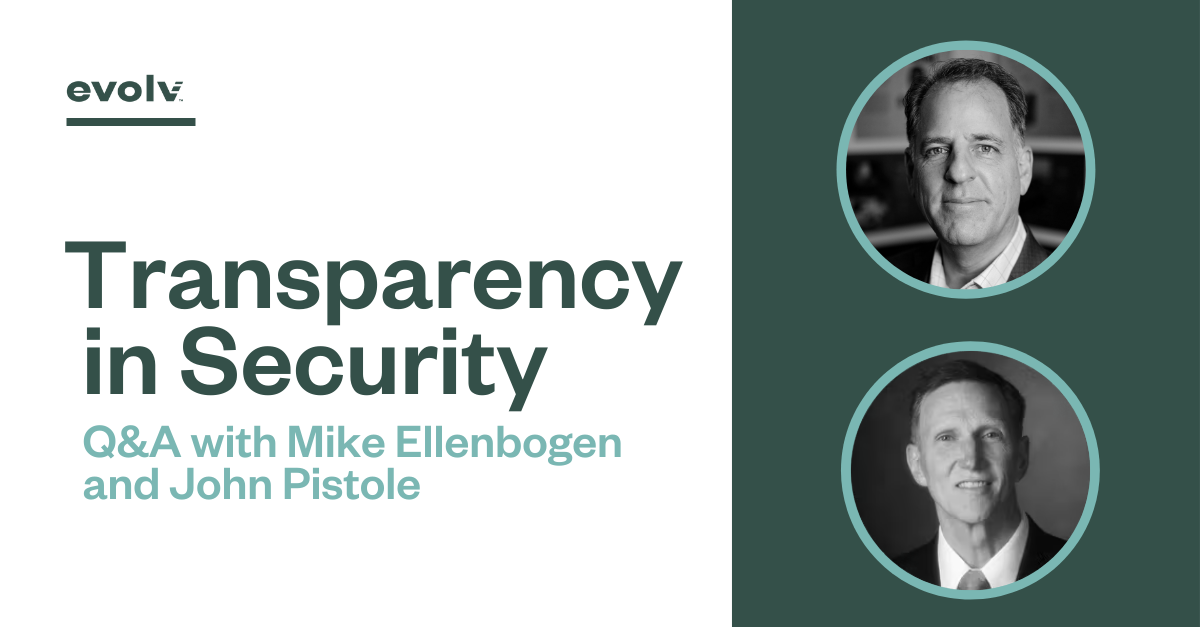
Transparency in Physical Security: Q&A with John Pistole and Mike Ellenbogen

The need to provide transparency without helping potential attackers is a fundamental paradox of the security industry. In their long and distinguished careers, former TSA Administrator John Pistole and Evolv founder Mike Ellenbogen have spent decades thinking about these issues and successfully finding the right balance.  That’s why we consulted with John, Mike, and other advisors to develop the Evolv Transparency Statement. The following Q&A is excerpted from recent conversations with John and Mike to provide additional insight into how we approach transparency. 

How has transparency featured in your career? 

John Pistole 

In 31 years in the government, mainly in the FBI and as the TSA Administrator, I found that transparency is one of those key issues that help define the trust and reputation of agencies, of the U.S. government overall, and of companies that provide security technologies. Each company or agency must be as transparent as possible while maintaining the core mission of keeping the public safe. 

 Mike Ellenbogen 

I grew up in aviation security technology where there is a very well-recognized and understood policy around transparency. In essence, at least regarding public release of technical details, there is no transparency. The specifications are classified by the TSA in the US and the ECAC in the EU. That specific information is called sensitive security information, and it’s very closely-held for what I believe are all the right reasons. 

The systems are tested by security professionals who have a legitimate need to know and hold the appropriate security clearances. These are independent professionals with a great deal of experience and resources to test in ways that most people cannot. These professionals have great credibility in the industry, so certification from a group like TSA is universally recognized as an indicator that the technology is fit for purpose.  

In aviation the people who know all the details don’t share them publicly. In fact, it’s illegal for them to do that, and that is well understood within that community. Outside of the aviation community, there are more questions because the standards aren’t as clearly defined. But it doesn’t change the basic requirement to keep detailed sensitive security information away from anybody who might use the information to exploit or attempt to penetrate a physical security system. That’s the goal at the end of the day. 

What kinds of information about weapons screening systems is most sensitive? 

Mike Ellenbogen 

I think it’s about granular specificity. The specific type and configuration of threats that are tested, the performance against those threats, and the specific weaknesses associated with those tests are the most sensitive. That information should be closely held. For example, it doesn’t make people safer if you publicly share that an attacker can defeat weapons screening by disassembling a particular handgun and placing one piece in their shoe and another piece under their hat. Sharing that kind of information only helps the bad guys. 

I do think that we can talk broadly about different categories of capabilities in a way that doesn’t disclose specific weaknesses that could be exploited by a bad actor. However, giving untrusted people a specific report that identifies known weaknesses just makes it more attractive for the bad guys to attempt to penetrate the facility and makes it easier for them to succeed. 

Are bad actors actively looking for sensitive information? 

John Pistole 

We saw this in the real world on Christmas day 2009, when Al-Qaeda in the Arabian Peninsula sent Umar Farouk Abdulmutallab from Brussels to Detroit with a non-metallic IED hidden in his underwear. They knew in advance that there was no detection for non-metallic bombs in most airport security protocols and regimens in use at the time. We know that they discovered this vulnerability through extensive online research. We also know that they conducted multiple scouting missions to probe and test for vulnerabilities at specific facilities using specific screening methods. It was a sophisticated intelligence gathering operation.  

Mike Ellenbogen 

I think bad actors are always looking for ways to circumvent the security processes in place. We see it in loss prevention all the time: people know that if you have a foil-lined bag, you can walk out with stolen goods without being detected by loss prevention technology. So that information has gotten out and it is being exploited on a regular basis. It’s a constant game of cat and mouse. 

What are the tradeoffs between transparency and security? 

John Pistole 

There’s a dynamic tension between how much information can be disclosed to the public and information that provides a roadmap to the bad guys. When I was at TSA, some original equipment manufacturers were disclosing information about their detection capabilities that, given my FBI background, I did not want to have out there. We had some good discussions with the manufacturers, and they agreed that on future iterations of their products they would not publish as much information publicly. Of course, they also agreed that they would provide that detailed information to us in a closed setting, which is necessary to know that their equipment can detect capably. 

How do government Inspector General Offices provide appropriate transparency without undermining security? 

John Pistole 

It’s usually a conversation between the Office of the Inspector General and the agency. Of course, the attorneys get involved to make sure that they are doing their job. There’s usually the unclassified document and then a classified annex that is not available to the public. But members of Congress and others can view the classified annex to have a better assurance of what the findings were and then what steps the agency is taking to address any issues. This helps provide appropriate accountability and oversight without compromising the safety of the public. 

Who needs access to sensitive security information about the capabilities and limitations of weapons detection technology? 

John Pistole 

The people who need to know are those who have been determined to be trustworthy to have that information. The more people who know, the greater likelihood that something will be shared inappropriately and/or inadvertently. In the US government the people with a need to know are people who have a security clearance at the secret or top-secret level, and then compartment segments after that, depending on how sensitive the information is. In the private sector, there may not be such a formal classification system in place, but it’s still compartmented information. Not everybody in the company needs to know everything about the businesses.  

Mike Ellenbogen 

In the private sector, the people with the most significant need to know are usually the security professionals who are responsible for protecting the organization from threats. They need to understand what the capabilities of the technologies that they’re deploying are, and where the potential limitations might be so that they can mitigate them. These professionals usually think in terms of layered defense, so they need to know what every individual component or layer is capable of. Those individuals need to know what specific technologies can and cannot do. 

It’s also important to realize that bad actors are looking at the people and processes just as much as they are looking at the technology. We talk about security systems as a combination of people, processes, and technology. Security professionals are rightfully concerned about the actions of any individual that creates an opening for a threat. It could be giving up passwords. It could be employees allowing unauthorized people to piggyback through turnstiles or secured doors. Bad actors know that well-intentioned people will hold a door open. They’re taking advantage of known weaknesses that originate with people and processes. 

Some people say that the most secure approach is full public disclosure for everybody. What’s your view? 

John Pistole 

I disagree with that view strongly. People who say that absolute transparency is best simply don’t understand the security business. They apparently don’t have an informed perspective or insight into just how determined the terrorists, spies, competitors, and other bad actors are in their efforts to harm individuals, countries, and companies. I get that “give full disclosure for everybody and let everybody make informed decisions” sounds great, but when you provide that carte blanche to everybody, that necessarily includes people with bad motives who are out to cause you harm. If there was no TSA security in the past 21 years, I can’t imagine we would have been able to avoid having more 9/11-type attacks. It just begs the imagination to think full transparency is the best outcome. 

Conclusion 

As John and Mike noted, providing appropriate transparency without assisting adversaries is an ongoing challenge faced by security vendors and practitioners alike. The Evolv Transparency Statement is our attempt to describe the principles that guide our approach to transparency. We will continue to consult with our customers, partners, advisors, and industry professionals to update our approach over time. As always, our mission to keep people safe will be our primary guide. 

About John Pistole 

John Pistole is the former administrator of the United States Transportation Security Administration (TSA) and a former deputy director of the Federal Bureau of Investigation. He is currently the president of Anderson University. In his role as Administrator of the TSA starting in 2010, Pistole led a 60,000-strong workforce, the security operations of more than 450 airports throughout the United States, the Federal Air Marshal Service, and shared security for highways, railroads, ports, mass transit systems and pipelines. Under his leadership, the TSA worked to transform as a risk-based, intelligence-driven counterterrorism agency dedicated to protecting the nation’s transportation systems. Prior to his leadership with the TSA, Pistole served as a 26-year veteran of the FBI with extensive national security and counterterrorism experience. After the attacks of September 11, 2001, John was placed in charge of the FBI’s counterterrorism program, eventually becoming the FBI’s Executive Assistant Director for national security. In 2004, Pistole was named Deputy Director for the FBI and contributed to the formation of terrorism policies during both the Bush and Obama administrations. John earned his bachelor’s degree from Anderson University in 1978. He went on to earn a juris doctorate from Indiana University Robert H. McKinney School of Law. 

About Mike Ellenbogen 

Mike is Founder and Head of Advanced Technology at Evolv Technology. Mike has spent more than 20 years shaping the explosives detection industry including as co-founder and CEO/President of Reveal Imaging Technologies, Inc., as Vice President of Product and Business Development of PerkinElmer Detection Systems where he was responsible for Research and Development, Engineering and Marketing, and as Director of Marketing of Vivid Technologies, where he was instrumental in the transition following Vivid’s acquisition by PerkinElmer. At both Vivid and PerkinElmer, Mike was responsible for market research, definition and development of new products and product enhancements. He has been issued 16 patents in the field of X-ray inspection and automated detection technology and has been broadly published within the security industry. Mike holds a Physics degree from Colgate University. 

New Standards in Physical Security

Many of the security screening standards in use today were put in place decades ago. They addressed the threats at the time and employed the security screening equipment that was available. The threat landscape has changed, and the breadth of vulnerable venues has expanded, yet the predominant security screening technologies in use today are still the ones developed decades ago. Evolv Technology co-founders Mike Ellenbogen and Anil Chitkara virtually sit down with our guest speaker Chuck Marino, CEO of National Security Export and Consultant Sentinel Security Solutions, LLC to discuss this new landscape, and ultimately what new security technology is needed to address this shift.

The Case for a New Standard in Physical Security

As our threat environment rapidly changes, our security standards are being left behind. Developed nearly fifty years ago and barely updated since then, current standards for metal detector technologies can’t keep up with all the metal objects we carry with us every day — and it shows.

In this infographic, learn the impact on guests, security professionals, and entire industries when old standards aren’t renewed in the face of advancing technologies – and an advancing threat environment – and see why the time has come for a new standard in physical security.

Download Now

eBook: The New Standard – A Security Technology Buyer’s Guide

Technology is advancing, changing the threat landscape from what it looked like decades ago when current standards for metal detectors were authored.

Our standards should be advancing, too. It’s time for a new standard: one that updates the requirements for the technologies protecting our venues, acknowledges the demand for a great guest experience, and removes the burden on security teams to visually distinguish everyday metal objects from weapons.

Today’s technology extends from machine learning and artificial intelligence onboard devices to cloud connectivity, data analytics, remote device management, and mobile applications.

Fill out the form below to download the eBook and learn the impact of a new standard for modern technologies in physical security, and how world-class venues can use this new standard to inform the selection and deployment of new technologies for physical security today—and well into the future.

Report: Guns in America: A Survey on Public Violence, Anxiety, and Threats

Download Now

“Guns in America: A Survey on Public Violence, Anxiety, and Threats” is a new report that quantifies not only the impact Americans’ anxiety around guns has on their everyday lives but also demonstrates the choices they make – and the businesses they patronize – are affected by the level of risk or threat Americans perceive those places to have.  

Download this report to learn more about the mental toll gun violence, shootings, and terrorist events are having on Americans across the country. 

Download Now

eBook: Five Ways Data Improves Physical Security

Summary

Access to digital information is changing the world dramatically, and physical security is no exception. Leading venues across sports, entertainment, theme parks, industrial workplaces, schools, healthcare, and places of worship can improve their security posture by leveraging better information about visitor curves, alarm rates, and threats across their venue during specific events … if they know where to find it.

Evolv Express® screens your visitors for weapons threats while they simply walk through at a natural pace. It also captures and presents critical information about visitor flow rates, alarm rates, and threat items in its companion, web-based application, Evolv Insights™— improving the data available for evidence-based decision-making across venue security and operations teams.

Fill out the form below to download the eBook and learn about five ways to utilize data to improve your physical security.

The New Standard for Workplace Safety

One of the first responsibilities of an employer is to provide a safe workplace. It’s just the right thing to do. It’s also a good business decision, and a regulatory requirement (see OSHA Section 5). The COVID-19 pandemic has tested employers’ commitment to workplace safety. Many employers have passed the test and kept their people safe from the virus. However, as the virus yields to gradually rising vaccinations and workers return, they are being greeted by a second, often forgotten pandemic: workplace shootings. 

The COVID-19 pandemic initially seemed to reduce gun violence, including workplace shootings. Based on the tragic headlines below, it now seems clear that the temporary lull is over: 

It feels ominous and tragic to me that we’ve had four workplace shootings in the first two weeks of October. Historically, there has only been about one workplace mass shooting per year. A recent Ontic survey of 300 security leaders at large companies found that nearly a fifth of them (18%) have had to deal with an active shooter event at one of their sites in the first five months of 2021 alone. It feels like something has fundamentally changed in the threat environment. 

What’s driving the change? Experts recently interviewed by NPR theorize that potential shooters have had a lot of extra time to plan attacks during the pandemic and that there are more targets available now that more people are back at work in more locations. I would add a few additional important drivers: the prolonged stress and isolation of the pandemic, rising resistance to mask/vaccination mandates, the spread of extremist ideologies, acute political polarization, widespread social unrest, and widely available firearms. It has all combined to create a tragically perfect storm. The DHS and FBI summarized the threat their May 2021 joint report, saying “The greatest terrorism threat to the homeland we face today is posed by lone offenders, often radicalized online, who look to attack soft targets with easily accessible weapons. Many of these violent extremists are motivated and inspired by a mix of socio-political goals and personal grievances against their targets.” 

Given the current threat environment, how can employers best fulfill their duty of care in providing a safe workplace? The most obvious way to prevent shootings in the workplace is to keep guns out of the building in the first place. Most employers have policies to prohibit guns on private property, but they have largely been unwilling to enforce their policies through weapons screening. Why? Because screening for weapons with old metal-detectors creates a prison-like experience for workers and leaves workers stuck in crowded waiting lines that are just unacceptable in a pandemic recovery environment.  

In an intensely competitive labor market, employers may feel forced to choose between a positive worker experience and a gun-free workplace, and when push comes to shove, they have often chosen worker experience. That choice is tragic because it is based on an outdated understanding of what’s technologically possible.  

AI is transforming every sector of the economy, and physical security is no different. AI-based weapons screening like Evolv Express® makes it possible to have both a great worker experience and a gun-free workplace. Reliable weapons screening that doesn’t require workers to stop and empty their pockets or surrender their bags as they walk through is a game changer.  

I believe this disruptive new technology is redefining the standard for employers’ duty of care to workers. Having a “no guns” policy without any effective enforcement is no longer an option. If proven technology to enforce a no-guns policy is broadly available, operationally feasible, and commercially affordable, it won’t be long before board members are asking why management is taking unnecessary risks. 

Sports stadiumsperforming arts and entertainment venues, and tourist destinations were the first to discover and implement the new standard in weapons screening because visitor experience and safety are fundamental to their operation. Now that the leaders in these industries have made their move to AI-powered weapons screening, the followers are racing to catch up. The same pattern will likely play out in industrial workplaces, citizen-facing government offices, health care facilities, office buildings, and other workplaces.  

Now is the time for employers to reshape their workplace safety strategy to reflect the current threat environment and the technological disruption that is underway. The good news is that investing in meeting the new standard is not going to break the bank or be disruptive to normal operations. We’ve worked hard to innovate not only in technology, but also in our pricing model. Our customers (and their CFOs) are often pleasantly surprised by our subscription-based “security-as-a-service” pricing for Evolv Express. They also love that they can often train existing staff to use our equipment, so there isn’t a huge labor cost hurdle to overcome. As a mission-based company, we want to make it easy for employers to do the right thing for their workers. It’s a win-win-win situation.  

As the pandemic recovery continues and seasonal hiring surges this fall and winter, more workers than ever will be walking into workplaces that are unprepared for the current threat environment. We should all hope and pray for their safety, but we can finally do much more than that. If you are an employer who is ready to do more, let’s talk soon

Download our workplace violence infographic to learn more about how violence in the workplace is persisting and on the rise in the aftermath of the COVID pandemic.

The Future Is Here: Smart, Connected Venue Security with Evolv

Senior security leaders across multiple industries, surveyed in a joint study by Microsoft and Accenture, cited “reactive threat management” and “intuition-led decision-making based on subjectivity” as top challenges in physical security. The technologies predicted in the study to transform these challenges? “Artificial intelligence and signals processing” at the venue’s threshold; the power of analytics to “sift through overwhelming amounts of data”, and Internet of Things-connected sensors and devices to “collect intelligence in real-time.”

These once sounded like the stuff of science fiction: so-called “smart cities” with “smart venues” that screen visitors unobtrusively, only stop potential threats while letting everyone else pass through, and stream business intelligence back to security teams to improve decision-making and enable a more proactive security posture.

Hello world! With Evolv Express AI-powered security screening and its companion analytics application, Evolv Insights, this future is here. In the latest software release launching this month, new capabilities for connectivity and analytics improve five important dimensions of physical security:

1 – Balance Physical Safety with Visitor Experience

Security screening with Evolv Express is powered by advanced sensors, cameras, and artificial intelligence to distinguish weapons threats from everyday items. It moves guests through a venue’s entryways up to 10 times faster than metal detectors: up to 3,600 visitors per hour at normal walking speed. No stopping to empty pockets or hand over bags means screening is less obtrusive, improving the visitor experience. And no stopping or queuing up means Evolv Express is safer than traditional methods, virtually eliminating the threat of “soft target” scenarios for mass casualty events.

As a connected device, dare I even say an IoT device, Evolv Express captures critical information such as visitor flow rates, alarm rates, and threat types detected at every venue entrance, making this data available for consumption and interrogation across multiple business dimensions—date, time, location, entrance, and event type—in its Evolv Insights analytics platform.

To maintain the highest degree of guest experience and physical safety, Evolv Express offers a range of settings, and the new What-If Sensitivity Setting Analysis in the latest release of Evolv Insights lets security professionals use historical data to see how the system would have performed on an alternate setting. This helps security teams refine their concept of operations (ConOps) strategies and further reduce nuisance alarms, improve guard performance, and improve the guest experience without compromising visitor safety.

2 – Know Your Vulnerabilities

New features for Alert Categorization and Analysis in the latest software release advance the system’s ability to report on what threat types are found at a venue. Security teams resolving issues at the Evolv

Express system simply “tag” alerts with a single, one touch icon set to indicate threat items or nuisance items.

Using this information, new dashboards in Evolv Insights let users drill down into where and when each type of alert appeared, across entryways, times, and events. Armed with this knowledge, security leaders can better focus staff training, deploy more experienced staff when and where they will be needed, and improve overall staff preparedness.

3 – Improve Venue Operations

Better data can help teams beyond security improve visitors’ experience—with ticketing, concessions, retail, ushers, guest services, guides, and more—because the better informed these teams are, the more seamlessly they will operate. Information gathered at every Evolv Express system and available in Evolv Insights analytics will help venue operations improve decisions about staff to guest ratios, staff deployment at different locations and times, along with other resource decisions to boost efficiencies and reduce waste.

To better understand how security and operational needs differ across types of events, the latest release of Evolv Insights introduces Event Type Analysis. Different types of events—think rock concerts, sporting events, corporate events, speaker series, and family productions—will likely exhibit very different characteristics across dimensions like threat types and frequency, alarm rates, visitor flow rates at different venue entrances.

Evolv Insights makes it easy to compare event types side-by-side to find commonalities and differences or to compare events of the same type to find and address anomalies, improving planning across many teams throughout venue operations—including security.

4 – Transform Security from Cost Center to Value Driver

Keeping venues secure not only protects people; it safeguards the brand—for venue leadership, their corporate sponsors, and the talent they attract. But security is too often seen as a necessary evil: a cost center rather than a value driver. I found this callout in the aforementioned Microsoft and Accenture study spot on and worth noting… No matter which metric the organization prioritizes, a data strategy will be required to optimize the outcome. An effective strategy will enable physical security to become the core intelligence platform of the organization, transforming from a cost center into a value hub. I could not have said this better myself.

With Evolv, the power of data and analytics at every visitor entrance means security teams can provide a high degree of value to executive leadership by providing transparency and visibility with accelerated, streamlined, reporting capabilities.

Evolv Insights offers both pre-defined and flexible dashboard views that users can save and return to, share with colleagues, print to file, and export to work with adjacent analytics packages. And in the latest release, subscribed users automatically get “pushed” Post-Event Summary Reports, without a separate need to access the Insights application.

5 – Adopt a Proactive Security Posture

When venue teams need critical data about their venue in the moment, wherever they’re located, the latest software release from Evolv offers the MyEvolv Portal mobile application. Teams can now access analytics, scanner monitoring, and management, and proactive communications from any device, including Android- and iOS-equipped smartphones and tablets, to facilitate faster, better decision-making and respond in the moment to security needs across their venue before they become an issue.

Evolv prioritizes connections between venue staff and its security systems both through analytics and through communications technologies like Request Assistance—a discreet, one-touch alert from the operator tablet to additional venue security to help resolve an incident at the system.

The latest software release extends this connectivity and communication with new Remote System Management in the MyEvolv Portal. Available in both the mobile and web-based application, system administrators can now remotely log into Evolv Express systems and interact as if they were co-located with the system for monitoring, troubleshooting, and configuration changes. And whenever critical changes to the system occur, subscribed users receive new Proactive Notifications via text, email, or in the application.

Conclusion: The Digital Transformation of Physical Security is Here

While much has been imagined about the benefits of a future world—with “smart venues” powered by connected products and better data to improve visitors’ experience while making everywhere safer—Evolv brings that future to life today. It enables venue security and operations leaders to access better data for evidence-based decision-making, ensure connectivity between people and security technologies throughout a venue, and improve the guest experience while maintaining the highest standards in physical safety both today—and tomorrow.