Evolv Technology Takes Home the Gold in 2020 Edison Awards Threat Defense and Security Category

Evolv Express® Also Earns Platinum and Gold Designations in Secure Campus Awards 2020


WALTHAM, MA – March 25, 2020 – Evolv Technology, the leader in free-flow weapons detection, today announced that Evolv Express® was named the Gold winner in the Threat Defense and Security, Applied Technology category in the prestigious 2020 Edison Awards™. A global panel of more than 3,000 leading business executives selected winners that represent “game changing” products and services combined with innovation and leadership in concept, value, delivery and impact.

Evolv Technology is the leader in human security dedicated to making the world a safer place to live, work, learn and play by helping protect innocent people from mass shootings, terrorist attacks and similar violent acts. This recognition comes on the heels of Evolv Express being honored by Secure Campus 2020 Awards for outstanding campus security services and product, earning Platinum status in the Perimeter Protection category and Gold status in the Screening Equipment category.

Imagine walking into a stadium, tourist destination, warehouse, performing arts venue or school without emptying your pockets or bag, knowing everyone inside was thoroughly screened for weapons. Evolv delivers security and freedom of movement with a discrete tool that seamlessly screens people and their belongings in real-time, instantly differentiating personal items from weapons. Evolv Express, the first-of-its-kind AI-based, free-flow weapons-detection system, works at the pace of life to accommodate thousands of individuals and groups per hour. Capable of screening more than 3,600 people per hour, Evolv Express eliminates the long lines common with legacy weapons screening such as metal detectors, while drastically reducing the need for secondary screening that is accompanied by personal intrusions such as hand wands and pat downs.

More than 50 million people to date have been screened by Evolv in a rapid, undisruptive manner while preventing more than 5,000 weapons from entering a range of public and private facilities. Evolv is used for visitor and employee screening at top entertainment venues, schools, international airports, stadiums, corporations, hospitals, large-scale events and national landmarks worldwide. Customers include Big Night Entertainment, Pittsburgh Symphony Orchestra, The Biltmore Estate, Gillette Stadium, L.L. Bean, Oakland International Airport, Spartanburg School District Six in South Carolina and many others across the globe.

“Evolv has redefined weapons-screening and threat detection by making security human again,” said Evolv Chief Executive Officer Peter George. “Behind Evolv Express is a team of incredibly talented security industry thought leaders and innovators who are committed to keeping people safe as they go about their daily lives. We could not be more honored to be named a winner in the threat defense and security category by the Edison Awards, which are recognized across the globe.”

“After a thorough review, the Edison Awards Judges recognize Evolv Express,” said Frank Bonafilia, Executive Director of the Edison Awards. “It’s a game-changing innovation standing out among the best new products and services launched in their category.”

About Evolv Technology

Evolv Technology is the leader in human security. The company is dedicated to making the world a safer place by helping to protect innocent people from mass shootings, terrorist attacks and similar violent acts. Evolv’s AI-based, free-flow weapons-screening and threat detection systems work at the pace of life to accommodate thousands of individuals and groups per hour – screening 50 million people to date in a rapid, undisruptive manner while preventing more than 5,000 weapons from entering a range of public and private facilities. Evolv’s customers include hundreds of top entertainment venues, schools, international airports, stadiums, corporations, hospitals, large-scale events and national landmarks around the globe. Led by a team of security industry thought leaders with a track record for delivering first-to-market products, the company holds more than 100 patents. For more information, visit https://evolvtechnology.com/.

About the Edison Awards

The Edison Best New Product Awards™ is the world’s most revered Innovation Award dedicated to recognizing and honoring the best in innovation and innovators since 1987. For more information about the Edison Awards complete program and a list of past winners, visit www.edisonawards.com.

###

PR Contacts:

Evolv Technology
Julie Zomar
media@evolvtechnology.com
(781) 374-8100

CHEN PR for Evolv
Jennifer Torode
jtorode@chenpr.com
(781) 672-3119

Evolv Express® vs. the Traditional Walk-Through Metal Detector

In today’s world of everywhere violence, we should no longer be screening with yesterday’s technology. Manual inspections, hand wands and traditional metal detectors are slow, invasive, inefficient, involve too many nuisance alarms and create long lines, forcing venues to choose between safety and the visitor experience. 

Did you know, some venues are actually opting not to implement any security at all because they’d rather not make the trade-off between safety and visitor experience?  This can’t be the choice you make.   

Deploying screening technology in your venue is no longer something you and your team should dread or delay. With Evolv Express®, the first-of-its-kind free-flow weapons-detection system, visitors and employees walk through while simultaneously being screened for potential threats.

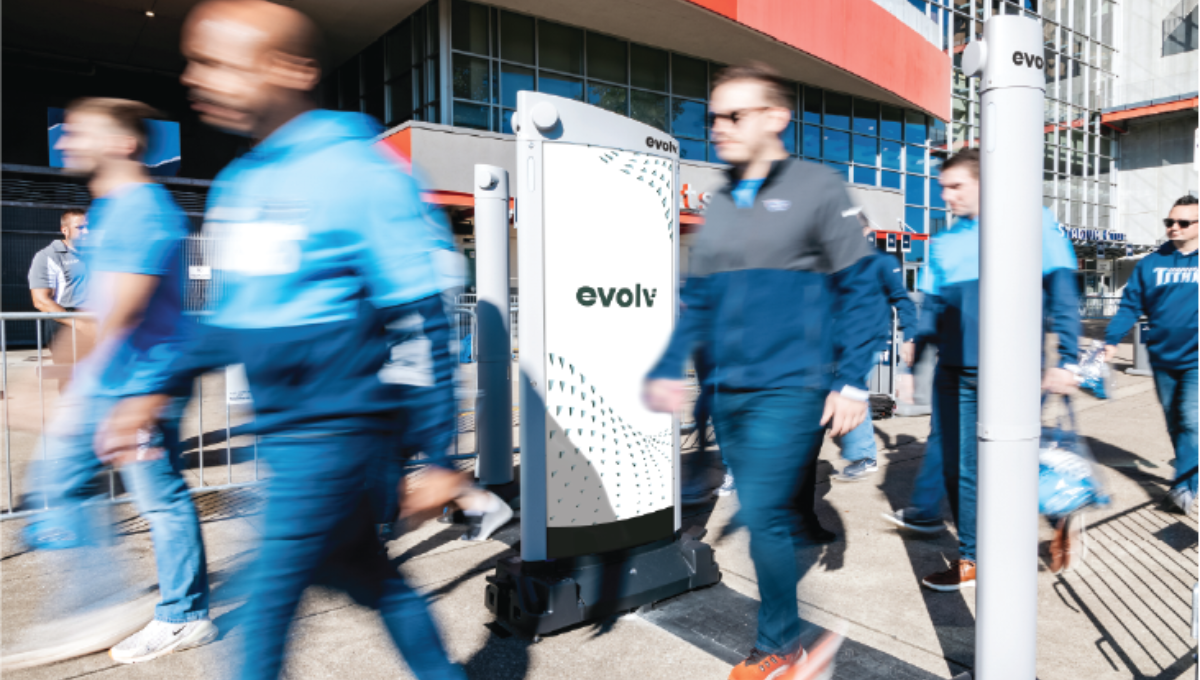
Through the power of AI, Express instantly differentiates threats from personal items such as keys, coins, belts and cell phones, making it easy for guards and frictionless for visitors. In fact, visitors no longer need to stop, empty pockets or remove bags.  They simply walk right through at a natural pace one-at-a-time or in groups.  It’s the fastest weapons-screening product on the market, screening 60 people every minute, 10X faster than traditional walk-through metal detectors.

This two-lane system is approximately 11 feet wide and requires far fewer guards than traditional metal detectors to manage. In fact, some venues are seeing a 70% reduction in labor costs

For those of you accustomed to traditional metal detectors, it’s going to be a positive shock…

  • You no longer need a large footprint for security equipment
  • Long, frustrating security screening lines will no longer form outside your venue
  • Guards will now be able to conduct targeted searches using image-aided alarms
  • And, your labor costs will decrease by up to 70%

Finally, venues can stop threats, while assuring a welcoming visitor and employee experience.

If at 800 people per hour, you need 50% less screening equipment, and 60% fewer guards, imagine what your ConOp would look like as your visitor throughput needs increase.

Download our full infographic to see what screening 1200, 1600, 2400 and 3600 people per hour would look like with Evolv Express versus traditional metal detectors.

Evolv Express® Compared to Walk Through Metal Detectors (WTMD)

Download Now

Evolv Technology Launches First Free-Flow Weapons-Detection System Designed to Stop Active Shooters and Other Threats

Express is the fastest weapons-screening system on the market, consistently screening 60 people every minute for firearms and other threats.

WALTHAM, MA, October 22, 2019  – Evolv Technology, the leader in free-flow weapons detection, launched Evolv Express™, the first no-stop weapons-screening system built to automatically screen groups of people as they walk through without slowing or stopping. With hundreds of systems deployed globally that have screened more than 25 million visitors to-date, Evolv continues to deliver innovative threat detection products. Express screens visitors individually or together, while automatically differentiating weapons from personal items.

Express is the fastest weapons-screening system on the market, consistently screening 60 people every minute for firearms and other threats. That’s 3,600 people per hour – 10X faster than a traditional checkpoint system. Express is designed to address the active shooter epidemic by detecting potential shooters before they enter a venue, without slowing the flow of visitors. Applications for Express include addressing workplace gun violence and school shootings, protecting iconic landmarks and keeping sports and entertainment venues safe. Venue managers no longer must choose between effective security and positive visitor experience.

“We live in an era of viral violence which has created a mass vulnerability problem. There is a clear need for a better way to deter or detect firearms and other threats before they enter a safe space, all while maintaining a positive experience for visitors and employees. Since the vast majority of visitors pose no threat, how do you allow them to walk right through while simultaneously identifying and separating those few individuals who may require a closer look?” stated Mike Ellenbogen, Chief Executive Officer, Evolv Technology. “We’re dedicated to solving the protection paradox. Today’s facilities need a solution that can quickly identify a threat but still welcome the crowds. We’re proud to have developed the first weapons-detection system capable of preventing the mass slaughter of innocent people without subjecting visitors to the traditional prison-like security experience.”

Using a new patented method of threat detection, Evolv’s Cortex AI™ software platform can instantly detect and identify a person carrying a weapon without slowing the flow of visitors who are carrying their personal items and bags. By fusing the latest high-speed sensors and Cortex AI, Express is the only weapons-detection system to deliver:

10X Faster Throughput than Traditional Checkpoints: Screening more than 3,600 people per hour. Visitors and employees walk one at a time or in groups through multi-lane entrances up to eight feet wide.

Free-Flow Screening: Only with Evolv, groups of people are screened simultaneously without removing personal items. Visitors no longer must stop and empty their pockets or remove their bags. They simply walk through naturally.

Real-Time Weapons Detection: The Evolv Cortex AI software instantly distinguishes between threats and personal items such as keys, coins, belts, and cell phones on their body or in their bag. Weapons include firearms, explosive devices, and knives.

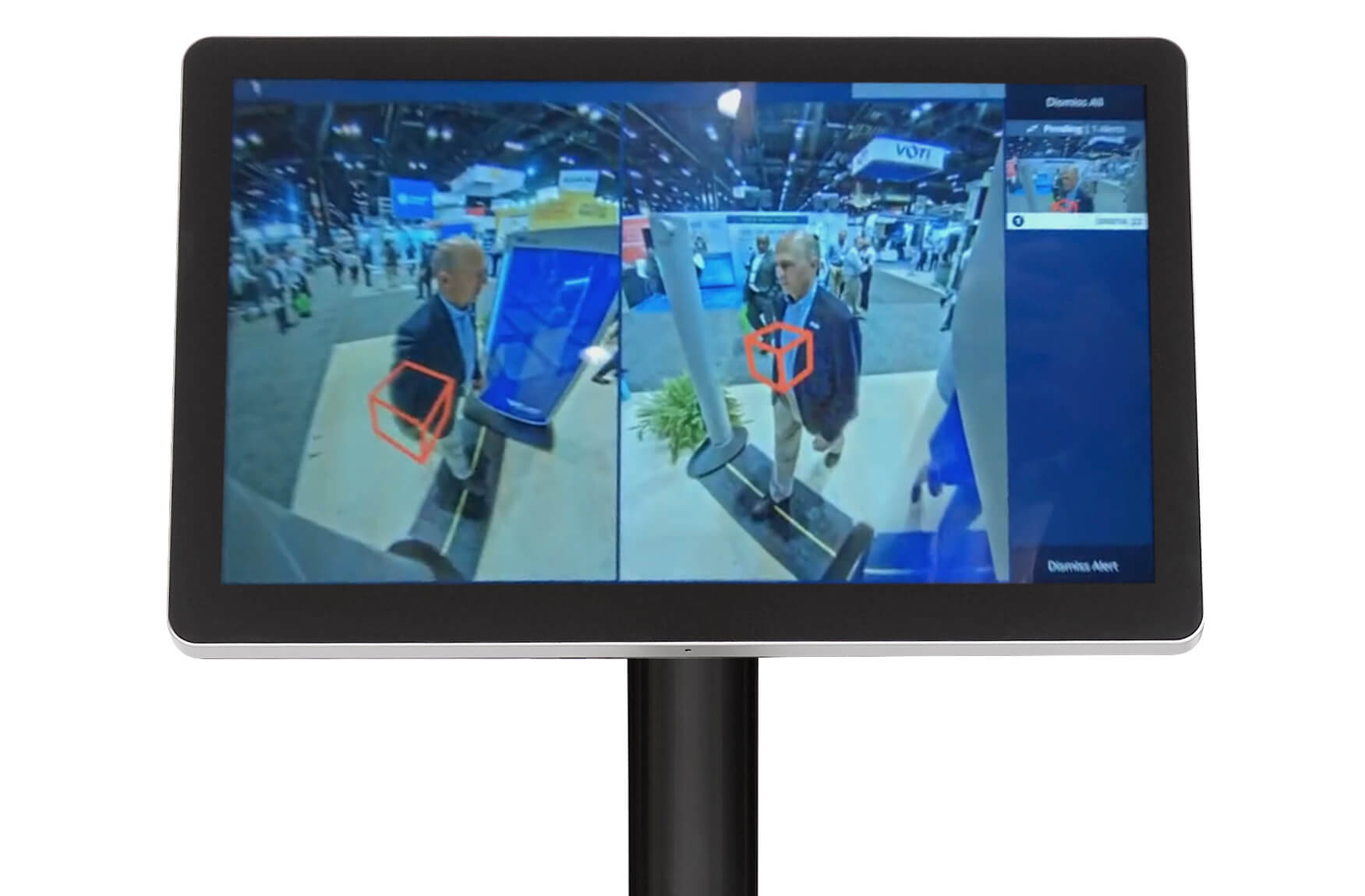
Targeted Searches: Express provides guards with a real-time image on a local tablet, highlighting the individual with the potential threat and the location on the visitor’s body or in their bag.

Smarter Over Time: Stay ahead of the threat landscape. With the Evolv Cortex AI software platform, Express becomes more intelligent as new threat profiles are discovered.

Evolv is being used by iconic venues worldwide to screen people for threats in a free-flow operation.  Express debuted at the Global Security Exchange (GSX) Conference in September, enabling security teams to experience the system live in action for themselves:

Evolv reduces the burden on security teams and takes the hassle out of people screening. Contact us to Experience Evolv.

ABOUT EVOLV TECHNOLOGY

Evolv Technology has screened more than 25 million people to-date, preventing visitors from bringing over 5000 weapons into public venues and places of work worldwide. Organizations such as Lincoln Center, Oakland Airport, Gillette Stadium, and LL Bean use Evolv’s free-flow weapons detection to prevent active shooters and terrorists from entering their venues. By fusing the latest sensors and Cortex AI, Evolv delivers the only weapons detection smart enough to screen thousands of people per hour, without the need to stop, and empty pockets or remove bags. Evolv eliminates the need to choose between safety and convenience reducing the burden on security teams and taking the hassle out of people-screening at places of work, schools, transportation hubs, sports stadiums, entertainment venues, hotels and conference centers, airports, houses of worship, and government agencies. For more information, visit www.evolvtechnology.com.

Media Contact

Julie Zomar
Evolv Technology
P: 781-374-8100
E: media@evolvtechnology.com

The Active Shooter Epidemic: One Major Preventive Measure Launching Today

Too many mass shootings.

Too many venues without security checkpoints.

Too few technology solutions identifying the individuals who require a closer look.

Too many conversations with security professionals and venue operators asking for something better.

At Evolv, we have had enough. The “new normal,” as some have called it, is unacceptable. We’ve dedicated ourselves to keeping people safe by using technology to stop active shooters. The safer world we envision should be something that everyone simply expects without having to think about it.

Six years ago, Mike Ellenbogen and I started Evolv Technology with a mission to save lives.

Prior to the founding of Evolv, we spent more than two yearsconducting research. We met with security professionals across the globe anddeveloped a deep understanding of modern threats and what security professionalsneed to prevent mass casualty events. We visited university labs and small techcompanies to understand the latest innovations in sensors, data synthesis,image reconstruction, machine learning, and design thinking. Then, leveragingour combined 40+ years of experience using technology to solve critical,complex problems, we started Evolv.

At Evolv, we set out to solve a very tough problem: how do you recognize that the vast majority of people pose no threat, while simultaneously identifying those few who may be a threat and require a closer look. It’s a simple problem statement, but a difficult question to answer.


We launched the Evolv Edge system in 2017, after about 3 ½ years of research and development. Evolv Edge is one of a kind. It’s the first product in the industry to screen people and their belongings at high speed without requiring them to stop or remove items from their pockets and bags. From a technology perspective, Edge’s combination of sensors, signal processing, detection algorithms, and user-centered design is like nothing else on the market. Gone are the white bowls for your keys, coins, wallets, belts and cell phones; gone is the need to stop and put your hands in the air. There is no need to place your bag on a table for a guard to search prior to walking through the Edge. With the Edge, you just walk through.

Since its launch, the Edge has screened more than 25 million people around the world, primarily at entertainment venues, sports stadiums, tourist locations, workplaces, hospitals, and housesof worship. In that time, the Edge has detected more than 5,000 weapons. Priorto selecting the Edge, many of these venues tried walk through metal detectors,but found the experience for their visitors to be too slow and cumbersome. These outdated pieces of equipment also resulted in long lines, creating a potentially new security target and concern.  

Feedback on the Evolv Edge has been very positive. We’ve seen first-hand the reactions of visitors going through the system and guards operating it. The most common question we are asked is “Why don’t they have these everywhere?” 

What We’ve Learned

As we deployed the Edge and spoke to thousands of security professionals and venue operators, we again asked how we could advance screening technology to make many more venues even safer, while continuing to deliver a positive visitor experience. These conversations were enlightening. We heard significant concern about several different scenarios:

  • Workplace Violence Prevention:
    One of the biggest areas of concern was the proliferation of workplace violence. People should not be concerned for their safety while at work. Many employers, however, are not willing to put a traditional checkpoint in place. They are looking for a system that screens people with little-to-no inconvenience.
  • Event Screening:
    Another scenario we heard was about screening large crowds for events. The shootings in Las Vegas, Gilroy and Jacksonville Landing highlight the need to screen large numbers of people at special events.
  • Tourist Screening:
    The third scenario we continued to hear was around screening at tourist locations. Many of these locations, whether an observation deck, museum, or landmark, carry their own unique complexities. Many visitors are carrying food, clothing, cameras, and a host of other personal items for a day’s outing. Often there are international visitors speaking a range of languages.

These three scenarios were just a few of the many that were highlighted.

In many cases, security teams had tried traditional checkpoints with walk through metal detectors and found them to be unsustainable solutions. Traditional screening created massive lines, frustrating visitors or employees, and resulted in an unacceptable overall experience. These stories, which we continue to hear on a daily basis, inspired the design for our newest product. 

Introducing Evolv Express

We’re now launching our second product, Evolv Express®. Whereas the Edge screens individuals one-at-a-time as they pass through the system for venues who want a control point, Express screens large groups of people at a time with no stopping, no emptying of pockets or removing bags. After eighteen months of development, we’re now releasing Express, the fastest threat screening product on the market that ensures every individual and their belongings are screened as they pass through without even breaking stride. We have incorporated the latest high-speed sensors that move data in real time to a detection algorithm that renders a decision as people pass through; with Express, 60 people can be screened every minute, that’s 3,600 per hour. The system screened more than 250,000 individuals during our pilot testing this spring and summer. As with the Edge, Express detects those individuals who require a closer look, and automatically alerts guards and security personnel to confirm those individuals are not a threat. 

How Express Works

Evolv Express combines the latest technologies and user-driven design principles to provide this high throughput, truly frictionless approach to screening thousands of people per hour. It all starts with the brains of our system, the Evolv Cortex AI™ Software Platform. This isa machine learning-based AI system that uses data sets we have generated from the system to train the algorithm. The training is conducted on a methodicalbasis, starting with a designated threat set, such as firearms. A range of threats is scanned, and classifiers are developed, refined, tested, tuned, and hardened to detect the threat set. Similarly, a range of non-threatening items such as cell phones is scanned through the system. A similar approach is undertaken to create classifiers. As the range of threats and non-threats are analyzed by our development team, the algorithm is continually refined. Over time, as newthreats emerge and data is collected, the algorithm will continue to berefined. This process is done in our labs in a controlled manner. Once we are confident in the performance of each new algorithm, it will be released and upgraded to Express systems operating at customer sites. 

A key Express component is the sensors that collect data to drive the algorithm. These sensors were designed by Evolv to optimize the separationof the signals for both threat and non-threat items. After scanning millions of people with the Evolv Edge system, we had developed a tremendous body of knowledge regarding sensors as well as the typical items that are carried by visitors through our systems. This body of data informed the design for the Express sensor set.

We have also optimized the data flow through our system. For each individual screened, the Edge system moves nearly 1 million data points to the algorithm, with a resulting red light / green light decision as the person exits. For Express, this ultra-high speed data-processing engine has been further optimized to render a decision in less than one second from the time a person starts walking through. 

A significant amount of time was spent on the Express user experience. The UX has a number of components: the industrial design of the system, the interaction with visitors being screened, the operator interaction with the system, and the people moving and setting up the system. Each of these elements has been carefully thought through and tested with the respective user group.

  • Industrial Design:
    The Edge was a significant step forward in designing a system that is welcoming to people passing through it. We have taken some of those key design elements and made improvements to streamline the look even further. Additionally, we recognize these systems need to visually fit into the environment, so we added the ability for users to add custom branding or signage on a key component of the system.
  • We widened the overall design to make it easier for people to pass through with minimal disruption.
  • Operator Experience:
    Our focus on the operator experience has resulted in a system that is easy to operate as thousands of people pass through each hour. There are a mix of audio and visual cues for the operator. If an individual alarms, there is a picture of the person alarming, with the alarm location clearly outlined for further evaluation. 
  • Ease of Deployment:
    Finally, a key element of the system is the ability to move it around to enable screening at different locations. The system has built-in mobility capability, for easy breakdown, movement, and set-up. When the system is powered on, an automatic software calibration routine runs through diagnostics, resulting in the system being up and operational in two minutes.

We are starting a roadshow to preview the Express to security professionals around the U.S.  Next week we will be unveiling at the ASIS GSX Security Show in Chicago.  After that, we will be in major cities around the U.S.   And, you will start to see the Express working at venues around the country keeping people safe. 

Our Mission

We set out to solve a very tough problem: how do yourecognize that the vast majority of people pose no threat, while simultaneouslyidentifying those few who may be a threat and require a closer look; how do youimprove public security without disrupting the public? Over the past 6 years we’ve dedicated our resources and our expertise to answering these questions.

We’re humbled to have the opportunity to ‘make our dent’ in the universe and couldn’t be more excited to launch Evolv Express.
The Active Shooter Epidemic: Prevention is Possible

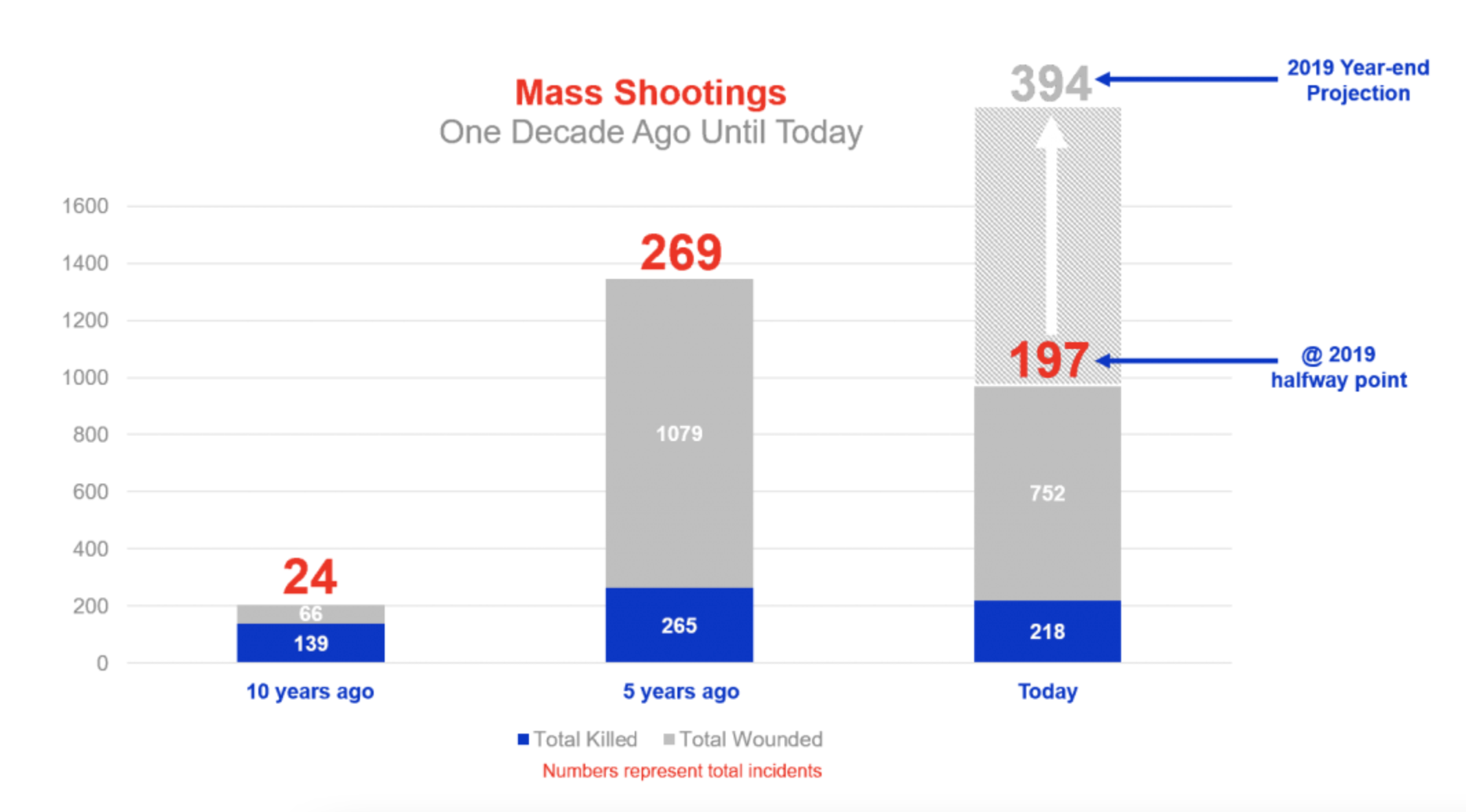
As I was traveling last week, two magazine covers caught my attention. They describe the epidemic that is taking lives, traumatizing families, and devastating communities across this country. In August alone, 53 people died in mass shootings; many more lives were forever changed. In the days after each event, news coverage follows a familiar arc: understand the event and the shooter, report heart wrenching stories about the victims, then engage in discussion about preventing this type of event from happening again. Inevitably, whether due to politics, disagreement on the right course of action, availability of funding, or some other reason, weeks will pass, and we will revert to the status quo. Another event will occur, and the cycle will begin anew, with more lives senselessly lost and many others permanently altered. 

Despite this paralysis at the federal level, there is real, measurable action happening at the local level. My own children have been doing ALICE drills in their elementary, middle and high schools to prepare for active shooters for as long as I can remember. Think about that: reading, writing, arithmetic, and active shooter training. Bullet proof backpack sales have soared this summer. Sensors have been placed throughout buildings to detect shots fired and locate the source to help police respond. In the past twelve months, more than 500,000 people have been trained in bleeding control techniques and more than 14,000 stop-the-bleed kits have been sold. These are all important measures that help in the response after the shooting has started. 

Mike Ellenbogen and I have spent the last eight years searching for different technologies that would detect an active shooter before he or she enters a facility. We have developed technology that is designed specifically to recognize that while most people entering a venue pose no threat, there may be a few individuals who require closer evaluation. Advances in technology finally make it possible. We use the best sensors and machine learning algorithms packaged in a welcoming design, allowing thousands of people to pass through while automatically detecting those few who may be of concern. Virtually everyone walks through with a cell phone in their pocket. The technology instantly differentiates that phone from a weapon, alerting guards to those few visitors who require a closer look. Thousands of weapons have been detected with numerous examples of deterrence when people saw the system and decided not to enter. Our newest product is launching this month. 

Our mission is to prevent active shooter incidents. Regardless of the outcome of mental health and gun safety initiatives, something can be done today. Our technology is preventing weapons from entering facilities. We are saving lives. We work closely with the broader community of security professionals and technology companies to keep people safe. It takes people, process and technology to address this problem. Our technology is a foundational piece that we hope may reduce these senseless tragedies.

Something can be done today to curtail this epidemic.  

Celebrating July 4th Should Be Fun AND Safe

Holidays andcelebrations bring people together — but in doing so, create “soft targets”,i.e. locations and venues that people gather that aren’t closely or heavilymonitored and protected.

Examples of large,well-known holiday gatherings include Rockefeller Center around Christmastime,the annual St. Patrick’s Day parade in Boston, and the New Year’s Eve fireworksshow at TIAA Bank Field in Jacksonville, Florida.

Since we know thatattackers are increasingly targeting public venues and large-scale gatherings,as security professionals, we have an opportunity to transform the way weapproach security to meet this evolving threat landscape.

Withone of the most popular holidays in America right around the corner, it’simportant to recognize the myriad ways we create soft targets during the fourthof July. Whether the Boston Pops July 4 Firework Spectacular, acommunity concert, or workplace barbeque, massive amounts of people areplanning to come together in celebration across the country.

Ona day intended to celebrate freedom, one of the last things venues want to dois burden guests with onerous security measures. However, allowing these largegatherings to go unprotected is a sure way to create a soft target and openyourself up to an attack.

Here are several proactive best practices that your venue – outdoor or indoor – can take to protect your staff and guests this 4 of July.

1. Collaborate with Law Enforcement

In the event of an attack, local law enforcement is essential to mitigating damage and protecting guests. Your venue security, law enforcement (e.g. police, fire department, etc.), and venue staff should all be introduced prior to an event. Establishing relationships between these is key to fast, streamlined emergency response.

2. Perform a Security Threat Assessment

In light of recent active shooter and bomb incidents, performing a security threat assessment and establishing specific response protocols will help safeguard your staff and guests.

In partnership with local law enforcement, walk the perimeter and identify all entry and exit points. Determine if you are able to lock down the event – and if so, identify what it will take to quickly make that happen without letting unwanted persons in, or a person of interest to escape.

It’s good to ask yourself these questions while performing your assessment:

  • Where are the gaps in our security?
  • What will we do if a threat is identified?
  • Do we have enough perimeter control measures? (i.e. gates, security personnel, signage, etc.)
  • Do we have screening systems in place to identify persons of interest and detect threats?
  • How do we physically lock down the event?
  • Will communicating to all security personnel and law enforcement be easy?
  • How easy will it be for law enforcement to enter the venue/event?
  • Where should local law enforcement be placed for rapid response?
  • Do we have proper evacuation signage for event attendees?
  • If an incident occurs, and exiting the event is not an option, do we have adequate areas for attendees to take shelter?

3. Build Emergency Response Plans & Procedures

Upon performing your security threat assessment with local law enforcement and your security staff, you will want to work together to determine safety plans and procedures in the case of an attack.

Think about including the following:

  • An emergency response & communications plan – to ensure all staff and local law enforcement know what to do and are notified immediately
  • A bomb threat plan – to manage bomb threat calls and know what to do if you locate a suspicious object
  • An evacuation plan – with venue layout and evacuation routes

4. Incorporate Visual Deterrents

While creating plans and procedures, as well as highlighting evacuation routes, are an important and necessary process to ensure you are prepared, there are a few ways to keep yourself left of boom/bang.

Notifying guests that there are screening solutions upon entrance has actually proven to prevent attackers from entering or even targeting a venue. For example, the Orlando nightclub shooting that took place in 2016 was actually intended for Disney World’s shopping and entertainment complex, however the shooter became spooked by police that were on-site and instead chose the night club as his target.

Thus, maintaining a strong security presence can deter attackers from executing their plans and simultaneously show guests they’re being protected. Whether you implement visible cameras, strategically place security guards and police on horseback, add signage identifying items guests are prohibited from carrying into the venue, or simply alert guests that they’ll be subject to screening, there are numerous ways to show an attacker that the venue is prepared to deter an attack. 

As Americans look forward to sporting red, white and blue, you and your staff need to be prepared for potential attacks on your celebrations. For more resources on protecting mass gatherings, the Department of Homeland Security provides several steps venues can take to strengthen security posture. And, for future events, consider implementing next-generation weapons-sensing technology to efficiently identify threats and improve your guests’ experience.

Looking to learn more about how to protect a soft target? Read our blog “Relying on 100-Year-Old Technology is Not the Answer to Stop Today’s Active Shooter.”

Beyond Bodyguards: Awards Season’s Security Challenges

With Sunday’s 91 Academy Awards now in the rearview mirror, water cooler talk around the countryturns to awards season takeaways. The majority of these conversations may focus on big winners, surprise snubs, and jaw-dropping fashion, but at Evolv, physical security is the main topic of discussion.

Hollywood’s awards season, held annually between October and February, culminates in a series of televised award shows. Each year, millions of people across the globe settle in to watch the year’s leadingactors, writers, musicians, and artists gather to be recognized for outstanding contributions to their industries. Venues hosting the biggest industry shows may change year-to-year but regardless of location, awards season has always been a time for Hollywood to put its most glamorous side on display — from onstage presenters and performers, to celebrity-packed audiences, red carpets, and after parties.

The polished and glamorous Hollywood environment displayed during these award shows may appear perfect, but that’s hardly reality. Any large event held at a public venue generates potential security threats. Despite the glitz and glamour, events like the Emmys or Oscars have similar physical security concerns to those of concert halls, sports stadiums, and airports around the globe.

Threats don’t discriminate

While celebrities and those in the entertainment industry can sometimes seem “untouchable,” they are not immune from the fact that any popular venue can be a potential target for active shooters and terrorists. Threats today don’t discriminate based on popularity, wealth, appearance, or talent. For venues, physical security concerns are universal, regardless of whether celebrities or the general public will be in attendance.

Modern security systems should protect all people regardless of the type of venue or event. Evolv’s customers include entertainment venues, airports, stadiums, corporations, hospitals, large scale events, and landmarks worldwide. For example, the Kravis Center, a performing arts venue in West Palm Beach, uses the Evolv Edge to ensure its audiences, artists, and staff members remain safe, while providing patrons with the best customer experience possible.

Security fit for the red carpet

Traditional security systems often detract from the aesthetic of the environments in which they’re used. The use of metal detectors, for example, requires guests to line up single file, dump out the contents of pockets and bags, and walk through the dated technology, only to be patted down later by a security guard. While it may be amusing to consider someone like Lady Gaga being patted down by security guards on the red carpet and forced to empty personal items from her clutch, this scenario accurately depicts the problem with using outdated security systems for red carpet events.

Fortunately, Evolv solutions use the latest AI and machine learning technology to enable frictionless, seamless, and effective security that can be modified to blend into all types of environments, including the red carpet. 

Be on the lookout

Many celebrities are faced with people who have the ability to do them harm, such as known stalkers, over-exuberant fans, or pesky paparazzi. The manual screening methods that traditionally have been used to identify such people require guards to memorize tens, if not hundreds of faces prior to the event, and have proven to be inconsistent and ineffective.

Facial recognition technology has significantly improved the ability of security teams to identify unwanted persons at large-scale events such as award shows. Because facial recognition technology, like Evolv’s Pinpoint, enables an event or venue to input images of people to “be on the lookout for,” guards are able to identify potentially dangerous guests almost immediately.

While this technology is ideal for diffusing threats before they occur, it provides other potential benefits too. Evolv Pinpoint’s ability to input images of people can be utilized for expected guests as well, enabling red carpet staffers to appropriately greet their A-list guests upon arrival. Facial recognition tech can ensure everyone feels like an award winner.   

Everyone, whether a celebrity at the Golden Globes or a family attending a major league baseball game, has the right to be safe. By deploying the most advanced screening capabilities, public venues can address a variety of threats, scenarios, and potential targets, so that no matter the event, guests and the overall guest experience are protected.

Whitepaper: Using Innovative Technology To Protect Against Insider Threats At Airports

Summary

Airports have moved quickly and decisively to adopt new technologies to increase security and thwart attacks. From drones for perimeter screening to advanced facial recognition programs to new scanning technologies that make it possible to rapidly detect explosives, firearms and other weapons hidden on a person, these are just a few of the tools being used to fortify airports. While adoption rates for new technology aimed at bolstering security to address insider threats have been growing steadily, there’s been little innovation as it relates to employee screening or for the public areas of the airport.

Download Now

Fill out the form to download this whitepaper to learn how Evolv Technology’s Edge® System provides the best Risk Based Security (RBS) solution to detect metallic and non-metallic threats that cause mass casualties.

Why I Started Evolv: A Q+A with Co-Founder and CEO, Mike Ellenbogen

I recently sat down with Mike Ellenbogen, our CEO and co-founder. We discussed his career path, what’s to come in the security industry in 2019 and Mike’s advice for aspiring entrepreneurs. See what Mike had to say.

Melissa Cohen: Mike, you have a lot of experience launching new companies and building something from the ground up based on a new idea. You did this with both Evolv and your previous company. Can you tell us about an accomplishment that shaped your career?

Mike Ellenbogen: Absolutely. I love building things and always have. I had a eureka moment that triggered the inception of my first company, Reveal Imaging. After new legislative requirements for airport security screening were put in place following September 11, I realized it made sense to employ smaller, less expensive systems and connect them together via a network of PCs. We rethought the way checked baggage was screened in the U.S., considering the total cost of the systems as opposed to just the cost of the technology. Ultimately, Reveal Imaging was acquired by Science Applications International Corporation (SAIC) in August 2010. I’m immensely proud of the work that team did and grateful for the experience – it’s really helped shape who I am today and is what motivated me to keep going and start Evolv.

MC: Based on your extensive experience in the security business, what do you think makes a good CEO in the industry?

ME: There needs to be an inclination to push beyond the conservative approach that is so common in the security industry. There are plenty of businesses out there with the “same old” security technology that’s been around for decades. I like to push the envelop and ensure that my company is offering something that solves a problem while also surprising and delighting. I think it’s important that a security industry CEO sees the world that can be rather than replicating what’s already out there or being happy with the status quo.

MC: What’s the biggest challenge you’ve faced in building either of these businesses and how did you overcome it?

ME: The core technology at both companies was/is really complicated – millimeter wave imaging is a challenging field, so is Artificial Intelligence (AI). Of course, you have to have technology that works in order to have repeatable and reliable customers that you can pursue. Leading an emerging technology company and inventing fundamentally new technology, there’s inherently a lot of pieces you have to glue together. It’s daunting and the success of the company is reliant on a deep understanding of the physics of the real world and how to appropriately push the boundaries of electronics and processing.

With any new technology or applications, there is also a steep learning curve among your teams. An engineer may be familiar with the technology, but not with the application. On that note, another challenge is finding the kind of people that can help move the physical security technology industry forward. We look for people with credibility, who have energy and creativity, and can also help move the needle.

MC: What are some of the biggest trends and themes you’ll be watching for in the security industry in 2019?

ME: We’ll definitely see further integration of AI and facial recognition into more security technologies and applications. Disparate AI capabilities will need to be packaged in a way that is more useful for customers in 2019. We’ll also see an increase in compute power at the edge, for example, more compute power within security cameras rather than via a central/integrated service. And, I know people have been saying this outside of the security industry for years, but we’re going to see expanded use of the cloud and Software as a Service (SaaS) within security technologies. While this has already started, some major shifts in this space are coming.

MC: Let’s do some rapid-fire, fun questions. How would you describe your leadership style?

ME: I like to think I present a vision of what could be to get people behind that vision – you need people to believe in the vision to engage them in getting there. Considering I’m focused on solving problems in a new way, I also recognize that it’s important for me to surround myself with people who are optimistic but real.

MC: What is your top productivity hack?

ME: I live my life multi-threaded, which I think is just another way of saying that I’m always trying to be efficient. I do a lot of different things in parallel. For example, I turn the coffee pot on before I get ready for work so that it’s ready when I leave. I take pride in maximizing my time like this.

MC: What piece of advice would you give your younger self?

ME: I always wanted to run a company and invent something – this desire was within me from a very young age. I would tell myself you need time to see the opportunities in the market, so find an industry you really love, make it your own, and word incredibly hard at it.

MC: What motivates you?

ME: Every day I’m motivated by the vision that the technology we’re working on is important and helping to save lives. As I mentioned before, I also love building new things and, in doing so, helping to bring success to the people around me.

MC: What best practices can you share for future leaders who are looking to start a business?

ME: It’s all about the people. Whatever your path, you’ll be spending a lot of time in the trenches with them, so you better like them. And of course, expect the unexpected!

Three Trends Impacting Entertainment Security

In past blog posts, we’ve discussed the need for weapons screening and how to improve security at performing arts venues. In taking a look at the broader entertainment industry as a whole, the conversation around security looks different.

At large concert venues and sports arenas, we often find that security is already a defined and established practice. These venues typically have a dedicated security team, led by a veteran security chief and supported by a series of technologies and procedures. In contrast, we find that many performing arts venues – primarily those that are not located in big cities – are usually at the beginning of their security journey.

While security and the practice of people screening is not new to the entertainment industry, there have been significant developments in the past five years that have impacted how security directors approach securing these venues. As patron experience, speed and increased detection continue to remain paramount in screening, security directors at these venues are starting to ask themselves what they can be doing better.

With that, let’s explore three ways entertainment security has changed and how these venues are looking beyond traditional security processes and procedures to improve security screening and create a more welcoming visitor experience.

Access to Artists Draws Attention to Stalkers

Weeks after wrapping her worldwide Reputation tour, it was revealed that Taylor Swift’s team was using facial recognition technology to scan for potential stalkers at her shows. Unbeknownst to her concert goers who stopped at kiosks to get a behind-the-scenes glimpse of her rehearsals, the system was secretly recording their faces and immediately sending the data to a “command post” in Nashville that attempted to match hundreds of images to a database of her known stalkers. While Swift has started to receive some backlash over the use of the technology, it represents a growing trend in entertainment security: the need to control stalkers.

To-date, the majority of entertainment venues have taken the same standard approach to security – screening the entire general fan population via a manual bag search and metal detectors. However, as celebrities, athletes and artists provide more access to their fans – think paying $200 extra for a meet-and-greet ahead of the show – security directors are beginning to look beyond traditional screening methods to prevent known assailants from getting close to talent. While Swift’s team is one of the first to come out and acknowledge the use of facial recognition technology to spot and identify stalkers, they are not the first and will certainly not be the last. In the coming years, I expect we will see facial recognition technology leveraged more frequently to identify stalkers. In addition, the use of advanced sensors such as millimeter wave technology will be used to identify any concealed weapons, particularly non-metallic ones, that fans might be attempting to bring in.

Monetizing the Security Experience

Two headlines from earlier this year that really caught my eye when thinking about entertainment security, at sports venues in particular: “Nobody’s Going to Sports in Person Anymore. And No One Seems to Care,” and “College football attendance sees second-largest decline in history.” As ticket prices rise, and as temperatures continue to drop in some regions, a noticeable trend in sports and entertainment is that people simply aren’t going to as many games as they used to. Instead, they are choosing to watch the games from the comfort of their own homes from one of their many devices, often via streaming services.

Because of this shift, heads of these facilities are beginning to explore how they can create more value for the fan experience. Think about what Disney was able to achieve with the introduction of the FASTPASS – pay extra on top of a standard ticket price to spend less time waiting in lines for popular attractions. What if this same concept could be applied to security at concerts and sports games? An improved security experience, whether it be less invasive or a faster process, is one way venues are working to get fans back into seats – and they’re looking at how technology can help them do this.

Protecting Against Insider Threats

Unlike employees who work at airports or office buildings, many of the employees who work at entertainment venues are subcontractors who only work during games or when events are happening. There is a level of employee screening that is happening; however, it varies from venue to venue. For example, if a venue is home to a national sports league team – such as the Boston Bruins – the venue itself needs to meet the NHL standards for security. Employee screening is a component of meeting this standard. Because these venues already have standards in place for games, they tend to follow these standards for all events. However, venues that are not the “home” for a national team do not have a standard set of security practices in place for screening employees that they follow all the time.

The recent shifts in the entertainment landscape means that everyone from C-level executives to security directors at entertainment venues are tackling new security challenges every day. Whether they are hosting the AFC East Championship Game or night two of an artist’s summer tour – fan experience, detection capabilities and the overall speed of security will continue to dictate security processes throughout the entertainment industry. As the industry itself has shifted, we will start to see more of these facilities leveraging new, innovative technologies such biometrics and facial recognition technologies to combat today’s threats.

To learn more about what is ahead for physical security in 2019, check out our recent blog post.

Photo Credit: Jeff Egnaczyk