Setting a New Standard For Safety, Security and User Experience

Would you rely on a standard developed in the 1970s for gas-powered cars as the basis for operating a modern electric car? How about a 1970s standard for land lines to manage your smart phone? Seems pretty ridiculous to rely on decades-old standards to define, inform and keep up with today’s pace of innovation and the varied ways technology has shaped lives over the past 10 years, let alone the past 50. 

Yet, when it comes to our safety when we gather in groups in public places, the only “standards” our industry has available to measure the effectiveness of our security technology was developed in the 1970s for uses that just don’t apply in today’s world and for today’s threats. Not only that but these standards are also based on old analog technology—walk through metal detectors—that are even older than the standards themselves and are incapable of meeting today’s needs for modern weapons detection.  

So, you see why I put the word “standards” in quotation marks. In reality, there has never been a security and safety standard that was designed specifically to meet the needs of today’s modern venue—able to specifically and accurately detect weapons while delivering a free-flow, touchless and friction-free experience to visitors, employees, and other patrons. There weren’t many 80,000 seat stadiums in the early 1900s when metal detectors were first deployed. For decades, security professionals have been hindered by static, outdated technology as they try to react to a new threat environment in today’s dynamic world. 

Until now, of course.   

Today’s standard for physical safety and security must address an era in which soft targets, weapons proliferation, and a global pandemic have dramatically and permanently changed the security landscape. A modern solution must detect weapons, not just metal. It must go beyond security—meeting the concerns and expectations of visitors for a touchless, seamless experience, whether attending a sporting event, concert, mall, school, workplace, or any other places where people gather. 

Eight years ago, when we started Evolv, it was clear that the tools organizations were using for security and safety at their points of entry were obsolete at best, and dangerous at worst. Metal detectors were originally designed primarily for applications such as courts and prisons to prevent a small number of visitors from walking in with small contraband, such as razors or pocketknives.   

The standards developed in the 1970s were based on this old technology and established by the National Institute of Justice for courts and jails, and then adapted by the US FAA, Transportation Security Administration, and other regulators for aviation security. There were no cell phones in the ’70s, no proliferation of assault weapons, no steady drumbeat of gun-related violence.  

Relying on those standards and that technology just doesn’t meet today’s security needs. It forces people to queue in long lines, which creates another potential target for attackers. It forces them to hand their personal belongings to strangers, which is anathema to a safe and pleasant experience with COVID now a daily part of our lives. Worse, the standards are designed to detect metal, not weapons, which requires everyone to dump their pockets and virtually every bag to be searched. Because they weren’t willing to create a line around the block, many organizations avoided using metal detectors and just relied on a visible guard presence, handbag checks by security personnel or, often, no security at all.  

A new standard for detecting weapons at modern venues is needed and was one of the reasons we started Evolv. As I say perhaps far too often, some things have to be believed in order to be seen. We believed we could build a new system that could discriminate weapons from the innocuous everyday objects we all carry while allowing the free flow of people. We could see a new standard because we believed it could be built and, in fact, we could be the ones to build it. 

Evolv Express® is the culmination of years of hard work to develop what I consider to be “wicked smaht” (pronounced in a Boston accent) software, leveraging technology advances that would have seemed like science fiction back in the 1970s. These include advanced video analytics, machine learning, artificial intelligence, sensors, and more.  

It has taken us the better part of six years to perfect the technology. With the help of our early customers and our talented team, the Express is the product that fulfills the original vision we had for Evolv. Our system sets a new standard for physical security because it delivers what venues need, now and into the future, including: 

  • Digital technology hardware and software systems that replace obsolete metal detectors with modern weapons detectors. 
  • Free-flow, frictionless screening, with a touch-free experience for patrons in a post-COVID environment. 
  • Simplified deployment, management, upgrades, and operations. 
  • The opportunity for organizations and security leaders to improve security, increase safety, deliver a great user experience and significantly reduce security costs—all at the same time.  

The world is a very different place than it was in the 1970s when the existing “standards” for physical security were adopted. A new standard is needed to adapt to this new world and the current threat environment. We believe the Evolv Express is the next industry standard. Why? Because it fulfills our core mission of making the world safer.  

The Road to Now

One of the best aspects of being part of the Evolv leadership team is the chance to work closely with our founders, Mike Ellenbogen and Anil Chitkara. In light of our recent listing on the NASDAQ exchange, I felt it’s an appropriate moment to sit down with Mike and Anil to get their perspective on their road to now.  

Dana: Why did you start Evolv back in 2013? 

Mike: Evolv is my third startup in the physical security space, so I am deeply aware of the challenges and technical limitations associated with preventing active shooter and terrorist attacks. Many of our original Evolv team members have been together now through three startups in physical security. The 2012 Sandy Hook school shooting and the 2013 Boston marathon bombing directly affected people close to both Anil and me. Those events really crystalized for us that the world needs a fundamentally better way to prevent these types of attacks, and that there was currently no good solution. We looked at the situation and said, “We know how to solve these types of problems and we’re in a unique position to make a real impact. If not us, then who?” It just felt like it was time to get the band back together.  

Anil: It’s personal to me. I have been close — painfully close — to multiple terrorist events, and I decided that I needed to turn my energy to making the world safer from future attacks. My close friend and college roommate, Steve, was on the 101st floor of the North Tower on 9/11. He had just gotten married and had a son. Twelve years later I was on Arlington Street in Boston with my three young children waiting for my wife to cross the finish line of the 117th Boston Marathon. She finished, we drove home and found out that 45 minutes after we left that the first explosive device had detonated. A close friend wasn’t as lucky. He was seriously injured and still has shrapnel in his neck. So, as Mike said, we started Evolv to stop these types of senseless acts. We saw that they were happening in more types of locations in more towns and cities, harming more and more people. We just knew there had to be a better way to prevent them from happening.  

Dana: What problem did you set out solve? 

Mike: There are plenty of technologies that help minimize the response time after an event has already started: video analytics, gunshot detection, etc. But this after-the-fact type of solution doesn’t address the real problem. The world needs a way to prevent the bullets from flying in the first place. At the time, the only available solutions to try to stop attacks like the Boston Marathon bombing were old school metal detectors. This technology is over 100 years old and was never designed for today’s visitors and spectators, with all of the items we normally carry — like smart phones and tablets — or for today’s venues. If you’ve ever stood frustrated in a security line, cursing the slow security screening process, you understand the problem. We saw the need for a frictionless process that can identify threats without slowing down visitor flow, ideally without even breaking stride. Our goal was to help any venue, with or without government mandates, to create a safer environment for their visitors without negatively affecting the visitor experience. 

Anil: Old metal detectors and manual security checks were widely used after 9/11. These approaches treated everyone as a threat, forcing them to stop, empty their pockets and bags, and submit to a search. We wanted to pivot the paradigm. The vast majority of people are not a threat – so why not let them pass through without ever stopping and only stop those few who need a closer look? Why can’t most people be screened as they walk through at the normal pace of life without ever stopping? That’s what we wanted to deliver. 

Dana: Why did you think you were the right people to solve it? 

Mike: This isn’t a problem space that you just decide to get into and a couple of weeks later you fully understand it. A couple of kids in a dorm room aren’t going to figure it out. The physics is very, very challenging. The math is hard. There are all kinds of subtle environmental issues that cause huge problems in the real world but don’t exist in the lab. We have a unique team of very talented people with the depth of experience to anticipate many problems and the context to cleverly solve new problems as they come up. We’ve also been able to leverage the latest advances in sensors and machine learning that hadn’t been available or applied to this problem space before. Our prior success in this market also gave us excellent access to capital from really smart, deeply connected? committed? investors. Even with all these advantages, we had to work the problem really hard from many angles for a long time, but in the end, we cracked it. 

Anil: Building on what Mike said, we really benefited from having a multidisciplinary technical team with an intimate understanding of different venues and their operational requirements. I don’t know of any team that has collectively spent more time on the front lines, shoulder-to-shoulder with security professionals as they conduct screening operations. We knew the challenges the staff were struggling with, and we knew what they wanted and needed. There are just as many subtle process issues as subtle technical issues of the kind Mike mentioned. We combined our knowledge of all these issues with our background in user experience design to solve for both the visitors being screened and the security staff operating the system. We’ve got hundreds and hundreds of lessons from operating in so many different environments in the real world.  And we continue to incorporate these experiences into our product and our team’s approach with our customers. 

Dana: Why wasn’t it solved before? 

Mike: Most companies in our space wait for a clear market with a well-defined specification, usually from some government agency, before they’ll consider committing the time, resources and capital to develop a new product. There is no established “firearm detection standard” or “IED detection standard” out there to start from. We recognized that there are thousands of venues, from schools to stadiums to workplaces, that want to a create an environment that’s safe from threats to the crowd.  Most of them aren’t really worried about objects that might be considered threats in a prison environment, or even an aviation environment. They are primarily concerned about firearms in the US and other similar threats to the crowd outside the US. These concerns have been well-known and almost universal for decades, but the venue operators had broadly rejected security metal detectors because they are awful.  There are few products in the world so universally hated as walk-through metal detectors. Users made a value judgement and decided it wasn’t worth creating a line that trails around the block in order to screen visitors for weapons. Most just went with the lowest common denominator – guards looking in visitors’ bags or perhaps a cursory hand-wanding. We were willing to create the detection system we thought people were really looking for, even though there wasn’t a specification available to reference. It was definitely the harder path, but we believe it was ultimately the right path. 

Anil: I think we looked at the problem very differently than others in this space. We didn’t want to find metal, we wanted to find weapons. In fact, we wanted to ignore personal items such as cell phones, keys and belt buckles. Once you look at the problem from a different lens, you start to think about the technology direction differently. The hardest part of the problem was to build a robust, resilient system that was adaptable to operate in a multitude of environments with different types of visitors carrying a wide range of personal items. A family going to a theme park is carrying different personal items than a worker going into a warehouse, a kid going to school, or a couple going to the opera.  We focused on understanding three key factors: stream of commerce coming through, the environmental factors at the site, and operational variables for different security approaches. We then built a system that would be robust, resilient and flexible to meet these varied situations.   

Dana: What were the major challenges? 

Mike: One of the biggest challenges was being able to identify threats without slowing down the visitor flow, ideally without even breaking stride and with people walking together, even side-by-side. This requires being able to isolate individuals and find threats almost instantly, which is hard when you also need detection to be both more precise and more accurate than existing systems. Another related problem was providing a welcoming, non-threatening visitor experience while also creating a clear visual deterrent. Having an industrial design that unsettles threat actors by conveying that there is some serious tech under the hood without making it scary to harmless visitors was a tricky balancing act. And finally, there is the simple fact that we had to raise tens of millions of dollars of capital to adequately fund R&D and production. We had to innovate at the edge of the possible in both bits and atoms, and that’s just harder and more expensive than developing other types of products. That said, there’s nothing I enjoy more than being together with a group of smart people tackling tough problems like these. 

Anil: It’s hard. It’s just really, really hard. Because the system is detecting and preventing weapons from entering facilities, it needs to operate at extremely high-performance levels. It can’t be right just some of the time. Additionally, we look at the security system as a combination of technology plus people (security staff) and process. These elements all need to work hand-in-hand. And people are fallible and inconsistent. It’s insanely difficult to maintain the same level of vigilance for every person coming through over a two-hour shift. With lines forming, anxious visitors, under hot sun or in driving rain — it’s just hard. We used advanced technology to automate the mundane, repetitive tasks so the security staff can focus on the most important tasks that require human attention. They need to address those few people who may be a threat with focused attention and follow their prescribed protocols.  It took lots of iteration to get that balance right. 

Dana: So, is this what you’d call a deep tech problem? 

Mike: This is absolutely a deep tech problem. First, you have to understand the physics and develop the sensors that enable the system to discriminate between innocuous everyday items and real security threats. Then you need to design a hardware and software architecture that can work consistently, anytime and anywhere, while screening up to 3,600 people per hour, or one person per second. That’s essentially as fast as people can stream through a set of double doors. And then once you have the data and can keep up with the flow, you need to process the information and make a decision while visitors are still within a stride of the threshold. This requires a combination of advanced embedded software and machine learning. Anyone with a titanium hip or knee will appreciate the system’s ability to ignore these implants and other everyday items while automatically detecting actual threats. 

Anil: What Mike said. It’s deep tech that requires a cross functional, highly integrated approach.  I don‘t even understand the math on our whiteboards or the signal chain through the system.  But it works, and it works really well. 

Dana: Where do we stand relative to accomplishing the Evolv mission? 

Mike: When we started Evolv, we envisioned a world where people were safe in all the places we live, work and play. We’ve taken a big step toward that vision, but it feels like we’ve only just scratched the surface so far. There are plenty of venues that want to create a safer environment for their visitors, fans, employees, students and guests but are just now starting to learn that Evolv exists. We need to do more to get our story out there. We’re also thinking deeply about other ways to apply our core technology to prevent gun violence, active shooter and terrorist events in different types of applications and spaces. There are plenty more technology and business problems to solve on the road to fully realizing our vision. We know we have a long way to go, but we’ll get there eventually. 

Anil: Evolv has taken a major step toward making the world a safer place. Many of our customers were not using any security screening technology before we deployed our products at their locations. We’ve kept thousands and thousands of weapons out of places where they aren’t welcome. We’re now screening over 11 million visitors a month, and that number continues to grow rapidly. But the fact is, there are still shootings and bombings. There are fatalities and injuries that can be prevented. We’ve got to accelerate and scale everything we do to match the scope of the problem. Our story has just begun. 

Democratizing Security: Keeping People Safe

Helping Evolv become a public company has been an incredible, and humbling experience. Our customers, employees, advisors, and investors have been wonderfully unified behind our mission of making the world a safer place, and we are truly thankful for their support. Building momentum through an unpredictable pandemic has been a wild ride, but we’ve come through it stronger than ever. Now that our transformation into EVLV on the NASDAQ is complete, it’s a good time to look to the future. 

While becoming a public company is a noteworthy milestone for all our stakeholders, the stakeholders I am most focused on are the millions of innocent people rushing back into their favorite venues, unaware that they’re surrounded by concealed weapons. Compelling new data and the lived experiences of our customers have convinced me that the threat profile is spiking in ways that few people fully realize and even fewer are equipped to address. As security professionals, we need to start thinking differently about the threat and work together to address it. 

Take Me Out to The Ballgame, but Don’t Touch Me. 

After 16 months of pandemic anxiety, travel restrictions, lockdowns, social distancing, and masking, the vaccinated population is justifiably feeling entitled to return to all their favorite gathering places. Most people are emerging from the pandemic fog with excitement, but many still harbor significant anxiety about being in crowds or having physical contact with? strangers. The professionals who run facilities and venues are understandably thrilled to welcome back their visitors, but it must be done in a way that recognizes the long-lasting—and possibly permanent—changes in visitor expectations. Going back to densely crowded, hands-on security screening is not what anyone wants in the post-pandemic world. 

There are More Guns than You Think  

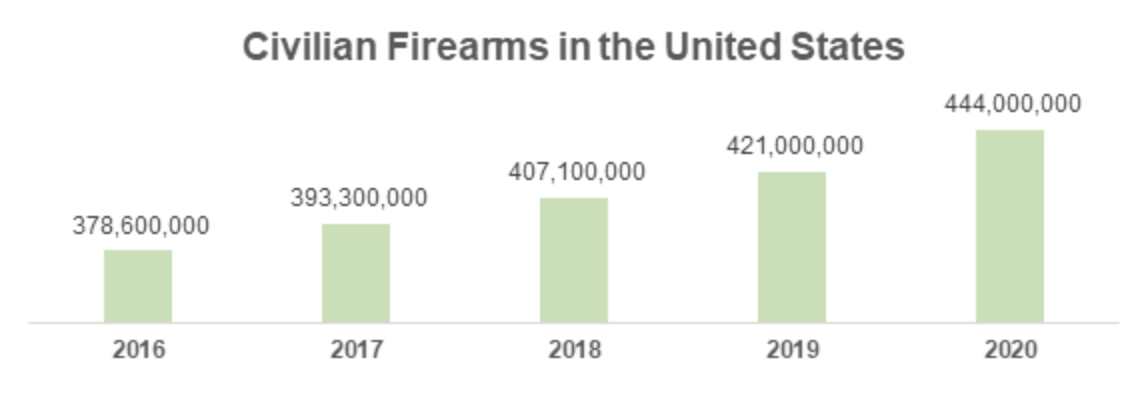
It’s no secret that there are a lot of guns out there, but many people don’t realize that they likely encounter multiple concealed guns every day without realizing it. Based on industry data, we estimate that there are over 440 million civilian-owned guns per person in the U.S. That’s around 1.3 guns for every person in the country. About 42% of U.S. households own at least one gun and few guns are kept exclusively at home. A quarter of Americans say they carry a gun at least sometimes and nearly a fifth, 18%, claim to carry every day. And no, it’s not just a red state thing: 28% of people in the Northeast say they carry a gun at least some of the time. 

Civilian Firearms in the United Statesbased on Evolv analysis of datafromSmall Arms Survey 2018andSmall ArmsAnalytics2018-2021.

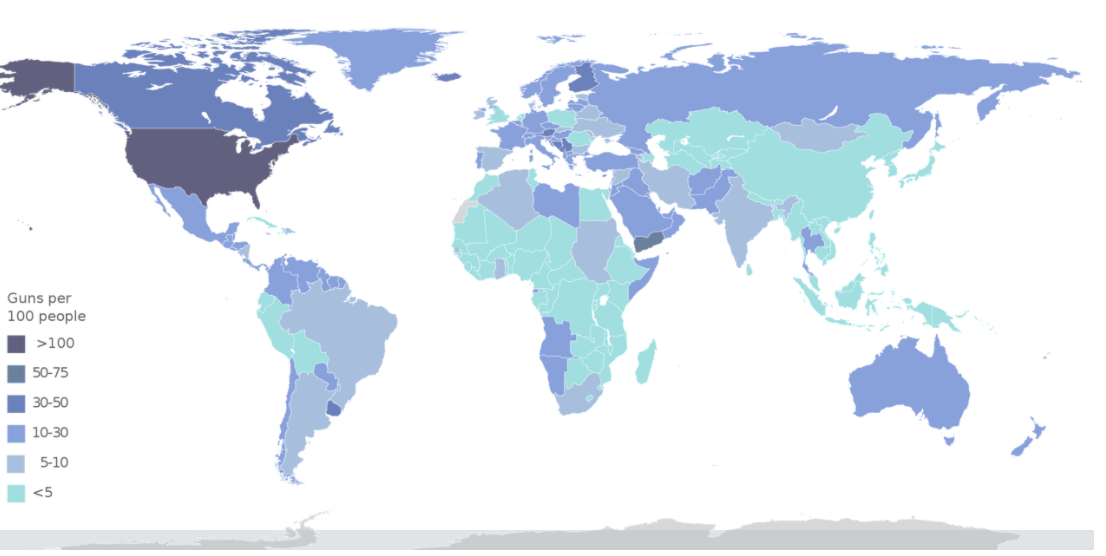
Another fact that might surprise you is that the United States is not the only country where civilian-owned guns are common. According to Small Arms Survey research, there are 85 countries with 10 or more civilian-owned guns per 100 population. The list includes Germany, France, Italy, Belgium, Australia, New Zealand, and many other countries you might not expect. There are almost half a billion civilian-owned guns outside the United States, and while mass public shootings may feel less common in other countries, the list of tragic incidents outside the U.S. is not short.

Map of civilian guns per 100 people by country from theSmall Arms Survey 2017.

Guns are in the Building 

Nearly every privately-owned facility and venue prohibits dangerous weapons, but the inconvenient truth is that many weapons slip through. How do I know this? Because most of our customers tell us that when they start using our Evolv Express® weapons detection screening, they find a shocking number of guns—far more than they expected and more than they ever found using procedures based on old technology such as metal detectors. I know of one facility in the U.S. that found 57 concealed guns in their first hour of testing Evolv Express at a single entrance. And no, it wasn’t a gun show or a law enforcement convention. It was a place where any average American family might find themselves on any given day of the week.  

The stark reality is that old metal detector screening procedures fail to catch a lot of guns. That’s not to say metal detectors don’t work—it’s the combined system of people, process, and technology that fails. Metal detectors alarm on so many harmless objects that security staff divert all bags and pocket contents into slow, error-prone manual searches. Working under the angry stares of hundreds of frustrated visitors, security staff are under incredible pressure to keep things moving. The guns slip through. 

A Fraying Society is a Dangerous Society 

The likelihood of tragic violence increases when more guns are in the hands of people who are unusually anxious or fearful. New gun purchases were up 64% last year in the United States. The CDC says 40% of U.S. adults reported recent battles with mental health or substance abuse during 2020, with the prevalence of anxiety up 3X and depression up 4X year on year. And ongoing political polarization and extremist ideologies are creating an increasingly volatile situation.  

More guns in more anxious hands means more tragic incidents. It’s just math, but that’s the reality of where we are as a society. The U.S. Department of Homeland Security summarized the situation in a 30 June law enforcement bulletin as follows: 

“In recent weeks, domestic violent extremists (DVEs) motivated by various violent ideologies have continued to advocate violence and plan attacks. As of 16 June, racially or ethnically motivated violent extremist-white supremacists (RMVE-WSs) were sharing downloadable links to a publication discussing targeting mass gatherings, critical infrastructure, and law enforcement officers.”

It’s not just a handful of extremists who are changing the threat landscape. While only a tiny minority of gun owners are infected with the extremist ideologies that the DHS is tracking, the fact remains that many of people around us every day are feeling threatened enough to arm themselves. This increases the risk of tragic escalations where misunderstandings and opportunistic conflict can quickly erupt into violence. 

The Duty of Care to Keep People Safe 

The police recently arrested a man who tried to enter a major tourist destination with an unlicensed gun that was detected by Evolv Express. When questioned, the man explained that he felt threatened by recent public protests and felt he needed the gun to protect his family on vacation, and was willing to take the risk of detection. That’s where we are. The strength of the “visible deterrent” factor is fading fast. Facilities and venues need to start reliably detecting and stopping guns, and then let the public know they have this capability. It’s the only way to reclaim the lost ground, and it needs to happen soon. 

If anxious gun owners are trying to slip into major tourist destinations with guns even when they know it is illegal and can clearly see security screening in place, it is safe to assume that they are also entering schools, grocery stores, malls, houses of worship, and other facilities where weapons are also prohibited, but screening is largely absent. The threat is everywhere.  

As noted earlier, our customers tell us they find a surprising number of weapons with Evolv Express. They also tell us they love that they find more guns while allowing harmless visitors to enter ten times faster than their old screening process based on metal detectors and universal bag checks. They tell us they need fewer front-line security staff overall with Evolv Express, and the remaining staff loves the new process. They also tell us they love the operational awareness they get from Express Insights™ analytics. We hear this same story across hundreds of sites as we scan over 11 million individual visitors every month.  

At this point, I believe it has become abundantly clear that Evolv Express has set a new and higher standard for what security screening should be.  I believe every facility and venue owner has a duty of care to carefully consider the new standard that our weapons detection system represents in light of the escalating threats we’re seeing. We are committed to democratizing access to this technology over time so it can be everywhere it needs to be to keep the vulnerable masses safe.  

If you want to be part of raising the standard of safety for millions of people, we’d love to have your support. Here are a few ideas on how you can help. If you are responsible for security at a facility or venue, please get in touch so we can discuss your needs. Consider speaking with the security staff at the places you gather most often and ask them if they have considered weapons detection. If you’ve experienced the speed and precision of Evolv Express in person, help us tell the world about it. And if you are looking to get more directly involved, note that we’re hiring in almost every department. Together we can all do a little to make everywhere safer.  

Today’s Threat Environment: A Conversation with Former Secret Service Director Mark Sullivan

I recently had the privilege of participating in a webinar with Mark J. Sullivan, former Director of the United States Secret Service and a member of the Evolv Board of Directors. 

It’s always enlightening to hear Mark’s views on a range of topics focused on the state of security today and best practices for security professionals. Since he left the Secret Service, he’s worked with a wide range of organizations to help improve their security. Here are some highlights from our conversation. 

Me: What kind of creative approaches have you seen with security professionals in terms of using their budgets most effectively? 

Mark: I see a lot of people conducting threat vulnerability and risk assessments. It comes from having good plans, good policies, and good procedures. As well as having clear lines of communication with leadership—using people, technology, and ultimately using multiple layers of security to come up with the best plan for that organization

Me: As you look out over the threat landscape today, what are you seeing as the threats that should be of particular concern to us all? 

Mark: Automatic weapons, shoulder weapons, assault weapons, vehicle-born improvised explosive devices (VBIEDs), and improvised explosive devices (IEDs). These threats continue to evolve, and the challenge is to anticipate where the threats may come from. We are seeing that the softer targets become attractive to those who are looking to do harm.  

Me: As security professionals think about the softer targets within their venues, and as they think about multiple layers of security, they should think about security protocols and mitigation approaches that might be visible and some that might be less visible. What is your guidance? 

Mark: A lot of it comes down to situational awareness. Is there any type of pre-attack surveillance going on? How do we identify those types of pre-attack behavior? How are human resources used to provide a physical presence? How is access control handled? Are the people coming in, the right people? They also have the challenge of the insider threat. How do you identify those people in the organization that are potentially going to cause harm? 

Me: What is your perspective on the value of deterrence as part of an overall security plan? 

Mark: People are hardening their venues, their buildings, their businesses, and many people are doing it via screening. Over the past 15 years, we have seen that every professional sports league has gone to screening. They’ve been very aggressive with it and very successful keeping threats out. As threats continue to evolve and as firearms continue to be the instrument that people are using, more and more people are looking at that visible and effective system of screening. 

Me: Let’s talk about the threats themselves. In May 2021, we saw 72 active shooter incidents in the U.S. – more than two a day. How should security professionals think about this wide range of threats and identify the ones that might be the most impactful?  

Mark: No one security protocol is going to fit for everybody. Every venue, every business, every organization is going to have to approach it from an individual perspective. A lot of people are coming up with their matrix of what they believe to be their highest threat, what risk those threats present to them, where the gaps are, and what are the best ways to mitigate against that risk and how do you close up the gaps. 

Me: What are some of the best practices you’ve seen? 

Mark: Communication and decision making are both very important. We don’t want bad things to happen, but we know that they are likely going to occur. I think people are putting a lot of time and effort into having well-defined plans to react to a situation. I see more and more people coming up with Security Operations Centers or Joint Operation Centers: One central location as a coordination point for situational awareness is important.  

Me: Let’s talk a little bit about technology. During the pandemic, we’ve seen a change in consumer expectations around touchless technology: Touchless payments, curbside pickup, touchless ticketing, etc. We’ve seen touchless security as an expectation of consumers, whether it’s fans, employees, or kids going back to school. We’ve seen a desire to use modern technology to make things fast and accurate. How have you seen technology, technology screening, and maybe even the Evolv Express® system affect and positively impact security at venues? 

Mark: You want technology that is going to be impactful for the operator. During the pandemic, one of the things with Evolv Express screening is the fact that it is touchless. I think that has been impactful. We’re looking for technology that is going to get the job done efficiently and effectively. The less contact the better. The more you can enhance the patron experience, the client experience, all the better. That is the goal for Evolv. Making their community safer and making it a better experience. And, you don’t want to require the operators to have deep technical skills. You want this technology to be easy to understand, easy to operate, and easy to deal with. 


The full webinar is available at Security Magazine

The New Standard: Safety in Motion

What if we lived in a world where we could work, learn and play together without the fear of weapons violence? This is what our founders Mike Ellenbogen, Co-Founder and Head of Technology, and Anil Chitkara, Co-Founder and Head of Corporate Development have set out to do. All of us at Evolv Technology share that same mission; transform security to enhance everyone’s life. This is our duty-of-care and we hold ourselves accountable to it. 

As of today, six months into 2021, there have been 319 mass shootings, compared to 417 in all of 2019 (according to www.gunviolencearchive.org). The old standards for security aren’t keeping up with the security requirements of today. Many institutions that have used metal detectors for security realize they can no longer keep large numbers of people queuing in security lines. Aside from the potential health hazard lines create, this opens up an additional security vulnerability. Venues and enterprises that have never used security screening are now budgeting to keep their visitors safe. Traditional metal detector technology just cannot address the pace of life and the ubiquitous need for security in our daily lives.

We need new standards. We need security that continually improves – touchless, free-flowing, and frictionless technology – supported by a strong concept of operations and enforced by well-trained security personnel. The days of bag checks, wands, and body checks are unacceptable and biased. We must find the weapons, not the metal. Advanced sensors and artificial intelligence are at the forefront of this evolution. This is where we come in.

We are obsessed with our customers’ success and strive to do better and be better for them. That requires authenticity and real products that work. At Evolv we do what we say and say what we do. There is no room for bravado. 

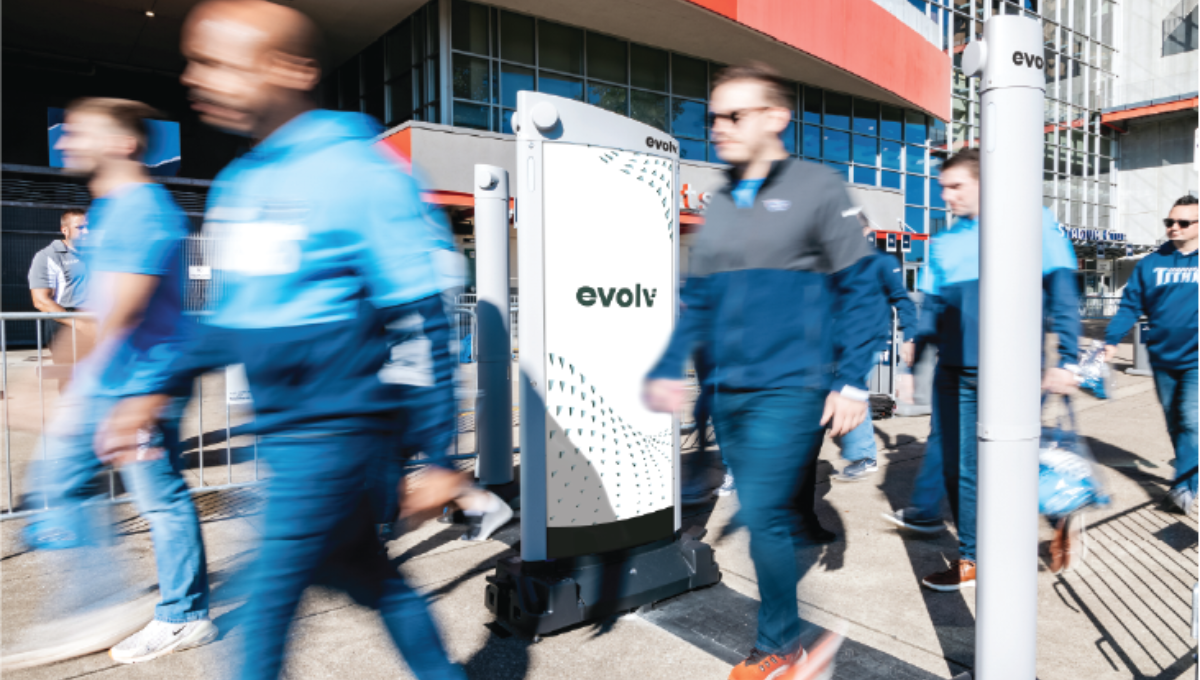
Evolv innovations are fueling the physical security transformation, disrupting the status quo. Evolv Express®, powered by Evolv Cortex AI™, can distinguish between metals that are personal items from weapons used for harm. No longer do visitors, fans, employees, and students need to stand in long lines to slog through metal detectors. They can move at the pace of life through our weapons detection systems, eliminating the potential soft targets long lines create to seamlessly flow through security. Life shouldn’t feel like airport security.

New standards call for a new brand. We’re calling it Safety in Motion. The modernized look is representative of our technological innovations in security screening, using cutting-edge technology for today’s security needs. Moreover, we wanted our new brand to reflect our mission: Transform security to enhance everyone’s life. We think it does, we hope you do too.

Transforming Human Security and Saving Lives

Evolv Earns Edison Award for Completely Reinventing Threat Detection

Last week I had the distinct honor of accepting, on behalf of everyone at Evolv Technology, the Edison Award we won last year for the “game-changing innovation” that our Evolv Express® system and Evolv Cortex AI™ software platform represent. We got word of the award last spring, but there was no public event at which to actually receive it – so while I participated in this year’s ceremony from afar, it was gratifying to virtually bring the award home.

That’s because the Edison Award is one you want to display proudly for all to see. It’s one of the few awards that truly recognizes significant technical innovation in products that solve actual problems in the real world, as opposed to in a lab. And herein lies our story.

As the original announcement said, the award goes to companies that are “changing the world with their incredible vision, their commitment to innovation, and the introduction of new products and services that will make consumers’ lives safer, healthier and more sustainable.” 

Our second-generation product, Evolv Express, for which we earned this award, is a game-changing weapons detection system. With its’ ability to scan up to 3,600 people an hour and the intelligence to differentiate between weapons and personal items – without forcing people to empty pockets and bags or break stride – it’s improving security at the speed and scale required in this post-pandemic world. 

Evolv Technology is leading the digital transformation of physical security, one that is touchless and addresses today’s threat of pandemic viruses as well as concealed weapons. By harnessing our technical innovations in sensors and AI to overcome the widely recognized deficiencies of outdated security screening products, Evolv’s technology enables ticketed venues, workplaces and schools to vastly improve their ability to keep their customers, employees, guests, students and staff safe all while rapidly and more naturally enter these venues.  And, it’s all done in a way that integrates with the way people want to live, and more importantly, the way they deserve to live.


Edison, Bell and Early Metal Detectors

The Edison Award, of course, is named after Thomas Edison, one of the greatest inventors of all time, and holder of some 1,093 U.S. patents. Evolv Express is an entirely new approach to metal detection technology first created by another renowned inventor and Edison contemporary, Alexander Graham Bell.

While Bell is best known as the inventor of the telephone, he was also experimenting with a metal detection device around the time in 1881 when President James Garfield was shot by a disgruntled diplomat. The bullet was lodged in the president’s chest and for weeks physicians attempted to find and extract the bullet.

Bell had successfully used his device to detect bullets in sides of beef and shrapnel in Civil War veterans, so he thought it may be of use in Garfield’s case. But the device failed for a simple reason: unbeknownst to Bell at the time, underneath the horse-hair mattress on which the president was lying was another made of steel wires. Those wires interfered with Bell’s metal detector, which was based on electrical inductors, rendering him unable to find the bullet. In other words, the technology couldn’t separate the signal from the noise – we’ll come back to this technical challenge

By the 1920s, metal detectors using radio frequency (RF) waves began to come on the scene. While they have been refined over time, the metal detectors we all pass through today are based on that same 100-year-old technology.  

Interference: An Age-old Issue

And that technology still suffers from the same challenges that rendered Bell’s detector unable to help President Garfield….interference. As we all know, anytime you pass through a metal detector, you are asked to empty your pockets and remove any metal – keys, phones, wallets and so on, and pass through in single file. In effect, all those personal items are interfering with the detector’s ability to detect the real threat: weapons. Legacy technology and an outdated approach certainly don’t integrate with the way people live today.

Necessity is the Mother of Invention

In 2013, after the Sandy Hook school shooting and Boston Marathon bombing and amid terrorists shifting targets to nightclubs and stadiums around the globe, we founded Evolv with the singular goal of keeping people safe by finding a way to detect weapons at places that aren’t mandated to do so – like nightclubs, schools, workplaces, sports and concert venues.

These kinds of venues, companies and schools need security that does not disrupt the public gathering experience and avoids the problems that come with traditional security approaches such as crowds, single-file lines, bag checks, wands and invasive pat downs.

We knew there was a hurdle to get over. If the detection device presents too much hassle and creates lines, people won’t embrace it.  It needed to be seamless, accurate and fit within venue operations.  It had to balance the desire to improve safety with the need to maintain or even improve the visitor entrance experience.

Evolv has a Singular Goal

Starting out with a small team of colleagues who are world-class in understanding detection challenges, we had the idea to combine state-of-the-art sensors with smart software and machine learning algorithms to solve this problem. After refinement and iteration, we’ve delivered on our goal: detection technology that is all at once accurate and frictionless. And can perform reliably under real world conditions.

Now, About that Signal to Noise Problem

When I say accurate, I mean we can reliably differentiate a weapon from a phone and the other objects we all carry on a daily basis, and we’ve accounted for variables such as wind and vibration that may throw off other forms of RF-based sensors. And by frictionless, I mean you no longer have to empty pockets, go through screening single-file, or even slow down your normal walking speed.

Security Can Only be Effective if it Works in the Real World

Innovation in our space has to address often competing requirements: balance the physics of detection, address the realities of the all the stuff we carry, and support the operational needs of the customer.  And it has to satisfy all three in a way that achieves high throughput, quickly and more securely.

That, I would argue – and the Edison Award folks apparently agree – is game-changing technology. And it certainly helps to make us all safer.

So, I proudly accepted the Edison Award last week on behalf of all the smart, dedicated people on the Evolv team who helped develop this technology, refine it in the lab, and bring it out into the field, where it can solve real-world problems. I hope both Edison and Bell would be impressed.

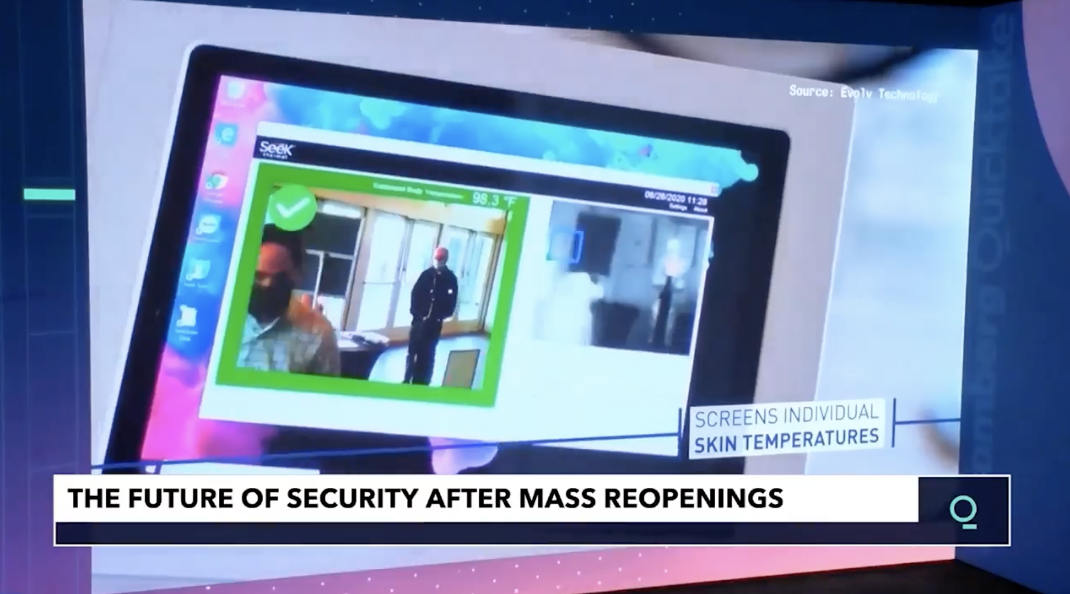
The Future of Security After Mass Reopenings

Using AI to Stay Safe

On April 21, 2021, Evolv Technology CEO, Peter George, joined Bloomberg Quicktake Anchor, Tim Stenovec, to discuss Evolv Technology’s touchless AI-based security screening technology.

Transcript

Tim Stenovec (Quicktake Anchor):
Well, this week, a leader in AI touchless security screening announced an update to let customers comprehensively review, analyze, and collect valuable data on their security checkpoints. Evolv Technology says it’s screened more than 50 million people, second only to the TSA in screening people in the US. The company recently announced plans to go public using a SPAC merger with New Hold Investments. Joining me now is evolve technology CEO, Peter George. Hey Peter, thanks so much for taking the time and joining us on Quicktake this afternoon. Where would people have interacted with Evolv Technologies products without even knowing about it?

Peter George (Evolv Technology CEO):
Well, they would know about it because they’d walked through our venues, Tim, places like stadiums, performing arts venue, schools. What would be different about walking into that venue through our system is that they’d walk into the venue and not break stride, no lines, nobody would touch their stuff, and we be able to screen for threats without them breaking stride and without them divesting of the things that they normally carry.

Peter George (Evolv Technology CEO):
And that is a transformative experience.

Tim Stenovec (Quicktake Anchor):
Yeah. I mean, I’m looking at the website right now, and I know that I’ve certainly walked through these machines at museums and venues. I wonder, though, what it’s fair to call these, right? Are these metal detectors? Not really, right?

Peter George (Evolv Technology CEO):
No. Their threat detection security screening devices, advanced sensors powered by artificial intelligence. So we can find the needle in the haystack and the needle is the weapon amongst all the things that people are carrying.

Tim Stenovec (Quicktake Anchor):
Right.

Peter George (Evolv Technology CEO):
And the magic is the ability to discriminate between a phone and a firearm. And that’s really, really hard. We’re all carrying phones and keys and things that are metal. Metal detectors are really good at finding all metal, but they’re really bad at finding weapons, and we find weapons really well.

Tim Stenovec (Quicktake Anchor):
How do you do it? What’s the technology that you use?

Peter George (Evolv Technology CEO):
Sure. So we’ve combined very, very advanced sensors. As you know, there’s been a lot of advancements in sensor technology and cameras, machine learning, and artificial intelligence. We fuse those all together. And we, as I said, could find the needle in the haystack. So as people walk through the venue, we’re creating different kinds of telemetry, the fragmentation of the metallic composition, the shape. Oftentimes, we’re looking for the barrel of a gun and when we find it, we can make a quick determination. But if it’s anything else that’s either metal or anything else they’re carrying, they can walk in without it. And so the ability to find a weapon on people while they’re moving without them taking their things out of their pockets is really, really important. You can imagine it completely transforms the entry into venues, where there are lots of people. We basically make lines go away and make the people in the venues on the other side super safe.

Tim Stenovec (Quicktake Anchor):
Okay. This sounds pretty great. I got to tell you, I haven’t been in an airport in a long time, but I know that the last time I was in an airport at TSA, this is not the technology they were using. There was a long line. Why doesn’t TSA use Evolv Technology?

Peter George (Evolv Technology CEO):
Sure. So we’re going to let the TSA worry about the sterile environment and the sterile environment is making sure nothing gets on a plane with 500 people and goes 10,000 feet in the air. The founders of this company actually had spent a lot of time in aviation and recognize that there was a big need for safety outside of aviation, where people were gathering, stadiums, performing arts venues, theme parks, and using traditional technology like metal detectors, which by the way, Tim, was invented 90 years ago, to solve that problem just didn’t make any sense.

Peter George (Evolv Technology CEO):
So it’s a really hard problem to solve, which is to find weapons on people that the weapons are concealed while they’re moving, and we solved the problem. It took us five years to do it and about a hundred million dollars. And so we’re in a great position now to democratize security and bring security to all those other venues, not like airports, that when people come back from this pandemic, they want to gather safely and we can allow that to happen.

Tim Stenovec (Quicktake Anchor):
I want to understand though about why it wouldn’t be in an airport right now and why TSA wouldn’t use it. Is it because the technology isn’t as sensitive as a metal detector? You use the term a sterile environment.

Peter George (Evolv Technology CEO):
Yeah. So we are in some airports today. In fact, seven of them. People are using our technology for employee screening.

Tim Stenovec (Quicktake Anchor):
Okay.

Peter George (Evolv Technology CEO):
So people could use it in their airport, but most of our focus is in the 0 billion TAM, which is non-aviation TAM, non-regulated.

Tim Stenovec (Quicktake Anchor):
You say TAM, total addressable market?

Peter George (Evolv Technology CEO):
Yeah, that’s right. Yeah. That’s right. Yeah.

Tim Stenovec (Quicktake Anchor):
What about this SPAC here? There was a surge in SPACs over the last few months. We saw a real dip in the most recent time period. Why is SPAC the right way to go public?

Peter George (Evolv Technology CEO):
Yeah. So look, we knew we were going to raise money and/or go public in the next couple of years. Their both certainty to close, and then timeframe, time to the capital we thought was super important. And the SPAC vehicle provided us that in a really a terrific way. As you know, we’re helping reopen America. And now’s the moment for people to understand who we are and how we can help them. So we felt by fully capitalizing the company, we can take advantage of the accelerated growth that we have in the market and help customers reopen safely. So we’re thrilled about this. Our plan is to become a public company sometime in Q2, probably in June. We’re really excited about that and working very closely with all kinds of venues today helping them open up.

Tim Stenovec (Quicktake Anchor):
Yeah, well, it’s certainly cool technology and I hope to be back in museums and concert venues soon as well. Evolv Technology CEO, Peter George. Hey Peter, thanks so much for taking the time, and for joining us on Quicktake.

Living the Mission Every Day

I grew up in Paterson, N.J. where my dad served as a police officer for 25 years. At a very young age I decided to follow in his footsteps and set my sights on becoming a police officer. After graduating from high school, I was too young to apply for police work and honestly still had some growing up to do so I enlisted in the Navy. Upon being discharged, I returned to my hometown in New Jersey and focused on finding a job in law enforcement. While participating in the hiring process for several agencies, I was routinely asked why I wanted to be in law enforcement and my standard answer was that I wanted to help people and keep them safe. I know this sounds so stereotypical, but I truly believed this and carried this commitment with me throughout my twenty-eight-year career and still to this day in my current role.

I was successful in finding a career opportunity in law enforcement and started my career as a corrections officer working in a county jail, I later transferred to the courts as a sheriff’s deputy but still had a longing to be a patrol officer and moved with my family to the Seattle, Washington area where I served as a patrol officer with a city police department south of Seattle. While with this agency I worked in several positions in patrol, but my favorite assignment was in the community policing unit where I was very active in working with the community on crime prevention matters and also with an elementary school where I worked closely with the school staff and students delivering classes to them on personal safety and crime prevention.

In early 2002 I transferred to the Port of Seattle Police Department, which is responsible for policing Port owned properties on the Seattle waterfront and the Seattle-Tacoma International Airport. Immediately after joining the Port, I became deeply involved in the community, volunteering in schools, conducting crime prevention training sessions, implementing block watch programs and educating people about safety.

In 2017, after serving 28 years in law enforcement I retired and joined a technology company that was implementing a security/safety program to enhance a mobile platform offering which moved me to the Tampa, Florida area. A few months later I was on my way to the gym when I heard the news report regarding the active shooter incident at the Route 91 Harvest Festival in Las Vegas. I have to admit, it hit me really hard, I pulled off to the side of the road and listened to the report and felt this overwhelming need to help out, unfortunately I was far from the area and retired for a few months already so there wasn’t much I could do. I thought back of my years in law enforcement and what my former peers might be doing to work with their communities to assure everyone was safe but that was as much as I could do. I realized in that moment that I really missed being active in a job where my primary focus was to keep people safe.

Throughout my law enforcement career, I had committed an immense amount of time to personal safety training which included active shooter training for both the community such as Run, Hide, Fight principles and as the Training Unit Commander we implemented active shooter response programs for our officers. Additionally, I had the opportunity to serve as the Executive Producer for a video called Airport Active Shooter which came about after the active shooter incident at the Los Angeles World Airport (LAWA).

Several months later, while attending a conference in New Orleans I ran into Chris McLaughlin who was a VP of Global Solutions with Evolv who I had previously met when I was with the Port Police. I was really impressed with the company’s offering and upon researching the company further, I felt connected to the Evolv mission: To make places safe and keep people safe. That aligned with my life’s mission, the core belief in which I had always taken enormous pride, it seemed like a match made in heaven and it was!

A Common Purpose with Our Customers

At Evolv, I get to live my mission every day. A few weeks ago, I heard about the shooting at the Sarasota County Fair which is practically in my backyard. It really bothered me. It so happened we had an Evolv Express® system in the area because we were conducting a proof-of-concept pilot for a potential customer in the Tampa area. The system was available, and I immediately thought: “We can help.”

I reached out to our internal team and leadership all of which were supportive, so I called the Fair and spoke with their CEO and offered to help them. Our offer was to let them use an Express system free of charge for the remaining week of the fair to screen guests for weapons. They were thrilled. Seeing the Fair had an immediate need to keep people safe we stepped up and got an Express up and running to help solve a problem, just like my days as a police officer, focused on solving problems. We had great results at the Fair and the entire Fair Executive Team were very impressed with the Express and even more impressed with our Company for our willingness to step up and help keep people safe!

I really enjoy my role with Evolv, it affords me an opportunity to develop close relationships—friendships—with many of our customers. A big part of that is the fact that we share a common mission to keep people safe.

One example is the Dr. Phillips Center for the Performing Arts in Orlando where keeping people safe was at the forefront of their “Front yard Festival” concept.  In order to provide patrons with a safe way to be entertained during the pandemic they pivoted and created an outdoor venue. Their front yard became their performance space and with a mix of new programming, they are reigniting the greater Orlando community – all within a safe perimeter where they leveraged the Evolv Express touchless approach to weapons screening as part of their reopening plan.

Another example is the Florence County School District in South Carolina. We all are too familiar with the shooting incidents that have occurred at our schools and the Florence County Schools are committed to preventing these types of incidents from occurring in their schools and implemented the Evolv Express to assist them in keeping staff and students safe.

Florence had metal detectors, but the superintendent, school board and security director wanted to use a more innovative way to prevent weapons from entering the schools. Despite the additional cost of the Express, they were focused on protecting their students and staff and made the investment in Evolv. After assuring we were the right fit for their environment, we worked with their team to deploy the Express and enhance the overall process of screening for weapons replacing the walk-through metal detectors which had more of a prison feel than that of a learning environment.

Safety First, Always

From the time I talked with Chris McLaughlin in New Orleans, one of the things that has been consistent is that we are always up front and honest with our customers—and with ourselves. We tell customers exactly what our systems can and can’t do and work with the customer to develop an overall process to address their screening needs. If we get asked a hard question, we always give the honest answer. Having been on the receiving end of many sales pitches over the years I can honestly say that was not my experience with many other companies. I truly appreciate that Evolv is honest in our approach to solving a very serious problem of gun violence and works hard at improving our technology to assure we meet our mission of keeping people and places safe.

When I left law enforcement, I couldn’t be sure I would ever find a job in the private sector that would give me the same sense of satisfaction I had and fulfill the need I have inside to help people. But Evolv is a truly mission-driven company. To me, that’s the beauty of the company. We all feel that way, from the junior levels of the company to the very top; doing what is right for the customer, keeping places safe, keeping people safe.

Evolv Technology Brings Data Analytics Capabilities to its AI-enabled Touchless Security Screening System

Evolv Technology, the leader in AI touchless security screening, today announced Evolv Insights™, a powerful SaaS-based analytics dashboard that provides security and operations professionals the ability to comprehensively review, analyze and collect valuable data from their Evolv Express® security screening systems throughout their venues and facilities.

Evolv is transforming the physical security industry by providing the world’s first AI-enabled touchless screening system. Built on its Evolv Cortex AI™ software platform, Evolv is continually improving the security posture for customers through machine learning and on-demand analytical insights in a way that legacy metal detectors and other analog screening systems cannot provide.

Available through the secure My Evolv Portal, Evolv Express customers can use Evolv Insights™ to extract data about venue and entrance visitor arrival curves and counts, system detection performance, alarm statistics and comparisons across multiple sites, locations within sites, event types, detection settings, time periods and more. Depending on a customer’s desired level of granularity, the data can be presented annually, quarterly, monthly, daily, hourly, and even down to five-minute increments. Designed to provide actionable insights, customers can easily export data on-demand to enable sharing with colleagues and leadership via a range of user-friendly visual formats.

“We believe AI is changing the world and Evolv has been at the forefront in applying its many advantages to the physical security screening market,” said Vice President of Product Management Steve Morandi at Evolv. “Until now, security teams using outdated metal detector technology have been forced to make operational decisions based on biased judgment and anecdotal inputs, collected manually under the pressure of time. With automated data collection and actionable insights, security teams can move from reactive management and intuition-led decision making, to proactive, data-informed operations.”

Evolv Insights Allows Customers to:

“As a leader in designing weapons detection solutions, gaining insights into the actual throughput and alerts is fundamental to those designs,” said Founder and Managing Partner Dan Donovan at Ingressotek. “As an Evolv Technology Partner, we work with many of the most recognizable stadiums, sporting events and entertainment venues to keep their fans, patrons and staff safe. Having integrated, actionable data at our fingertips through Evolv Insights is very valuable, especially as our customers start reopening. Evolv Insights gives them easy access to details about visitor flow and other critical information to effectively plan resources as well as adjust in real-time.”

“The ability to better understand and anticipate how our patrons return to Omaha Performing Arts events as we come out of the pandemic will be valuable as we refine our reopening plans,” said Senior Vice President and Chief Financial Officer Arnold Reeves at the Omaha Performing Arts. “The data could allow us to make more informed staffing decisions, and also provide the ability to view and easily report percent venue occupancy numbers. With multiple entrances into the venues, the data portal will allow us to determine where volunteers are needed most to help enhance the patron experience. Without Evolv Express and Evolv Insights, we’d have to rely on visual cues and estimates.”

“We recently started using Evolv Express to enhance security screening for guests and team members throughout our facility,” said Potawatomi Hotel & Casino Security Director Sam Guzman. “With Evolv Express we have a state-of-the-art system that can help us increase security efforts while maintaining a high level of service for our guests.”

The Evolv Express system delivers up to a 70% reduction in cost and is 10 times faster than traditional metal detectors, resulting in screening an unparalleled 3,600 people per hour, per system. The system allows for visitors to pass through screening without breaking stride and continuing the pace of life, improving security at the speed and scale required in this post-pandemic world.

The world’s most iconic venues and companies place their trust in Evolv to protect their employees and visitors, including Uber, Lincoln Center, L.L. Bean, Six Flags, and hundreds of others. Evolv’s systems have been used to screen more than 50 million people, second only to the Department of Homeland Security’s Transportation Security Administration in screening people in the U.S.

Join us for a live webinar on Tuesday, April 20, 2021 at 11:00 a.m. ET to learn more.

In March 2021, Evolv entered into a definitive agreement for a business combination with NewHold Investment Corp. (NASDAQ: NHIC) in a transaction that would result in Evolv becoming a U.S. publicly listed entity. The transaction is expected to close in the second quarter of 2021, subject to satisfaction of customary closing conditions. For more information visit nhicspac.com.

About Evolv Technology

Evolv Technology is the world’s leading provider of AI touchless security screening systems that enhance safety without sacrificing the visitor, student and employee experience. Built on top of its Evolv Cortex AI software platform, the company provides an array of AI touchless screening technologies for weapons detection, identity verification and health-related threats.

Led by a team of security industry leaders with a track record for delivering first-to-market products, Evolv’s investors include Bill Gates, Florida Governor Jeb Bush’s firm, Finback Investment Partners, DCVC, General Catalyst Partners, Lux Capital, SineWave Ventures, Motorola Solutions and STANLEY Ventures. The company’s partners include Motorola Solutions, STANLEY Security and Johnson Controls. Evolv Express® has earned industry accolades such as the 2020 Edison Awards™, two Campus Safety 2020 BEST Awards, Campus Security & Life Safety magazine’s Secure Campus 2020 Awards and Best Places to Work by Inc. Magazine and Built in Boston.

In March 2021, Evolv entered into a definitive agreement for a business combination with NewHold Investment Corp. (NASDAQ: NHIC) in a transaction that would result in Evolv becoming a U.S. publicly listed entity. The transaction is expected to close in the second quarter of 2021, subject to satisfaction of customary closing conditions. For more information visit nhicspac.com.

Evolv Technology, Evolv Express®, Evolv Insights, and Evolv Cortex AI™ are registered trademarks or trademarks of Evolv Technologies, Inc. in the United States and other jurisdictions.

For more information, visit https://evolvtechnology.com.

Important Information for Investors and Stockholders

This document relates to a proposed transaction between NewHold and Evolv. This document does not constitute an offer to sell or exchange, or the solicitation of an offer to buy or exchange, any securities, nor shall there be any sale of securities in any jurisdiction in which such offer, sale or exchange would be unlawful prior to registration or qualification under the securities laws of any such jurisdiction. NewHold has filed a registration statement on Form S-4 with the SEC, which includes a document that will serve as a prospectus and proxy statement of NewHold, referred to as a proxy statement/prospectus. A proxy statement/prospectus will be sent to all NewHold stockholders. NewHold also will file other documents regarding the proposed transaction with the SEC. Before making any voting decision, investors and security holders of NewHold are urged to read the registration statement, the proxy statement/prospectus and all other relevant documents filed or that will be filed with the SEC in connection with the proposed transaction as they become available because they will contain important information about the proposed transaction.

Investors and security holders will be able to obtain free copies of the registration statement, the proxy statement/prospectus and all other relevant documents filed or that will be filed with the SEC by NewHold through the website maintained by the SEC at www.sec.gov. Alternatively, these documents, when available, can be obtained free of charge from NewHold upon written request to NewHold Investment Corp., c/o NewHold Enterprises, LLC, 52 Vanderbilt Avenue, Suite 2005, New York, New York 10017, Attn: Charlie Baynes-Reid, or by calling (212) 653-0153, or by email at info@newholdllc.com.

Participants in the Solicitation

NewHold and Evolv and their respective directors and executive officers may be deemed to be participants in the solicitation of proxies from NewHold’s stockholders in connection with the proposed transaction. A list of the names of the directors and executive officers of NewHold and information regarding their interests in the business combination will be contained in the proxy statement/prospectus when available. You may obtain free copies of these documents as described in the preceding paragraph.

This communication does not constitute an offer to sell or the solicitation of an offer to buy any securities or a solicitation of any vote or approval, nor shall there be any sale of any securities in any state or jurisdiction in which such offer, solicitation, or sale would be unlawful prior to registration or qualification under the securities laws of such other jurisdiction.

Forward-Looking Statements

This document contains certain forward-looking statements within the meaning of the federal securities laws with respect to the proposed transaction between NewHold Investment Corp. (“NewHold”) and Evolv Technologies, Inc. (“Evolv”). These forward-looking statements generally are identified by the words “believe,” “project,” “expect,” “anticipate,” “estimate,” “intend,” “strategy,” “future,” “opportunity,” “plan,” “may,” “should,” “will,” “would,” “will be,” “will continue,” “will likely result,” and similar expressions. Forward-looking statements are predictions, projections and other statements about future events that are based on current expectations and assumptions and, as a result, are subject to risks and uncertainties. Many factors could cause actual future events to differ materially from the forward-looking statements in this document, including but not limited to: (i) the risk that the transaction may not be completed in a timely manner or at all, which may adversely affect the price of NewHold’s securities, (iii) the failure to satisfy the conditions to the consummation of the transaction, including the adoption of the Agreement and Plan of Merger, dated as of March 5, 2021 (the “Merger Agreement”), by and among NewHold, Evolv and NHIC Merger Sub Inc., a Delaware corporation and a direct wholly owned subsidiary of NewHold, by the stockholders of NewHold, the satisfaction of the minimum trust account amount following redemptions by NewHold’s public stockholders and the receipt of certain governmental and regulatory approvals, (iv) the lack of a third party valuation in determining whether or not to pursue the transaction, (v) the inability to complete the PIPE investment in connection with the transaction, (vi) the occurrence of any event, change or other circumstance that could give rise to the termination of the Merger Agreement, (vii) the effect of the announcement or pendency of the transaction on Evolv Aviation’s business relationships, operating results and business generally, (viii) risks that the proposed transaction disrupts current plans and operations of Evolv and potential difficulties in Evolv employee retention as a result of the transaction, (ix) the outcome of any legal proceedings that may be instituted against Evolv or against NewHold related to the Merger Agreement or the transaction, (x) the ability to maintain the listing of NewHold’s securities on a national securities exchange, (xi) the price of NewHold’s securities may be volatile due to a variety of factors, including changes in the competitive and highly regulated industries in which NewHold plans to operate or Evolv operates, variations in operating performance across competitors, changes in laws and regulations affecting NewHold’s or Evolv’s business and changes in the combined capital structure, (xii) the ability to implement business plans, forecasts, and other expectations after the completion of the transaction, and identify and realize additional opportunities, and (xiii) the risk of downturns and a changing regulatory landscape in Evolv’s highly competitive industry. The foregoing list of factors is not exhaustive. You should carefully consider the foregoing factors and the other risks and uncertainties described in the “Risk Factors” section of NewHold’s registration on Form S-1 (File No. 333-239822), the registration statement on Form S-4 discussed above and other documents filed by NewHold from time to time with the SEC. These filings identify and address other important risks and uncertainties that could cause actual events and results to differ materially from those contained in the forward-looking statements. Forward-looking statements speak only as of the date they are made. Readers are cautioned not to put undue reliance on forward-looking statements, and except as required by law NewHold and Evolv assume no obligation and do not intend to update or revise these forward-looking statements, whether as a result of new information, future events, or otherwise. Neither NewHold nor Evolv gives any assurance that either NewHold or Evolv or the combined company will achieve its expectations.

Any financial projections in this communication are forward-looking statements that are based on assumptions that are inherently subject to significant uncertainties and contingencies, many of which are beyond NewHold’s and Evolv’s control. While all projections are necessarily speculative, NewHold and Evolv believe that the preparation of prospective financial information involves increasingly higher levels of uncertainty the further out the projection extends from the date of preparation. The assumptions and estimates underlying the projected results are inherently uncertain and are subject to a wide variety of significant business, economic and competitive risks and uncertainties that could cause actual results to differ materially from those contained in the projections. The inclusion of projections in this communication should not be regarded as an indication that NewHold and Evolv, or their representatives, considered or consider the projections to be a reliable prediction of future events.


###

Jennifer Torode
tel:7812545836
jtorode@chenpr.com



It’s About the Data – Applying Analytics to Step Change Security Screening and Operations

In 2006, Clive Humby, a British mathematician and entrepreneur in the field of data science, declared “Data is the new oil.” This compelling position has been amplified thru the years and referenced in numerous settings for various intents, particularly with the advent of machine learning and AI. While the comparison may often create interesting debate material, what is generally recognized is the finite supply of oil versus the infinite waterfall of data.

Until now, physical security screening and rich front door visitor entry data has been an untapped resource. With legacy screening systems, visitors pass through a security checkpoint as a single, moment-in-time transaction, and because legacy systems are analog, digital data escapes uncaptured in the wind—

Moving from analog to digital, Evolv has transformed physical security screening using state-of-the-art sensors and AI-based software. Our systems constantly capture valuable data at this “threshold real estate” which can be mined, analyzed and used for optimizing operational efficiency.

The refinery

Screening and entry data while plentiful is just a raw resource. From our “Data is the new oil” reference, it needs to be processed and refined to derive value. Analytics helps harness the data and extract value to improve your security posture, optimize your resources (both security, general venue operations, and front of house), and ultimately create delighted customers. 

The premise that using data and analytics to optimize operational efficiency is not a quantum physics or atom splitting concept. There’s nothing new here except it’s never been applied in the physical security screening space. In fact, some say that physical security screening is the land that digital transformation forgot. Evolv Technology just unveiled an important enhancement to our Evolv Express® digital, touchless screening system, one that gives companies access to a “refined” repository of data, self-serve analytics, and dashboard tools to improve decision-making across a variety of organization functions. Introducing Evolv Insights™our powerful, SaaS-based analytics application.

By leveraging the rich data from Express and its machine learning and AI engine, Evolv Insights™ provides security and operations professionals with a single, easy-to-use, self-service dashboard to view, review, analyze and gather insights, from their screening and venue entrance. Example data types are granular 5-minute visitor arrival curves, total venue visitor counts, system detection performance, identified threat category counts and comparisons across multiple business dimensions including sites, entrance doors, event types, system detection settings, time periods and more. 

And this is just the beginning. Future integrations of additional Express sensor data, 3 party data sources, social feeds like weather, and rich venue enterprise data will expand our ability to provide more predictive and prescriptive venue relevant insights.

Data and actionable insights to optimize operations

Until now, security teams have been forced to make operational decisions based on biased judgement and anecdotal inputs, collected manually under the pressure of time. With automated data collection and actionable insights, security teams move from reactive management and intuition-led decision making, to proactive, data-informed readiness. Resulting actionable insights will empower security teams to transform security, operations, and the holistic visitor experience.

  • Simply Report on Security Performance to Leadership – Quickly review aggregated performance across the install base. This “snapshot” provides unique situational awareness and enables a holistic view of customers’ Express systems to optimize performance. This view is especially helpful when showcasing system performance to leadership teams.
  • Data-driven Improvements to Security Posture – Access individual scanner, location and detection setting comparisons. Drilling down and comparing system performance related to clear rate, visitor counts, arrival curves, and more, enables root cause analysis and inspection by event types, venue locations, individual entrances, and singular scanners.
  • Partner with Operations Teams to Deliver a Better Visitor Experience – Review the density of visitor arrivals with a color-coded heat map and correlated time-series view. Anticipated patron arrivals across seasons, weeks, days, and specific hourly trends by entrance and event type is available. Understanding these load times helps to more effectively plan staffing to provide visitors and employees with a welcoming, line-free experience.

Security seat at the table and value center

The ability for security professionals to advance a “data beats opinion stance” and to provide actionable recommendations across the enterprise will elevate the interaction and effectiveness across functions. Security equipment and leaders will no longer be viewed as a “necessary evil”, but as a coordinated and integral part of overall venue success.

If data is the new oil, analytics is the new refinery!