Improving Gameday Experience from Street to Seat

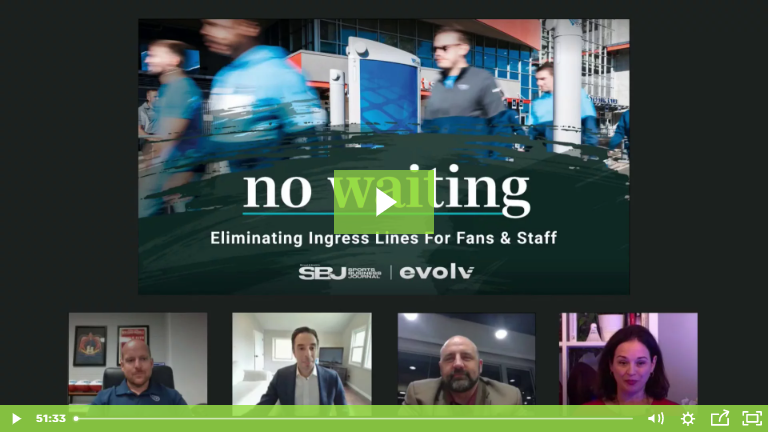
I recently had the pleasure of participating in a webinar that Evolv co-hosted with the Sports Business Journal.  These “lunch-and-learn” webinars have proven quite popular because they provide useful industry information in just an hour while attendees eat a sandwich (or perhaps a bagel, depending on time zone) at their desk.

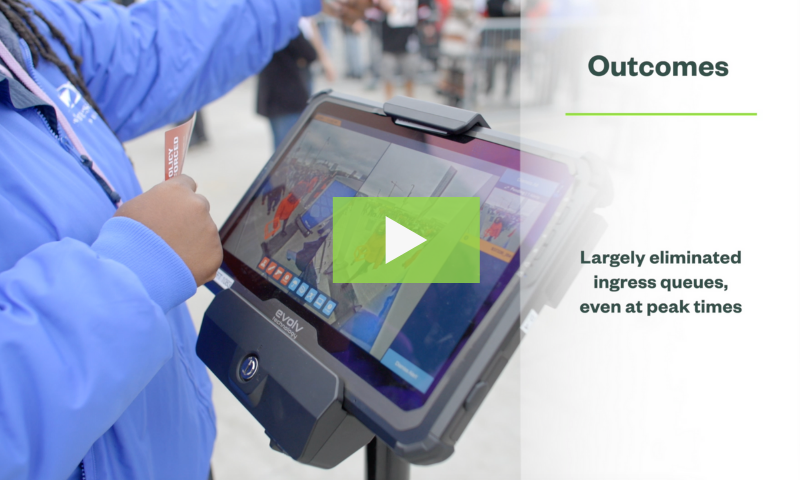
In this case, the content was indeed valuable.  Two of Evolv’s pro sports clients, Mercedes-Benz Stadium (Atlanta Falcons and Atlanta United) and Nissan Stadium (Tennessee Titans), shared perspectives on how our Evolv Express®‘ guest screening system has improved the gameday experience for fans and stadium employees alike.

I also wanted to go beyond the recording and share two additional insights from the session.

Guest Experience Is Key

The webinar was attended by people from all the major sports and many other fan-driven organizations.  We asked them whether, in their personal experience, team performance or guest experience was a bigger driver of repeat attendance.  Fully 75% of respondents answered guest experience.  This is certainly consistent with my own nearly two decades in pro basketball and hockey. 

I also view this strong consensus as very empowering for the people behind the scenes who make our industry work.  We may never put on a uniform, but we can still move the needle in terms of making fans have fun and want to come back.  Because the converse is true – a poor guest experience is a major driver of fans choosing not to return – we’re also under pressure to deliver.  Just like athletes, we need to always bring our A-game.  Thankfully, technology is increasingly giving us an assist.  That’s literally true with Evolv Express, where Artificial Intelligence instantly and invisibly performs many of the functions that make traditional ingress screening so slow and uncomfortable.  And, by getting fans into our venues faster and more smoothly, it also gives them more time to enjoy all the other amenities our venues offer.

Guest Entry Is a Multi-Part Process

Several webinar participants asked questions about the impact of Evolv’s exponentially faster screening speed – up to ten times quicker than legacy systems – on ticket scanning.  They wanted to know whether Evolv Express simply moved the location of, rather than eliminated, ingress queues.  This is a great question from experienced operators.  The short answer is that if no other operations change, it is indeed likely that there will be increased queueing at ticket scanners, which operate at lower throughput.  But, it’s also quite easy to make operational adjustments to avoid this outcome.  One simple approach is to add more ticket scanners.  With all the physical space and personnel freed up by Express, there will certainly be the resources to do so, and handheld ticket scanners are inexpensive.  Another approach is to move the location of entry screening, to create more space between screening and ticket scanning.  This is easy to do with Express, which is portable and weather resistant.  Longer-term, we are actively working on partnerships between our system and ticketing systems so that the current multi-part process can be further streamlined and consolidated.

One of the very few positives for our industry to come out of the COVID-19 pandemic has been the rise of webinars.  In-person conferences are still the best way to connect and learn, but webinars add a lot to the mix.  Thanks to all who participated in ours.  We’ll continue to use this format to share information and show how Evolv clients are transforming the guest experience at their venues.

Feel free to watch the full webinar recording below.


Webinar: Eliminating Ingress Lines for Fans & Staff

Secure, rapid, free-flowing, and relaxed guest entry is a goal that most public venue and live event operators share. In April, we co-hosted a free webinar with Sports Business Journal in which two best-in-class operators, the NFL’s Atlanta Falcons and Tennessee Titans, described how they have accomplished this goal after deploying the next-gen Evolv Express® guest screening system.

Their experience in simultaneously improving guest, staff, and security outcomes is relevant well beyond sports, and the lessons they learned can be applied in many settings and industries.

Transparency in Physical Security: Q&A with John Pistole and Mike Ellenbogen

The need to provide transparency without helping potential attackers is a fundamental paradox of the security industry. In their long and distinguished careers, former TSA Administrator John Pistole and Evolv founder Mike Ellenbogen have spent decades thinking about these issues and successfully finding the right balance.  That’s why we consulted with John, Mike, and other advisors to develop the Evolv Transparency Statement. The following Q&A is excerpted from recent conversations with John and Mike to provide additional insight into how we approach transparency. 

How has transparency featured in your career? 

John Pistole 

In 31 years in the government, mainly in the FBI and as the TSA Administrator, I found that transparency is one of those key issues that help define the trust and reputation of agencies, of the U.S. government overall, and of companies that provide security technologies. Each company or agency must be as transparent as possible while maintaining the core mission of keeping the public safe. 

 Mike Ellenbogen 

I grew up in aviation security technology where there is a very well-recognized and understood policy around transparency. In essence, at least regarding public release of technical details, there is no transparency. The specifications are classified by the TSA in the US and the ECAC in the EU. That specific information is called sensitive security information, and it’s very closely-held for what I believe are all the right reasons. 

The systems are tested by security professionals who have a legitimate need to know and hold the appropriate security clearances. These are independent professionals with a great deal of experience and resources to test in ways that most people cannot. These professionals have great credibility in the industry, so certification from a group like TSA is universally recognized as an indicator that the technology is fit for purpose.  

In aviation the people who know all the details don’t share them publicly. In fact, it’s illegal for them to do that, and that is well understood within that community. Outside of the aviation community, there are more questions because the standards aren’t as clearly defined. But it doesn’t change the basic requirement to keep detailed sensitive security information away from anybody who might use the information to exploit or attempt to penetrate a physical security system. That’s the goal at the end of the day. 

What kinds of information about weapons screening systems is most sensitive? 

Mike Ellenbogen 

I think it’s about granular specificity. The specific type and configuration of threats that are tested, the performance against those threats, and the specific weaknesses associated with those tests are the most sensitive. That information should be closely held. For example, it doesn’t make people safer if you publicly share that an attacker can defeat weapons screening by disassembling a particular handgun and placing one piece in their shoe and another piece under their hat. Sharing that kind of information only helps the bad guys. 

I do think that we can talk broadly about different categories of capabilities in a way that doesn’t disclose specific weaknesses that could be exploited by a bad actor. However, giving untrusted people a specific report that identifies known weaknesses just makes it more attractive for the bad guys to attempt to penetrate the facility and makes it easier for them to succeed. 

Are bad actors actively looking for sensitive information? 

John Pistole 

We saw this in the real world on Christmas day 2009, when Al-Qaeda in the Arabian Peninsula sent Umar Farouk Abdulmutallab from Brussels to Detroit with a non-metallic IED hidden in his underwear. They knew in advance that there was no detection for non-metallic bombs in most airport security protocols and regimens in use at the time. We know that they discovered this vulnerability through extensive online research. We also know that they conducted multiple scouting missions to probe and test for vulnerabilities at specific facilities using specific screening methods. It was a sophisticated intelligence gathering operation.  

Mike Ellenbogen 

I think bad actors are always looking for ways to circumvent the security processes in place. We see it in loss prevention all the time: people know that if you have a foil-lined bag, you can walk out with stolen goods without being detected by loss prevention technology. So that information has gotten out and it is being exploited on a regular basis. It’s a constant game of cat and mouse. 

What are the tradeoffs between transparency and security? 

John Pistole 

There’s a dynamic tension between how much information can be disclosed to the public and information that provides a roadmap to the bad guys. When I was at TSA, some original equipment manufacturers were disclosing information about their detection capabilities that, given my FBI background, I did not want to have out there. We had some good discussions with the manufacturers, and they agreed that on future iterations of their products they would not publish as much information publicly. Of course, they also agreed that they would provide that detailed information to us in a closed setting, which is necessary to know that their equipment can detect capably. 

How do government Inspector General Offices provide appropriate transparency without undermining security? 

John Pistole 

It’s usually a conversation between the Office of the Inspector General and the agency. Of course, the attorneys get involved to make sure that they are doing their job. There’s usually the unclassified document and then a classified annex that is not available to the public. But members of Congress and others can view the classified annex to have a better assurance of what the findings were and then what steps the agency is taking to address any issues. This helps provide appropriate accountability and oversight without compromising the safety of the public. 

Who needs access to sensitive security information about the capabilities and limitations of weapons detection technology? 

John Pistole 

The people who need to know are those who have been determined to be trustworthy to have that information. The more people who know, the greater likelihood that something will be shared inappropriately and/or inadvertently. In the US government the people with a need to know are people who have a security clearance at the secret or top-secret level, and then compartment segments after that, depending on how sensitive the information is. In the private sector, there may not be such a formal classification system in place, but it’s still compartmented information. Not everybody in the company needs to know everything about the businesses.  

Mike Ellenbogen 

In the private sector, the people with the most significant need to know are usually the security professionals who are responsible for protecting the organization from threats. They need to understand what the capabilities of the technologies that they’re deploying are, and where the potential limitations might be so that they can mitigate them. These professionals usually think in terms of layered defense, so they need to know what every individual component or layer is capable of. Those individuals need to know what specific technologies can and cannot do. 

It’s also important to realize that bad actors are looking at the people and processes just as much as they are looking at the technology. We talk about security systems as a combination of people, processes, and technology. Security professionals are rightfully concerned about the actions of any individual that creates an opening for a threat. It could be giving up passwords. It could be employees allowing unauthorized people to piggyback through turnstiles or secured doors. Bad actors know that well-intentioned people will hold a door open. They’re taking advantage of known weaknesses that originate with people and processes. 

Some people say that the most secure approach is full public disclosure for everybody. What’s your view? 

John Pistole 

I disagree with that view strongly. People who say that absolute transparency is best simply don’t understand the security business. They apparently don’t have an informed perspective or insight into just how determined the terrorists, spies, competitors, and other bad actors are in their efforts to harm individuals, countries, and companies. I get that “give full disclosure for everybody and let everybody make informed decisions” sounds great, but when you provide that carte blanche to everybody, that necessarily includes people with bad motives who are out to cause you harm. If there was no TSA security in the past 21 years, I can’t imagine we would have been able to avoid having more 9/11-type attacks. It just begs the imagination to think full transparency is the best outcome. 

Conclusion 

As John and Mike noted, providing appropriate transparency without assisting adversaries is an ongoing challenge faced by security vendors and practitioners alike. The Evolv Transparency Statement is our attempt to describe the principles that guide our approach to transparency. We will continue to consult with our customers, partners, advisors, and industry professionals to update our approach over time. As always, our mission to keep people safe will be our primary guide. 

About John Pistole 

John Pistole is the former administrator of the United States Transportation Security Administration (TSA) and a former deputy director of the Federal Bureau of Investigation. He is currently the president of Anderson University. In his role as Administrator of the TSA starting in 2010, Pistole led a 60,000-strong workforce, the security operations of more than 450 airports throughout the United States, the Federal Air Marshal Service, and shared security for highways, railroads, ports, mass transit systems and pipelines. Under his leadership, the TSA worked to transform as a risk-based, intelligence-driven counterterrorism agency dedicated to protecting the nation’s transportation systems. Prior to his leadership with the TSA, Pistole served as a 26-year veteran of the FBI with extensive national security and counterterrorism experience. After the attacks of September 11, 2001, John was placed in charge of the FBI’s counterterrorism program, eventually becoming the FBI’s Executive Assistant Director for national security. In 2004, Pistole was named Deputy Director for the FBI and contributed to the formation of terrorism policies during both the Bush and Obama administrations. John earned his bachelor’s degree from Anderson University in 1978. He went on to earn a juris doctorate from Indiana University Robert H. McKinney School of Law. 

About Mike Ellenbogen 

Mike is Founder and Head of Advanced Technology at Evolv Technology. Mike has spent more than 20 years shaping the explosives detection industry including as co-founder and CEO/President of Reveal Imaging Technologies, Inc., as Vice President of Product and Business Development of PerkinElmer Detection Systems where he was responsible for Research and Development, Engineering and Marketing, and as Director of Marketing of Vivid Technologies, where he was instrumental in the transition following Vivid’s acquisition by PerkinElmer. At both Vivid and PerkinElmer, Mike was responsible for market research, definition and development of new products and product enhancements. He has been issued 16 patents in the field of X-ray inspection and automated detection technology and has been broadly published within the security industry. Mike holds a Physics degree from Colgate University. 

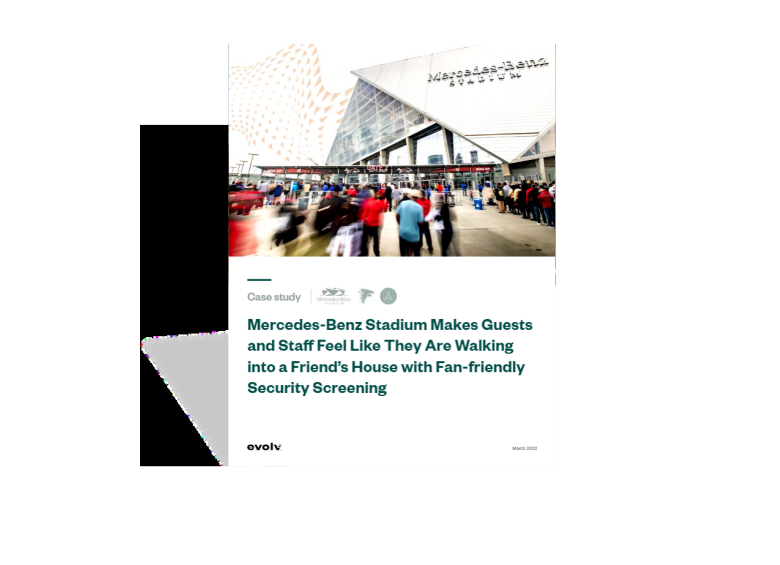
Mercedes-Benz Stadium Makes Guests and Staff Feel Like They Are Walking into a Friend’s House with Fan-friendly Security Screening

When Mercedes-Benz Stadium in Atlanta, Georgia opened in 2017, fan experience was at the very center of its design. Since then, the stadium is known for its state-of-the-art look, with the world’s largest scoreboard, over 4,000 miles of fiber optics connections, and more. “Our objective is to make attending events at Mercedes-Benz Stadium feel like you’re walking into a friend’s house—to a place you belong or even own,” notes Karl Pierburg, Chief Technology Officer at AMB Sports and Entertainment, the parent company of the Atlanta Falcons, Atlanta United, and Mercedes-Benz Stadium. In 2019, the security team embarked on an initiative to enhance the Mercedes-Benz Stadium guest experience further by transforming arrival and entry and landed on Evolv Technology. Through implementing Evolv Express, Mercedes-Benz Stadium was able to achieve the following and more:  

  • 90%+ of fans express satisfaction with ingress experience, a 3x improvement.
  • Went from an average of 40% of people being flagged for secondary bags checks to 6% to 12% with Express.
  • Dramatically improved security staff experience, morale, and retention.

Case Study Video

Watch how Mercedes-Benz Stadium Makes Guests and Staff Feel Like Secure with Fan-friendly Weapons Screening

Read the case study to learn how you can start your journey to a more secure and guest-friendly security screening solution in stadiums today.

Download NowLearn More

Download the infographic to see a snapshot view of the stadium’s goals and outcomes to learn how you can do the same.

Download Now

View more of our case studies on our resources page here.

Engaging the Evolv Express® System and Evolv Insights® for Ticketing Venue Security Screening

Summary

Ingress security screening remains a significant pain point for most ticketing venues. Fans and patrons want touchless, frictionless experiences, and ticketing venues want to give that to them. At the same time, ticketing venues must ensure the safety and security of fans and patrons by instituting appropriate security measuring— which includes security screening. But these legacy approaches to weapons screening are simply not a good fit for several reasons.

In this whitepaper, we outline 11 ways to use security screening data from Evolv Insights® and improve fan and guest experience – and better security

Legacy Security Screening Fails at Fan and Patron Experience

Legacy walkthrough and hand-wand metal detectors are a significant hurdle. They cannot scale to meet the volumes of fans and patrons who need to be screened. A large percentage of security alarms are false positives, prompting fans and patrons to pass through secondary security screening. Lengthy lines form in front of event entrances, which frustrate fans and patrons and create additional security risks. At the same time, unable to get fans and patrons into the venue, organizations lose opportunities for additional revenue from concessions and
different retail stores.

Fill out the form to download this whitepaper and learn more about the current holes in traditional security and how Evolv Express® can help address those areas.

New Standards in Physical Security

Many of the security screening standards in use today were put in place decades ago. They addressed the threats at the time and employed the security screening equipment that was available. The threat landscape has changed, and the breadth of vulnerable venues has expanded, yet the predominant security screening technologies in use today are still the ones developed decades ago. Evolv Technology co-founders Mike Ellenbogen and Anil Chitkara virtually sit down with our guest speaker Chuck Marino, CEO of National Security Export and Consultant Sentinel Security Solutions, LLC to discuss this new landscape, and ultimately what new security technology is needed to address this shift.

The Case for a New Standard in Physical Security

As our threat environment rapidly changes, our security standards are being left behind. Developed nearly fifty years ago and barely updated since then, current standards for metal detector technologies can’t keep up with all the metal objects we carry with us every day — and it shows.

In this infographic, learn the impact on guests, security professionals, and entire industries when old standards aren’t renewed in the face of advancing technologies – and an advancing threat environment – and see why the time has come for a new standard in physical security.

Download Now

Whitepaper: The New Standard for Weapons Detection

Summary

Physical security is always about more than detection technology alone. Security screening involves an integrated system of people, processes, and technologies that work together to address the threat in a specific operating environment. And defining the right technology to balance physical safety and guest experience relies on understanding how it fits within this broader system. While the right technology can harmonize with the people and processes that deploy it and thereby improve physical security, the wrong technology can in fact hinder the important work of safeguarding the public, putting an undue burden on security teams and increasing the risk of physical harm.

Every operating environment is unique, which is why re-evaluating what worked for airports, prisons, and municipal buildings is so critical to understanding the right security solutions for significantly different types of venues, their unique visitors, and the potential threats they may encounter. Critically examining historical standards based only on the technologies available at the time is the first step in this re-evaluation.

The next step?

A new standard that is better aligned to more types of venues, their business goals, their visitors, and their security needs. By exploring what’s possible with modern technology, what’s operationally sustainable for the people and processes across security teams, and how the system as a whole can better meet its objectives, venues can address the needs of both their employees and the visiting public alike, all while maintaining the high standards of weapons detection required to prevent the catastrophic loss of life.

Fill out the form below to download this whitepaper and learn about the new standard for weapons detection.

eBook: The New Standard – A Security Technology Buyer’s Guide

Technology is advancing, changing the threat landscape from what it looked like decades ago when current standards for metal detectors were authored.

Our standards should be advancing, too. It’s time for a new standard: one that updates the requirements for the technologies protecting our venues, acknowledges the demand for a great guest experience, and removes the burden on security teams to visually distinguish everyday metal objects from weapons.

Today’s technology extends from machine learning and artificial intelligence onboard devices to cloud connectivity, data analytics, remote device management, and mobile applications.

Fill out the form below to download the eBook and learn the impact of a new standard for modern technologies in physical security, and how world-class venues can use this new standard to inform the selection and deployment of new technologies for physical security today—and well into the future.

New State-of-the-Art Lower.com Field Delivers Unparalleled Fan Ingress Experiences with Evolv

Just a few years ago, the future of the Major League Soccer (MLS) club Columbus Crew looked bleak. The current owner of the Crew wanted to relocate the club to Austin, Texas. A group of avid fans formed #SavetheCrew and fought to keep the club in Columbus—and won. “The Haslam and Edwards families wanted to build an unparalleled fan ingress experience from the very start—and that is exactly what we did with breakthrough technologies like those from Evolv, Brandon Covert, VP of IT, Haslam Sports Group. By enabling Evolv Express®, Lower.com Stadium has been recognized as delivering the best fan ingress experience in the country and was able to achieve the following:  

  • Processed 80% of fans (16,000) entering the stadium through one gate in 20 minutes
  • Detected “ghost” weapons made with 3D printers
  • Delivered touchless, self-service fan ingress – from ticketing to security screening

Case Study Video

Watch how new State-of-the-Art Lower.com Field delivers unparalleled fan ingress experiences with Evolv

Read the case study to learn how you can start your journey to a more secure and guest-friendly security screening solution in the sports industry today.

Download Now

Download the infographic to see a snapshot view of the organization’s goals and outcomes to learn how you can do the same.

Download Now

View more of our case studies on our resources page here.