Digital Threshold News: Episode 2 Recap

In the second episode of Digital Threshold Live, “Trust and Confidence: The Foundation of Delivering an Exceptional Visitor Experience,” host Anil Chitkara, Evolv Technology Co-founder and Head of Corporate Development, was joined by Jason White, Managing Director of Corporate Safety and Security for Hershey Entertainment and Resorts.

Episode 2 Highlights

Hershey Entertainment and Resorts has done an excellent job navigating the COVID-19 pandemic. The company proactively discussed procedures at the start of the new year before COVID-19 really made its way to the United States, keeping the safety of its staff and customers at the forefront of risk management and business continuity strategies.

Chitkara and White discussed a variety of topics related to public safety, public health, the customer journey and the path back to normal, including:

  • Safely reopening in the wake of the pandemic, including technologies and strategies helping to make that possible.
  • Creating a touch-free, contactless environment using technology such as Evolv’s touchless security screening systems.
  • Safeguarding guests and employees with rigorous safety protocols, including temperature checks and COVID questionnaires as a health defense at each entrance.
  • Balancing uncompromising security and an outstanding guest experience.
  • Being prepared for inevitable staff quarantines and making sure Hershey Entertainments and Resorts was not short-staffed.
  • Having a plan in place as health protocols and dynamics shift. “We have very, very strict and very detailed exposure response plans that have worked very well for us to the point where we’ve had no cases of community spread within HE&R, which is something we’re very proud of,” White said.

You can view the OnDemand version of the webcast by clicking on the video below.

On November 12, 2020, we’ll host the third episode, A Data-Driven Look at the Pandemic with Erica Parker, Managing Director at the Harris Poll, register here. We hope to “see” you there. In the meantime, consider us as a security resource, click here to contact us.

To view our OnDemand version of Episode 2 or register for future episodes of Digital Threshold Live, click here.

Don’t have time to watch? Click here to listen to the podcast.

A Data-Driven Look at the Pandemic

Erica Parker, Managing Director at the Harris Poll, joined host Anil Chitkara to discuss public opinion on critical issues and trends related to COVID-19 and the pandemic’s effects on all aspects of society and business. Indeed, the future is not clear, so getting real data to share in these uncertain times is a valued commodity.

“We conducted a quantitative survey online from September 18th to October 3rd,” Parker said. “We interviewed a total of approximately 1,500 US adults across three key segments who have a key stake in the security screening process. In those three groups, we had approximately 700 parents of school-aged children, approximately 500 workers who work in large factories, warehouses, distribution centers, and approximately 500 folks who attended an event at a ticketed venue in 2019. This (survey) represents roughly 60% of the US population.”

One issue that is top of mind for everyone in the survey was the pandemic. But one of the other things that most concerned people was the risk of a mass shooting event. “We’ve seen a lot of interactions of different crises over these six months,” Parker said. “That’s important to think about that holistic environment that we’re operating in right now.”

Harris Poll launched a weekly tracking study at the beginning of the pandemic to share data about COVID-19 as a public service. “We’ve been tracking public sentiment on a range of topics as they come up,” Parker said. “Anything from the economy to healthcare, to jobs, and education, as the crisis continued to unfold.”

During the pandemic, fear remains a constant in the public’s mind, and it ranged from fear of the virus to fear over losing one’s job, with both concerns hovering around 52%. But the fear of returning to public activity is higher at 70%. “In the work that we’ve been doing across a variety of different industries, we speak with many businesses trying to figure out how to tackle this fear and help to restore public confidence in these particular activities.”

About Evolv Technology

Founded in 2013, Evolv Technology is the leader in human security solving the security screening problems of today with the most innovative technology and thinking. Evolv makes it possible for venues of all kinds to keep visitors and employees safe from concealed weapons, pandemic health threats and intruders.

Digital transformation is unlocking efficiency and value everywhere as organizations reimagine archaic processes and technology, better equipping themselves with interoperable and flexible capabilities. Within the Digital Threshold vision, venues and facilities can intelligently use data to create a frictionless experience for guests and employees. The result is an entry process that enhances the overall experience instead of diminishing it as it so often does today. Making weapons screening faster and more precise is part of the Digital Threshold vision, but it’s just the beginning.

A Data-Driven Look at the Pandemic

Erica Parker, Managing Director at the Harris Poll, joined host Anil Chitkara to discuss public opinion on critical issues and trends related to COVID-19 and the pandemic’s effects on all aspects of society and business. Indeed, the future is not clear, so getting real data to share in these uncertain times is a valued commodity.

>>

A Data-Driven Look at the Pandemic Featuring Harris Poll Research

Erica Parker, Managing Director at the Harris Poll, joined host Anil Chitkara to discuss public opinion on critical issues and trends related to COVID-19 and the pandemic’s effects on all aspects of society and business.

A Data-Driven Look at the Pandemic Featuring Harris Poll Research

The Harris Poll: Americans Demand Touchless Security Screening to Feel Safe Again at Ticketed Venues, Workplaces and Schools

November 12 Webcast with Evolv Technology and Harris Poll Executives Set to Review Implications for Venue and Facility Operators

WALTHAM, MA, November 3, 2020 – Grappling with risks prompted by COVID-19 and escalating violence, Americans prefer modern, touchless security screening systems over legacy metal detectors. They expect their schools, workplaces and ticketed venues to ensure social distancing and would abandon their plans rather than enter a facility with crowded security lines.

These and other insights were released today by Evolv Technology based on a new survey conducted by The Harris Poll. The survey was conducted online with more than 1,500 American adults who have a personal stake in the security screening experience: consumers who attended ticketed events in 2019 (n=506), parents of school-aged children (n=712), and workers at large factories, warehouses and distribution centers (n=504)[1].

Americans rate COVID-19 and the overall pandemic response as a top issue facing the country (83% say they are very or somewhat concerned). This did not, however, diminish their concerns about social violence, responding that they are very or somewhat concerned about mass shootings (83%), street crime (81%) and protest-related civil unrest (81%). All three groups believe that the risk of public violence is getting worse (70%) and nearly 3 in 10 (28%) express that they felt unsafe going out in public.

Nearly 7 in 10 (69%) Americans value the general sense of safety that physical security measures provide, and over half (54%) believe there is deterrent value in those measures. Significant majorities also agree, though, that traditional metal detector screening measures introduce unacceptable risks in the pandemic environment. Nearly 8 in 10 (79%) feel that metal detectors create long lines, and two-thirds (67%) feel that metal detectors create crowds that violate social distancing guidelines. A majority also believe that metal detectors require belongings to be touched by a security guard (70%), require pat down searches (52%), generate too many false positives (58%) and force families to separate during screening (57%).

When asked to consider how specific safety and security measures affected their likelihood of returning to venues and facilities, nearly 9 in 10 (87%) of Americans said were likely to return if touchless security screening was in place. A majority of Americans surveyed say they would prefer touchless security screening (52%) over metal detector screening (48%) if given a choice between the two at identical events. Touchless security screening that allows visitors to walk through with bags and pocket contents intact was preferred over metal detector screening that requires separate bag checks and emptying pockets before screening.

“For most venues and facilities, COVID-19 marks the end of the era for traditional metal detector security screening,” said Evolv Technology CEO Peter George. “The pandemic has pushed frustration with crowding and hands-on bag checks beyond the boiling point. However, there is a way forward. Visitors are saying they’ll come back to venues if they see security screening that preserves social distancing. Our customers are successfully reopening with touchless security screening and everyone is loving the new experience.”

Evolv Technology Co-founder Anil Chitkara and Erica Parker, managing director at The Harris Poll, will review the research results and discuss the implications for workplaces, schools, ticketed venues and other facilities on the November 12 episode of Evolv’s Digital Threshold Live webcast series. Learn more and register here.

Evolv is leading the digital transformation of physical security, one that is touchless and addresses the ‘new normal’ threat of pandemic viruses as well as concealed weapons. Using AI software and powerful sensors, Evolv Express® can screen up to 3,600 people per hour – 10 times faster than legacy approaches such as metal detectors, hand wands and manual inspections. The system enables social distancing at entrances and other security checkpoints while minimizing person-to-person interaction—requiring no stopping, no emptying of pockets or removing bags. People being screened simply walk through naturally, alleviating potential crowding and long lines while greatly reducing contact between guests, employees and security staff.

Deployed worldwide, Evolv’s touchless security screening systems have been used to screen more than 50 million individuals in an expedient, respectful manner. Customers include Six Flags Entertainment Corporation, L.L. Bean, Wynn Las Vegas, Oakland International Airport, two South Carolina school districts, Hersheypark, Set Jet, the Biltmore Estate, Pittsburgh Symphony Orchestra and hundreds of others. By using Evolv Express, organizations optimize the performance of their security teams while reducing screening expenses by as much as 70%.

Survey Methodology

This survey was conducted online within the United States by The Harris Poll on behalf of Evolv Technology from September 18 – October 3 among 1,502 U.S. adults ages 18 and older who are parents of school-aged children (n=712); work in large (at least 100 on-site employees) factories, warehouses, or distribution centers (n=504); or who attended an event at a ticketed venue in 2019 (n=506). This population represents approximately 60% of the US general population. Results are weighted to be representative of population under study based on US census population targets on education, age-gender, race/ethnicity, region, and income. For more information about the survey, please contact Jeff Whatcott at media@evolvtechnology.com.

About Evolv Technology  

Evolv Technology provides touchless security screening systems that ensure safety without sacrificing the visitor experience. The company’s latest product, coupled with a thermal imaging package, spots concealed weapons and potential virus infection threats using advanced digital sensors and artificial intelligence that is incredibly accurate, discreet and delivers significantly more throughput than older technologies. Evolv Express® has earned industry accolades such as the 2020 Edison Awards™, two Campus Safety 2020 BEST Awards, and Campus Security & Life Safety magazine’s Secure Campus 2020 Awards. Evolv’s customers include hundreds of outdoor entertainment venues, stadiums, large-scale events, cultural landmarks, corporations and warehouses, schools and hospitals around the globe. Led by a team of security industry thought leaders with a track record for delivering first-to-market products, the company holds more than 100 patents. Evolv’s investors include Bill Gates, Florida Governor Jeb Bush’s firm, Finback Investment Partners, DCVC (Data Collective), General Catalyst Partners, Lux Capital, SineWave Ventures and STANLEY Ventures. The company’s partners include STANLEY Security and Johnson Controls. For more information, visit https://evolvtechnology.com.

About The Harris Poll
Founded in 1963 by pollster Lou Harris, The Harris Poll is one of the world’s leading public opinion, social intelligence and strategy firms. Through continuous pulsing of society in the U.S. and internationally, Harris helps clients interpret, adapt and respond to constantly changing issues. Widely recognized for its polls and insight on voter sentiment, The Harris Poll also leverages bespoke polls to advise Fortune 500 C-suites on how to meet the evolving needs and wants of their customers and other stakeholders.

In 2017, The Harris Poll joined the Stagwell Group to create the largest independent data-driven digital market services firm in the U.S. The Harris Poll is run by co-CEOs Will Johnson and John Gerzema, two veteran strategists with backgrounds in analytics and brand marketing from senior roles at WPP agencies BAV Consulting and Young & Rubicam.


[1]As a whole, this group is referred to as “Americans” in this report. Some respondents classified in multiple groups, and so the sum of the categories is greater than the total number of respondents.

-###-


PR Contacts:

Evolv Technology
Jeff Whatcott
media@evolvtechnology.com
(617) 209-9926


CHEN PR for Evolv
Jennifer Torode
jtorode@chenpr.com
(781) 672-3119

The Current Threat Environment and the Need for a Layered Security Strategy – Keynote Presentation

Evolv Technology was a proud sponsor of the Counter Terror Business 365 Virtual event on October 8, 2020. During the virtual event, Nathan Bailey, Evolv Technology Sales Director of EMEA, gave a keynote presentation where he discussed the current threat environment, the need for touchless security screening in this new normal and how Evolv can help keep venues and facilities safe from terrorists and pandemic health threats worldwide.

Watch other CTB365 event presentations, including the final Panel Discussion & Round-up featuring: Philip Ingram, Figen Murray, Rick Mounfield, Paul Jeffrey, Gary Simpson, Nick Aldworth and our own Co-founder, Anil ChitkaraClick here.

ABOUT NATHAN BAILEY:

Sales Director, EMEA – Evolv Technology
For twenty plus years, Nathan Bailey has been a recognised leader in the security sector. From a young inspired engineer working on vehicle explosives detection systems to running a company providing the best technology to combat contraband and weapons from entering prisons and courts, Nathan has never wavered from the mission of keeping people safe.

At Evolv, he has responsibility for market development and customer success across Europe. Nathan has worked with some of the world’s most recognized sports clubs and event operators, bringing the full breadth of his screening systems expertise to organisations committed to physical and health safety.

ABOUT EVOLV TECHNOLOGY

Evolv Technology provides touchless security screening systems that ensure safety without sacrificing the visitor experience. The company’s latest product, coupled with a thermal imaging package, spots concealed weapons and potential virus infection threats using advanced digital sensors and artificial intelligence that is incredibly accurate, discreet and delivers significantly more throughput than older technologies. Evolv Expres® has earned industry accolades such as the 2020 Edison Awards™, two Campus Safety 2020 BEST Awards, and Campus Security & Life Safety magazine’s Secure Campus 2020 Awards.

Evolv’s customers include hundreds of corporations, airports, schools, cultural landmarks, hospitals, outdoor entertainment venues, stadiums and large-scale events around the globe. Led by a team of security industry thought leaders with a track record for delivering first-to-market products, the company holds more than 100 patents. For more information, visit https://evolvtechnology.com

VIDEO TRANSCRIPT

Hi my name is Nathan Bailey – Sales Director for Evolv technology and it’s my pleasure to be able to speak to you today and talk to you about the current threat environment, the need for a layered security strategy and a little about our products and services that have been widely used across the world today.

Before I begin, I’ll give you a little background about Evolv Technology…

Evolv was founded on the belief that everyone deserves to live, work, learn and play in a safe environment; free from terrorist activity, free from attack and free to live life to the fullest without fear.

Evolv technology was founded in 2013 and since then has grown to become the leader in touchless security screening technology across the US and following this success is developing and growing throughout the world today.

We’ve seen over the last few years just how much the world is changing, with extremism moving from well-organized terror cells such as al Qaeda to your local activist who are radicalized through online propaganda

We’ve seen attacks such as the Paris shootings, London Bridge attacks and Parsons green tube station to name just a few, we can see that these attacks come in many forms and from many mediums and now to top it all off we have a biothreat, to which the industry has been crippled.

As we have heard from Figen and Nick today we need to learn from these tragic events in the past to make things better for the future. With the new legislation coming out, every venue must do what is right to secure the public, the venue and their staff, from becoming a victim to such attacks.

We must seek at all levels to provide the best we can at every moment because one life lost is one too many.

Now there is no silver bullet to any of the challenges we face but we believe that one right step at a time and with the right approach we can improve and reduce the number of attacks the adversary inflicts.

The combination of an unprecedented number of weapons and unprecedented levels of anxiety and depression creates an unprecedented danger. We are living in an era of armed anxiety. Even though people are not gathering at scale today, that will change someday soon. Any gathering or workplace could be the next target. Any employee or visitor could suddenly erupt into the next violent threat. Any fan could reach their breaking point during an argument in your stands.

It could happen anywhere at any time.

So, when we look to the future and consider reopening the doors once again to the public, to our fans and visitors, we must consider that the attitude will be different, some people will be anxious about returning to larger gatherings not just because of the Biological threat but also the very real terror threat, and so as a company we aim to provide a solution that enables venues to reopen its doors with confidence, to provide a platform which is inviting to the visitors, fans and public. A system which reduces human to human contact and at the same time prevents weapons of mass destruction from entering. 

Reopening your venues will bring many challenges just, as we have heard from the guest speakers so far today and having worked with many sports stadiums, Event Arenas, theme parks, exhibition centers and conference halls , museums, hospitals and performing arts venues across the world prior to and during the COVID-19 Pandemic we understand just how difficult it is to plan for the new future. It’s important to remember, while you look to create a safer environment from biological threats, you cannot let your guard down on public safety related to weapons threats. You have a duty to protect all who enter from both public safety and public health.

We have heard from Rick Mountfield on the role of the security officer and I wanted to say that in almost all client engagement I have had over the past 6 months or so, staffing is one of the biggest concerns, with the ever increasing terror threat and now with the COVID-19 Bio threat, we have seen a large decline in the number of security personnel available and I’m sure that this has crossed your mind when looking at your reopening plans?

Because our Evolv Express system is capable of such a high flow rate for screening it replaces in excess of 10 to 15 metal detectors depending on your operational layout and as such reduces the number of security guards required to operate.  This in turn allows our clients to reduce their security teams considerably, save a huge portion of costs and then reinvest in retraining and repurposing the additional head count to perform other duties such as crowd management and behavioral detection, or you can look at getting canine teams in or use the money for additional screening systems… or simple save money and reduce your overheads.

Express enables fast, respectful, touchless screening for your security teams, fans, and patrons; No longer are people required to divest their personal belongings before passing through security, No longer does the security officer have to carry out additional metal wanding or pat downs to every person who walks through which infringes on personal space and puts both the officer and visitor at a greater risks of human to human contact. With a screening capacity of more than 3600 people per hour, the Evolv Express provides free-flow screening at the pace of life, and with its proprietary artificial intelligence platform, Express is able to differentiate between every day personal items like cell phones, keys and coins and Mass casualty Weapons.

I could talk all day about our system and its performance but I won’t, I hope you have a great time in session 2 and as I say goodbye I’ll leave you with this video which shows everything I’ve spoken about. If you want to learn more or talk to us, then please connect with me or one of the team after the show…

Digital Threshold News: Introduction & Episode 1 Recap

Welcome to Digital Threshold News. In this newsletter, we’ll keep you up-to-date on all the latest insights and thought leadership from our Digital Threshold Live webcast series and podcasts.

These webcasts and podcasts give us the opportunity to bring you the latest industry trends and lessons learned from professionals and practitioners who are at the intersection of venues and technology to keep you ahead of the curve. The goal is to give you specific, targeted actions you can bring back to your organization and inspire you to think about how the future of the industry is taking shape.

In the first episode of Digital Threshold Live, “Safely Reopening New York’s Art Venues in a Pandemic,” host Anil Chitkara, Evolv Technology Co-Founder and Head of Corporate Development, was joined by three impressive industry guests:

Alongside many of New York City’s cultural institutions, these leaders formed a coalition of sorts to bring together the city’s brightest minds in the face of the daunting task of navigating the COVID-19 pandemic and, now, reopening efforts aimed at creating a safer environment in a city accustomed to approximately 60 million tourists annually.

Episode 1 Highlights

Chitkara and the trio of industry leaders discussed a variety of topics relating to public safety, public health, the customer journey and the path back to normal, including:

Venue security and venue reopening are complex topics, but leaders like Prewitt, Schroeder and Slade are developing a roadmap toward a new normal and beyond.

You can view the OnDemand version of the webcast by clicking on the video below.

On October 22, 2020, we’ll host the second episode, Trust and Confidence: The Foundation of Delivering an Exceptional Visitor Experience with Jason White, Managing Director of Corporate Safety and Security, register here. We hope to “see” you there. In the meantime, consider us as a security resource, click here to contact us.

To view our OnDemand version of Episode 1 or register for future episodes of Digital Threshold Live, click here.

Don’t have time to watch? Click here to listen to the podcast.

Hershey’s Technology Allowed It To Adapt During the COVID Pandemic

Jason White, Managing Director, Corporate Safety and Security for Hershey Entertainment & Resorts, joins Evolv Technology Co-Founder Anil Chitkara for a conversation about how the coronavirus pandemic changed security at Hershey’s theme parks and resorts.

Hershey’s Technology Allowed It To Adapt During the COVID Pandemic

5 minutes with Peter George – The rise of physical security screening technology

null

The pandemic has made one thing clear for security professionals across the globe, there is no going back to the old analog, invasive security screening methods we’ve used for decades such as metal detectors, hand wands and pat downs.

Evolv Technology CEO, Peter George, recently talked with Security Magazine where he called upon his decades-long track record in the cybersecurity industry to discuss how physical security is entering that same digital transformation.

In this interview, you’ll hear Peter discuss why the future of people screening must be touchless and digital in order to deal with the realities of today’s threats from weapons and viruses, and, while it’s impossible to specifically predict every new threat, digital technology makes it possible to reduce the window of exposure and minimize disruption. That’s what Evolv’s Digital Threshold vision could deliver, creating Agile Readiness.

Read the full interview.

Safely Reopening New York’s Art Venues in a Pandemic

On the Digital Threshold podcast, industry leaders will provide insights regarding how modern venues and facilities are reimagining the arrival experience – and how innovations are elevating that journey.

In this debut episode, three guests with firsthand experience in reopening New York City for business in the wake of the COVID-19 pandemic joined host Anil Chitkara, Evolv Technology Co-Founder for a discussion on what they’ve learned from that experience and how those lessons might help craft future-proof best practices at the intersection of venues and technology.

Keith Prewitt, Chief Security Officer at the Metropolitan Museum of Art, Lisa Schroeder, Director of Finance at Lincoln Center, and Thomas Slade, Senior Security Director at the American Museum of Natural History, help oversee institutions that account for about 16 million visitors during a typical year. That makes each extremely qualified to provide useful tips and strategies for engaging in a successful reopening.

The three venues were part of a cultural consortium of sorts that helped spread best practices and strategies that were working as the pandemic progressed.

“I think one thing we all feel in New York City is the strong sense of community,” Schroeder said. “We all want places to open, and we all want to be safe. We take a lot of pride in that.”

While each individual space required its own unique strategy for adapting to the constraints of the pandemic, one thing was shared – a need for agility. Many venues didn’t expect the pandemic to linger as long as it has, and that required continuous work to remain flexible in the face of a shifting environment and regulatory pressure.

Specific technologies have also played a role, from thermal scanners and contact tracing methods to enhanced entrance screening and more. One of the most critical aspects, the trio said, was to thoroughly vet vendors who might have rushed to market to capitalize on the pandemic and uncertainty.

About Evolv Technology

Founded in 2013, Evolv Technology is the leader in human security solving the security screening problems of today with the most innovative technology and thinking. Evolv makes it possible for venues of all kinds to keep visitors and employees safe from concealed weapons, pandemic health threats and intruders.

Digital transformation is unlocking efficiency and value everywhere as organizations reimagine archaic processes and technology, better equipping themselves with interoperable and flexible capabilities. Within the Digital Threshold vision, venues and facilities can intelligently use data to create a frictionless experience for guests and employees. The result is an entry process that enhances the overall experience instead of diminishing it as it so often does today. Making weapons screening faster and more precise is part of the Digital Threshold vision, but it’s just the beginning.

Safely Reopening New York’s Art Venues in a Pandemic

On the Digital Threshold podcast, industry leaders will provide insights regarding how modern venues and facilities are reimagining the arrival experience – and how innovations are elevating that journey.

>>

The Rise of the Digital Threshold

The New Normal

Throughout this global pandemic period I’ve had many conversations with leaders responsible for people screening at live sports and entertainment venues, workplaces, schools, houses of worship, and outdoor theme parks across America. We’ve all felt a pandemic anxiety. Along with our heroic first responders, few feel it more acutely than these men and women responsible for helping people safely gather in a time when the act of gathering itself has become a mortal threat. Their entire world was shut down and is now in the process of reformatting and rebooting.

Most of the security leaders I am talking with are struggling with how to reopen safely, attract visitors, and stay open indefinitely. One thing I know for sure: there will be no going back to the old screening procedures. Why? Because three waves of change are combining to crest and crash down on the thresholds of their venues at the same time. The future of people screening will be quite different indeed, but it will be much, much better—at least for those who learn to adapt.

So, what are these three waves of change? They are the Normalization of Pandemics, Armed Anxiety, and the Digital Transformation of Physical Security. Let’s look at each in detail.

Wave 1: Normalization of Pandemics

Pandemic viruses turn unwitting visitors into weapons. COVID-19 has weaponized people in a way never seen before. Everyone now knows that packed crowds and human contact multiply the danger. Visitors and employees are looking at every venue and workplace with new eyes and formulating an internal risk score based on what they see. They are highly sensitized and are looking for evidence that the operators “get it” and have taken action. They don’t always know what they should expect, but they absolutely will expect security screening to be visibly different. COVID-19 has changed the risk profile of gatherings forever. A pandemic-aware security posture is the new normal.

Traditional high-touch entry screening is obsolete. Helping visitors feel safe in the new environment while delivering a financially sustainable entry throughput is just not possible with old metal detectors, manual bag inspections, and the resulting crowds. Along with new regulations and mandated protocols that venues must abide by, visitors and employees now also want to see a very orderly, safe, and socially-distanced people flow. A touchless visitor experience is part of the new normal.

A pandemic-aware security posture is not some passing fad. There have been six serious pandemics in just the last two decades: SARS, MERS, avian flu, swine flu, Ebola, and now COVID-19. Will there be more? Absolutely. Every physical security team must now develop the ability to adapt to future pandemics that are certainly on the way. Ongoing pandemic readiness is part of the new normal.

Evolv Technology customers, such as Six Flags and Hersheypark, have adapted to the pandemic by rolling out a new comprehensive health and safety plan for reopening their amusement parks. In the case of Six Flags, they’ve added thermal imaging for identifying guests with elevated body temperature and Evolv’s touchless security screening as part of their social-distancing procedures. We believe this is the beginning of a new trend of multi-threat screening that is changing venues and guest experiences forever.

Wave 2: Armed Anxiety

Research shows that there are as many as 393 million privately owned guns in circulation in the United States. The recent pandemic has spurred a new surge in gun purchases. More guns were sold in the first eight months of 2020 than were sold in all of last year. While most crime has significantly declined during the pandemic, shootings and killings remain at pre-pandemic levels.

Soon after pandemic lockdown orders started to lift, there was a venue-targeted active shooting incident in Arizona, and other active shooter incidents in Kansas and Texas. In 2020 the U.S. is on track to have an all-time record year for mass shootings, having reached the 2019 total of 417 on September 2, with four months still left to go.

The fact that shooting incidents persist amid the pandemic is unsurprising when we consider the historic levels of depression and anxiety that people are experiencing right now. The CDC reports that 40% of U.S. adults reported struggling with mental health or substance abuse during the pandemic—with the prevalence of anxiety being three times higher and depression four times higher than the same period last year.

The combination of an unprecedented number of weapons and unprecedented levels of anxiety and depression creates an unprecedented danger. Even though people are not gathering at scale today, that will change someday soon. Any gathering or workplace could be the next target. Any employee or visitor could suddenly erupt into the next violent threat. It could happen anywhere at any time.

Wave 3: The Digital Transformation of Physical Security

Outside the physical security world, businesses in every industry are unlocking efficiency and value by digitizing old manual and analog processes. They are re-imagining their organizations and operations in a future defined by software, data, sensors, mobility, networks, machine learning, automation, and analytics. It isn’t change for the sake of change; it’s change to allow the business to perform better in the modern world and be ready to respond more quickly to change in the future.

Anheuser-Busch InBev is using machine learning to help bars create more accurate orders, resulting in better customer satisfaction. Walmart is using shelf-scanning robots to optimize inventory performance. Black & Decker is using networked sensors to track the movement of materials in factories to increase labor efficiency and quality.

Is digital transformation worth the effort? Yes, with the greatest rewards going to those who start early and do it right. Across all industries, digital leaders clearly outperform the laggards in their industry in both growth and profitability according to recent Bain & Company research:

After comparing financial results for five categories of companies based on their degree of digital maturity, Bain found that revenues for the digital leaders grew 14 percent over the past three years, more than doubling the performance of the digital laggards in their industries. Profitability followed a similar pattern—83 percent of the leaders increased margins over that period while less than half of the industry laggards did so.

Unfortunately, physical security stands out as a laggard in digital transformation—especially when compared to the modern cybersecurity best practices that I am used to. Consider the findings of Accenture and Microsoft in their recent survey of physical security leaders:

“We found that although security leaders see the opportunity to enhance risk management with digital capabilities, the industry is at various levels of maturity, and at worst is a decade behind. Respondents identified “reactive threat management” and “intuition-led decision-making based on subjectivity” as the two leading challenges facing physical security operations today. These challenges—operating reactively and improving decision-making—make it difficult to be proactive. This puts your people, brand and reputation at risk.”

It’s not surprising that physical security managers are worried about “reactive threat management” and “intuition-led decisions” when their security screening technology hasn’t fundamentally changed since the 1920s and is completely devoid of digital data. Old analog metal detectors, hand wands, and manual bag inspections are artifacts of a pre-digital age. Weapons screening sometimes feels like the land that time forgot.

Today’s lack of modern technology in physical security operations has created an undue reliance on security staff. The security officers are burdened with an ever-growing list of tasks: watch out for bad behavior, answer guest’s questions, handle minor incidents, and clean up the physical space, in addition to the core screening role of manually checking everybody entering for prohibited items. There are simply too many things for any one security guard to manage.

Things could not be more different in the cybersecurity part of the business. Because cybersecurity was born inherently digital, cybersecurity professionals are immersed in oceans of digital data and refined pattern recognition based on cutting edge artificial intelligence. They have deep and meaningful analytics and real-time threat intelligence that help them adapt to new threats, in real time, and continuously tighten their perimeter.

The Rise of the Digital Threshold

How long will it be until we close the gap between the digital haves in cyber and the digital have-nots in physical security? It’s already happening. A new vision and technology architecture are emerging. We call this vision the Digital Threshold. The Digital Threshold vision applies the proven patterns of digital transformation and cybersecurity to everything that happens in the space people cross as they enter and exit modern venues and facilities.

Within the Digital Threshold vision, venues and facilities can intelligently use data to create a frictionless experience for guests and employees. The result is an entry process that enhances the overall experience instead of diminishing it as it so often does today.

Making weapons screening faster and more precise is part of the Digital Threshold vision, but it’s just the beginning. What if the entry experience could also seamlessly integrate digital health screening and health credential processing into the screening process? What if electronic ticketing, VIP identification, and BOLO alerts could also be part of the same seamless flow? And what if the Digital Threshold generated useful analytics that enable data-driven decisions about system adjustments and people flows? All of this is part of the Digital Threshold vision that not only addresses the current environment, but also creates the ability to adapt and flex to handle future needs as necessary.

The Digital Threshold as a Technology Architecture

The Digital Threshold is more than just a vision for frictionless entry experiences—it’s a digital technology architecture of components that work together to realize the vision. These components include Sensors, Analytics, and Actions, all on top of the AI Platform.

Sensors

In the Digital Threshold vision, sensors work together to spot multiple threats and to supply useful insights about visitors. Each sensor fills in a different part of the picture. Data from magnetic field sensors make it possible to see the difference between a gun and a smartphone. Thermal imaging cameras provide the raw data that makes it possible to spot people with elevated body temperature—a sign of potential infection. Visible light cameras could gather the imagery needed to count visitors, estimate visitor demographics, and identify visitors as employees, VIP season pass holders, or known threats. Microphones, biometric and credential readers, and other types of sensors could supply added insights about who and what is coming through the Digital Threshold.

As threats evolve and new sensors emerge, the Digital Threshold sensor array can expand as needed. Rather than sending visitors through an obstacle course of standalone technologies, the Digital Threshold allows venues to touchlessly screen for multiple threats in a single concept of operation (CONOP).

AI Software Platform

Digital Threshold sensors produce a flood of raw digital data that must be stored, organized, and turned into meaningful information. That’s where the AI software platform comes in. It’s the brains of the Digital Threshold vision.
AI uses machine learning to spot complex patterns in data. More data and more kinds of data make machine learning models more precise over time. Having multiple digital sensors makes it possible to bring everything together in a way that increases situational awareness.

The core value of the Digital Threshold vision is embodied in software. The hardware is almost incidental and will someday come in many different forms. Instead of installing new hardware to improve accuracy, the machine learning models could be upgraded just like the software on smartphones. This completely changes the game of system upgrades. As the Digital Threshold gets smarter over time, rolling out new capabilities becomes a matter of clicks, not forklifts.

At Evolv, we call our AI software platform the Evolv Cortex AI™. From the beginning we designed Cortex AI to be upgradable and extensible across a wide variety of threats. It’s the brain of all our products and an early expression of the Digital Threshold vision.
Actions

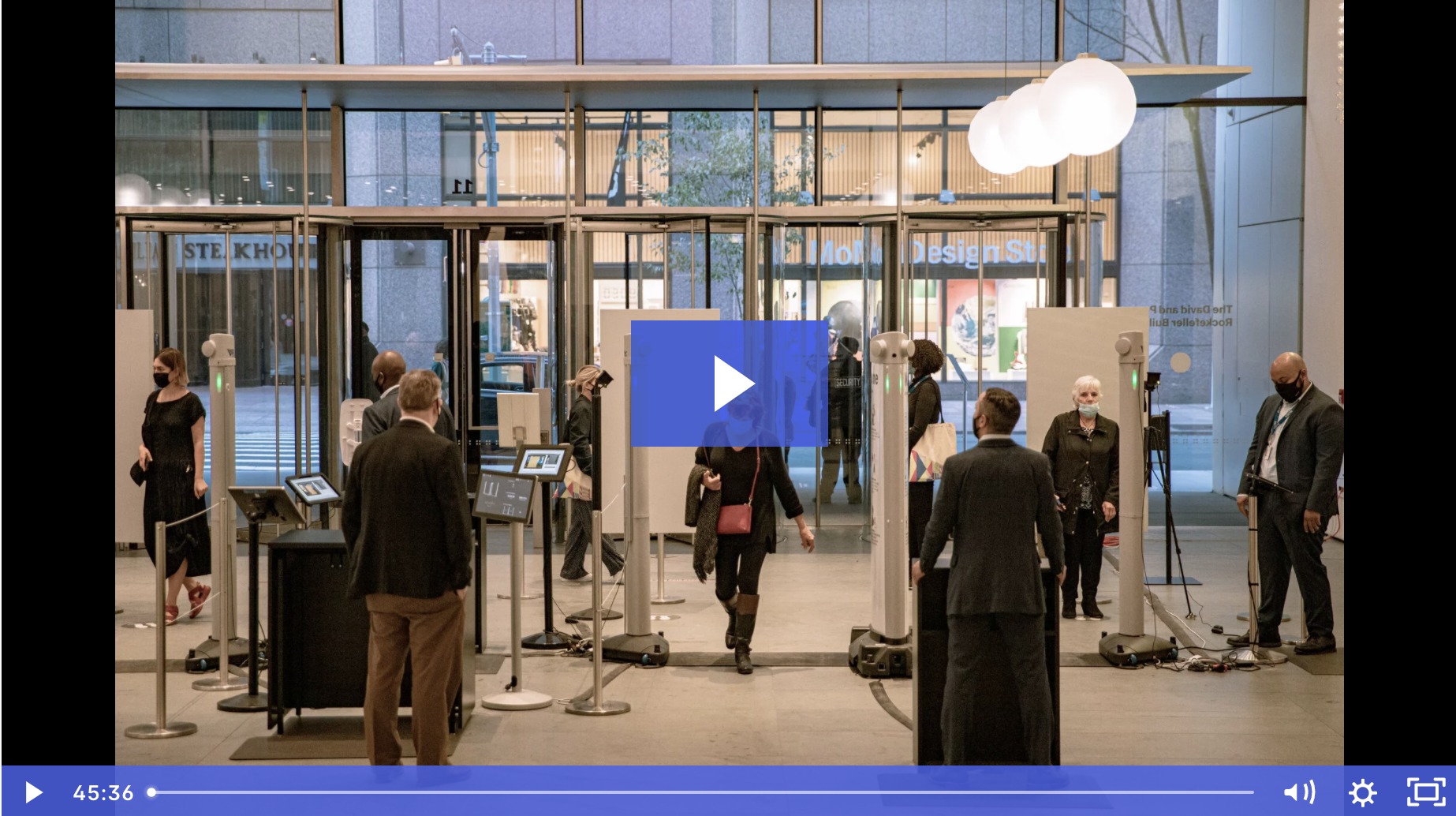
When the AI software platform identifies a problem, imagine if the Digital Threshold action flow engine could spring into action to orchestrate the appropriate response. It’s about much more than beeps and alarms. Imagine if visitors could see a temporary “Slow Down” message when sensors detect crowding that violates social distancing requirements. If a potential weapon is spotted, the visitor might be visually directed to a weapon screening resolution station on the left, while a person with elevated body temperature could be directed to a health screening station on the right. Season ticket holders might be greeted with a “Welcome Back!” display.

Whatever the situation, the Digital Threshold could guide visitors and guard staff with a suitable programmed response. The key word is programmed. Because it would be a software workflow engine, actions could be changed and customized over time without a hardware upgrade. It’s software-defined physical security that could prove to be just as revolutionary as software-defined networking.

Analytics

Because the Digital Threshold feeds on digital data, it could become possible to generate an ever-growing number of useful analytics to help plan and execute a frictionless experience. For example, based on the type of event, day of the week, forecast weather, and current tour of a specific performer, a Digital Threshold-equipped venue manager could potentially answer questions like the following:

  • What time did the arrival rate peak before last week’s event?
  • What is the mix of families and demographics of individuals coming through different entrances?
  • Is entrance throughput consistent with our social distancing guidelines?
  • Which doors seem to attract the most VIPs?
  • What are the demographic characteristics of our visitors by entrance?
  • What is the alarm rate at each entrance?
  • What are the top threats detected at each entrance?

Once the data is in an analytics platform, there is almost no end to the questions we might answer. Remember the Accenture and Microsoft research finding that physical security managers were worried about “intuition-led decisions?” Having powerful analytics could be a huge step down the path to data-driven decision-making. These analytic insights not only keep people safely moving based on their risk profile but also allow for venues to monetize the visitor experience more effectively.

Toward Agile Readiness

These four components of the Digital Threshold come together to transform the screening process to both block today’s known threats and quickly adapt to future threats as they emerge. I call this the state of “Agile Readiness.” Modern venues with agile readiness can quickly flex and surge into whatever comes next.

While it is impossible to specifically predict every new threat, digital technology makes it possible to reduce the window of exposure and minimize disruption. It’s about generating, harnessing, and trusting data to make the most important decisions about safety instantaneously. It’s about maintaining a security posture that engenders trust and confidence among employees and visitors. It’s security that is obvious but low-profile, strong but not invasive, fast but not cumbersome. That’s what the Digital Threshold vision could deliver, creating Agile Readiness.

Software Eats the World of Physical Security

Web pioneer Marc Andreessen has famously claimed that “software is eating the world” and I completely agree with him. The most interesting thing about cars these days is the software that makes them more efficient and safer. The most interesting thing about a watch these days is the software that makes it a fitness and health tracker and an extension of my phone rather than just a timepiece. The hardware of modern technology is still important, but more often only as a vessel for the innovative software it contains.

At Evolv, we are bringing the “software eats the world” phenomenon to security screening, and it’s already creating incredible value for our customers. Our early implementation of the Digital Threshold vision is successfully devouring the old security screening technologies, and it shows no signs of slowing down. It’s also empowering security teams to do an even better job of keeping people safe while optimizing financial and staff resources.

The software platform supplies the brain and connective tissue to integrate capabilities of new emerging technologies that transform the new visitor or fan experienceIt becomes the security platform to seamlessly integrate biometrics, video analytics, crowd intelligence, health posture data, electronic ticketing, and on-demand liability wavers to allow for a frictionless visitor, employee, and fan experience in a post COVID-19 world.

We have made substantial progress in realizing the Digital Threshold vision in the Evolv product line. Customers are telling us we have it right, but in many ways, we are just getting started. There’s a lot of room left to apply artificial intelligence to physical security, including new types of sensors to consider and analytics to create. It’s an extremely exciting time.

Addressing the realities of pandemics and armed anxiety while also developing the potential of digital transformation will require a new approach. We must reimagine these challenges and opportunities in a whole new light, unbound by legacy technologies or preconceived, outdated ideas. Armies of people using old ways of working simply cannot keep the public safe. The old solutions don’t scale wide enough or deep enough to address these threats everywhere they can appear. Much like we’ve seen in other industries, technology can fundamentally bend the curve back in our favor and return peace of mind. And peace of mind is what we all want and deserve, now more than ever.

One Chance to Get it Right

I believe that the realization of the Digital Threshold vision is inevitable, and the time to get started is now. I also believe that the transition will create winners and losers. Facilities that embrace and adapt to the digital future will earn lasting trust and long-term viability and loyalty. Facilities that are slow to adapt may never recover from the resulting loss of business and trust.

If you’d like to join us on the journey toward the Digital Threshold, consider attending our new Digital Threshold Live webcast series. We’ll be speaking with leading experts to explore the business drivers, technologies, and human dimensions of the Digital Threshold vision.