Three Trends Impacting Entertainment Security

In past blog posts, we’ve discussed the need for weapons screening and how to improve security at performing arts venues. In taking a look at the broader entertainment industry as a whole, the conversation around security looks different.

At large concert venues and sports arenas, we often find that security is already a defined and established practice. These venues typically have a dedicated security team, led by a veteran security chief and supported by a series of technologies and procedures. In contrast, we find that many performing arts venues – primarily those that are not located in big cities – are usually at the beginning of their security journey.

While security and the practice of people screening is not new to the entertainment industry, there have been significant developments in the past five years that have impacted how security directors approach securing these venues. As patron experience, speed and increased detection continue to remain paramount in screening, security directors at these venues are starting to ask themselves what they can be doing better.

With that, let’s explore three ways entertainment security has changed and how these venues are looking beyond traditional security processes and procedures to improve security screening and create a more welcoming visitor experience.

Access to Artists Draws Attention to Stalkers

Weeks after wrapping her worldwide Reputation tour, it was revealed that Taylor Swift’s team was using facial recognition technology to scan for potential stalkers at her shows. Unbeknownst to her concert goers who stopped at kiosks to get a behind-the-scenes glimpse of her rehearsals, the system was secretly recording their faces and immediately sending the data to a “command post” in Nashville that attempted to match hundreds of images to a database of her known stalkers. While Swift has started to receive some backlash over the use of the technology, it represents a growing trend in entertainment security: the need to control stalkers.

To-date, the majority of entertainment venues have taken the same standard approach to security – screening the entire general fan population via a manual bag search and metal detectors. However, as celebrities, athletes and artists provide more access to their fans – think paying $200 extra for a meet-and-greet ahead of the show – security directors are beginning to look beyond traditional screening methods to prevent known assailants from getting close to talent. While Swift’s team is one of the first to come out and acknowledge the use of facial recognition technology to spot and identify stalkers, they are not the first and will certainly not be the last. In the coming years, I expect we will see facial recognition technology leveraged more frequently to identify stalkers. In addition, the use of advanced sensors such as millimeter wave technology will be used to identify any concealed weapons, particularly non-metallic ones, that fans might be attempting to bring in.

Monetizing the Security Experience

Two headlines from earlier this year that really caught my eye when thinking about entertainment security, at sports venues in particular: “Nobody’s Going to Sports in Person Anymore. And No One Seems to Care,” and “College football attendance sees second-largest decline in history.” As ticket prices rise, and as temperatures continue to drop in some regions, a noticeable trend in sports and entertainment is that people simply aren’t going to as many games as they used to. Instead, they are choosing to watch the games from the comfort of their own homes from one of their many devices, often via streaming services.

Because of this shift, heads of these facilities are beginning to explore how they can create more value for the fan experience. Think about what Disney was able to achieve with the introduction of the FASTPASS – pay extra on top of a standard ticket price to spend less time waiting in lines for popular attractions. What if this same concept could be applied to security at concerts and sports games? An improved security experience, whether it be less invasive or a faster process, is one way venues are working to get fans back into seats – and they’re looking at how technology can help them do this.

Protecting Against Insider Threats

Unlike employees who work at airports or office buildings, many of the employees who work at entertainment venues are subcontractors who only work during games or when events are happening. There is a level of employee screening that is happening; however, it varies from venue to venue. For example, if a venue is home to a national sports league team – such as the Boston Bruins – the venue itself needs to meet the NHL standards for security. Employee screening is a component of meeting this standard. Because these venues already have standards in place for games, they tend to follow these standards for all events. However, venues that are not the “home” for a national team do not have a standard set of security practices in place for screening employees that they follow all the time.

The recent shifts in the entertainment landscape means that everyone from C-level executives to security directors at entertainment venues are tackling new security challenges every day. Whether they are hosting the AFC East Championship Game or night two of an artist’s summer tour – fan experience, detection capabilities and the overall speed of security will continue to dictate security processes throughout the entertainment industry. As the industry itself has shifted, we will start to see more of these facilities leveraging new, innovative technologies such biometrics and facial recognition technologies to combat today’s threats.

To learn more about what is ahead for physical security in 2019, check out our recent blog post.

Photo Credit: Jeff Egnaczyk

Another Troubling Twist in Terrorism

The security of our country, our workplaces, and our people has taken a significant turn for the worse over the past 48 hours. The unpredictable course of terrorism has changed yet again, with an expansion of the target set, modification of the means, and synchronization of multiple acts. These most recent course changes should cause us alarm.

Soft Targets Expanded from Locations to People

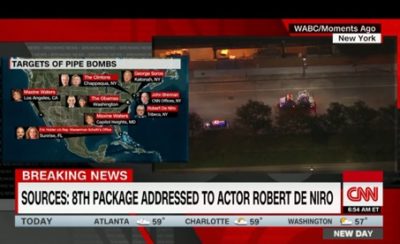
The 2012 Aurora, Colorado movie theater attack, the 2015 San Bernardino, California office building attack, and the 2016 Seaside Park, New Jersey bomb signaled a shift in targets from airplanes and iconic settings to seemingly innocuous locations in small towns and cities throughout the U.S. Earlier this week, pipe bombs were sent to a businessman, top current and former government officials, and an actor. Another pipe bomb was found yesterday at the CNN offices at the Time Warner Center in New York City.

Targets have expanded to include anybody, at anyplace, in anytown, USA.  Who’s next? Where will the target be? Will it be another pipe bomb, or something else designed to thwart our current capabilities?

Explosive Weapons Have Changed Yet Again

TV Screenshot

The “traditional” explosives once used have given way to homemade improvised explosive devices. This week is not the first-time homemade explosives were used.  The 2013 Boston Marathon pressure cooker bomb and the 2017 New York City explosive belt were constructed in an individual’s home. The pipe bombs sent this week were reportedly made of plastic PVC pipe and contained glass shrapnel.  These materials are of additional concern as they can be more difficult to detect with much of the security technology that exists today.

Pipe Mail BombPipe Bomb X Ray

The weapons being used by terrorists continue to expand, with new configurations of explosive devices, firearms such as 3D printed guns, and knives concealed in ever more ingenious ways. Detecting these threats as they are concealed on individuals has become increasingly difficult, as most security technologies have not evolved at the same pace as the targets they are designed to detect.

Large Number of Simultaneous Targets

The third troubling concern is that eight reported attacks have been launched over the past 48 hours.  The expansion of the target set obviously expands the potential impact of these devices, creates an enormous burden on our law enforcement and counter terrorism professionals, and elevates concern among the general public.

FBINew York Police

While these developments in terrorism are concerning, American counter terrorism, law enforcement, and security professionals are world class.  They continue to work diligently to identify suspicious packages, safely secure people, and remove these devices. They are also actively utilizing all available resources to identify the individual(s) responsible for these heinous acts. They will continue to work to keep us safe. They will continue to fulfill their mission with the utmost skill, professionalism, and effectiveness.

By providing these professionals with technology that helps them stay abreast of the latest terrorist evolutions, including technology that can detect the nonmetallic elements found in this week’s pipe bombs, companies like Evolv Technology can help level the playing field by keeping people safe. While new technology is being rolled out in many venues, more needs to be done. Our adversary will never stop innovating. Neither will we.

Evaluating the Need for Weapons Screening at Performing Arts Venues

Determining the need for a weapons policy and a threat detection solution at performing arts centers involves more than the security director to make purchasing and implementation decisions. From budget, policy and patron experience, the leadership team must work together to organize, evaluate, plan and implement and communicate such an important initiative.

This is entirely understandable. It’s one thing to work with a director of security and their technical staff, who are measured on their ability to keep employees, customers and other visitors safe. But involving the front-of-the-house team and human resources, who are responsible for creating the best customer and employee experience possible, is an even higher bar. A bad experience–say, delays or pat-down searches–can have a direct downward impact on sales. So if the front-of-the-house thinks a weapons screening technology is a bad idea, it probably won’t be seriously considered.

At least that’s how it has been. I’ve been focused on providing security solutions for over 15 years, but am now seeing the first meaningful shift in the relationship between security and the patron experience teams. Given the rise of senseless lone-shooter attacks in the U.S., many venues are coming to believe – or are at least are willing to entertain the possibility – that patrons will tolerate reasonable inconveniences for added security as long as it doesn’t degrade the overall experience too much. In fact, some of our customers believe their patrons want to make that trade-off. They want to know the people in charge of the facility they’re visiting understand the nagging “could it happen here” feeling they have on a night out.

This is especially true with performing arts venues, given the horrific attacks like those that took place in Manchester, England and Las Vegas, Nevada. In fact, executives at some of these venues are increasingly stretching their purview beyond the front door and into the street where people wait in line for popular events. Due to the increase in terror attacks using rented trucks and other vehicles, such as in Nice, France and Barcelona, Spain, venues are looking for ways to get people off the street as quickly as possible and into the safety of their facility.

The fact that patrons must already stop to hand over or scan a ticket creates a natural opportunity to do screening in a way that won’t cause delays. We did a time study at a Broadway theater earlier this year and found that the ticket-taking process typically takes around five to 10 seconds per person in a live environment. If we can help the venue screen the patron in that time or less, everybody wins.

Unlike many pro sports stadiums, which have had checkpoints and metal detectors for decades, many of these smaller, arts-related venues are adding physical security for the first time. Many don’t even have security chiefs. And yet performing arts is one of our fastest-growing segments.  If you work for a performing arts venue or any other type of company that is looking to create a security strategy as quickly and efficiently as possible, here are a few best practices:

Get out of the security silo, fast: In the old days, the trick to implementing physical security was to work with the head of security and let him or her try to overcome the natural resistance from other factors in their environment. But we’ve found it works best when representatives from the front-of-the-house, finance, facilities and human resources, were involved in the sales process, ideally from the initial conversation.  The security director provided a clear understanding to all the leadership team the consequences of an active shooter and suicide bomber in the facility and the solutions available to deter or prevent such a terrible event.

As security becomes a higher priority for a company, it makes sense to expand the number of seats at the table when considering new security solutions.  The most celebrated accomplishments in implementing security screening at Performing Arts Centers I have witnessed involved the inclusion of the entire leadership team from the beginning.   The CEO needs to bring their teams together and keep engaged throughout the process, clearly identifying their end-state goals and understanding of the tradeoffs.    In one very successful scenario we witnessed, the chief executive officer directly led the process which involved security, human resources, front-of-house, facilities and finance to drive towards the optimal solution.

The Show Must Go On: Three Ways Performing Arts Venues Can Improve Security Processes

Why did this happen? Why now?

Twenty years ago, we asked ourselves these questions after hearing news of senseless terrorist attacks at iconic locations in major world cities.

Today, we’re still asking questions, but now we’re concerned about where the next attack might happen. Shootings and bombings are no longer limited to iconic venues in iconic cities. They can happen anywhere – at an indoor concert in Manchester, England, an outdoor show in Las Vegas, Nevada, a nightclub in Orlando, Florida. Terrorism has proliferated into many different towns and cities, perpetuated by individuals inspired in their basements and armed with weapons from stores in their neighborhood.

The security professionals responsible for protecting different types of venues including entertainment and performing arts centers also ask these questions. While most use methods such as deployed guards and closed-circuit TV (CCTV) cameras as the cornerstones of their security strategy, there are limitations to these methods. In the U.S., for example, security guards earn an average annual wage of just over 0,000 and the annual turnover at guard companies is between 100% to 300%. On average, a security guard will remain in the same job for only three to 12 months! Technology can help mitigate these inconsistencies and is critical to enabling the more effective protection of these venues.

People going to see a movie, show, or concert are out to have an enjoyable experience. They have countless ways to spend their time and money, and organizations work hard to provide the best “entertainment” for their paying guests. They do not want to encumber their guests with long lines, slow security or burdensome processes. With improved technology, today it is possible for entertainment venues to offer a simple, unobtrusive experience to visitors entering while providing an enhanced level of security.

Performing arts venues pose a unique set of security challenges. Theaters, for example, tend to be high profile venues that play a prominent role in their cities. Live theater performances start promptly at a designated time, often with guests arriving from dinner or work just before showtime. Performers and patrons don’t want to be distracted by people filing in after the show commences, so doors are closed when the curtain goes up. As a result, security teams are under tremendous pressure to get people screened and seated quickly. Just before showtime is when the security process gets most chaotic.

Many performing arts venues are open and inviting by design. They were designed to encourage the public to come in and enjoy the art and architecture. This open environment runs directly counter to a secure building perimeter with checkpoints.

The “who” and the “what” are also unique elements for these organizations. The genre or artist can often dictate the type of crowd one might expect to see in attendance. The audience attending a chamber music recital is likely very different from the audience attending a rock concert. As entertainment venues broaden the types of performances they offer, security should be able to ”ramp up” or “ramp down” accordingly.

Lastly, guards are people and human behavior is inconsistent. Capability from guard to guard is different, and a specific guard’s security vigilance often wanes over the course of an evening. Very likely, the one hundredth person he or she screens is subject to a different level of scrutiny than the first. Experience, training, fatigue, and human error play a role in how thorough and effective a search is conducted.

  • Use security technology to improve upon the existing processes with more consistent and automated detection capability. Take the security approach to the next level by providing your guards with technology to augment their practices.
  • Offer the ability to consistently screen and to change the level of screening depending on when or where the event is or who the performer is.
  • Rather than using clunky metal detectors, use a blend of state-of-the-art technologies – high throughput technologies with sensors and artificial intelligence.

The threat landscape has shifted significantly in recent years. We could all use a night out to forget about the daily headlines. Performing arts organizations can help us enjoy our visits by adopting modern security methods that protect while keeping the user experience intact.    

To learn more about how to balance security and visitor experience, click here.

Five Factors to Improve Today’s Physical Security Screening Experience

Security screening technology is often measured by three factors – detection, alarm rates and throughput. At the macro level, these three metrics give a broad sense of whether or not a device will improve an overall security process. However, these three pieces don’t tell the whole story. Two other factors, closely tied to throughput, flesh out the overall security trade space. They are “touch rate” and “divestiture.”

  • The traditional factors – detection, alarm rates and throughput.
  • The five “must consider” factors – detection, alarm rates and throughput, along with touch rate and divestiture.

Only when the entire set of factors is considered as a whole, can the effectiveness and efficiency of the device be evaluated. In today’s world where physical security screening has become the “norm” in more and more of the places we gather, the latter two factors become increasingly important — to find a purpose-built device and the right process.

The age-old adage “there are two sides to every coin” speaks volumes. While “throughput” is important to security operators, it’s the combination of throughput, touch rate, and divestiture that matters to your customer.

With this is mind, when the U.S. Department of Homeland Security’s Transportation Security Administration (TSA) created the TSA Precheck Program, the focus was specifically on two things beyond detection: 1) touching people less and 2) letting them leave everyday items on or in their pockets and in bags. While “throughput” wasn’t the central tenant of the program, it was believed that doing the first two things for a growing population of travelers would ultimately speed up throughput for all travelers.

When the program was created its authors wondered whether these two things would be material enough to make a difference in the physical screening experience. More than half a decade later, there is a clear differentiation between the highly customer-focused TSA Precheck practice and “regular” screening, underscoring the point that customers place high value on an improved experience.

Customer experience matters.

Not all customer environments will be the same; each will have slightly different objectives. Some will be in high threat locations; others will not. Regardless of the customer or their venue, the following things will always ring true. First, your physical screening system must detect threats at a high level and with limited alarms. Second, your physical screening system must do this in a way that keeps people moving, minimizes physical touching and allows them to walk at their pace without losing control of their belongings. Finally, in a world of limited or shrinking budgets, your system must be able to deliver efficiencies – either in terms of hard budget savings or repurposed security resources.

If you’re reading this blog, it’s possible that you’re implementing a comprehensive security screening solution for the first time. Or, perhaps, you’ve already implemented something in response to growing threats over the past decade. In either case, I encourage you not to start at square one. Why not learn from the organization that has been the face of post 9-11 security for almost two decades? Certainly, the TSA has made mistakes. And, thankfully, they have also made significant advances. You can learn from both, and you don’t have to spend a decade to do it.

Consider the five factors discussed above and evaluate your overall security process through a customer lens. Is the technology in your current process, or the one you are considering, purpose built to meet today’s security concerns while also preserving the culture, look, and feel of your venue? If it isn’t, you have options. There will always be two sides to this coin, but there are ways to ensure that both shine for decades to come. Contact us to find out how.

Note: To underscore the importance of the customer experience, I highlighted the tangible changes to TSA Precheck screening. It’s important to acknowledge the foundation of the program is built on the concepts of trust and access, and the public’s willingness to share personal information for the benefit of this streamlined screening experience.

Shining a Spotlight on Better Event Security

Mass shootings like the one that occurred this past weekend at The Jacksonville Landing entertainment complex and last year at the Route 91 Harvest Music Festival in Las Vegas shake us to our core. They make us feel vulnerable in moments when we should instead feel excited. Large performance spaces have been cultural cornerstones for thousands of years because they uniquely bring together people regardless of race, creed or gender over a shared love for the arts. Attacks like these exploit one of the most powerful uniting forces in our society.

The challenge for security professionals is that these venues take a number of different forms. For example, in the Boston area you could see Moulin Rouge at the Emerson Colonial theatre, the Eagles at TD Garden arena and Cirque du Soleil’s LUZIA under a big top at the grounds of Suffolk Downs – all within the same month. As adversaries shift their focus to public places and become increasingly innovative in their strategies, we need a new approach to venue security.

A New Focus for Attackers

Since adversaries have moved on from hard targets such as airplanes, government facilities and military bases, there has been a significant shift to soft targets such as performing arts centers, sporting venues and arenas. While this is widely known – our CEO tells the story often of the anxious conversations he recently witnessed fellow parents having as he picked up his son’s friends to take them to an Imagine Dragons concert at a stadium – not enough is being done to address this new focus of keeping loved ones safe.

Further, the attack method and the perpetrator have changed. The rise of crowd-sourced terrorism has led to readily accessible means for an attack. Firearms, vehicles and home-made explosives are within reach as adversaries shift their focus from high-profile locations to anywhere people gather.

Raising the Current on New Security Technology

While attackers have focused in on specific venues, security screening technology has been largely unchanged. Today when you go to a see a show at a theatre, you’ll likely wait in line for sometimes 30-45 minutes before approaching a metal detector for which you have to empty your pockets or divest personal items before walking through. Many stadium and arena operators no longer even allow visitors to bring backpacks or other bags into their venues to improve the efficiency of screening.

Advancements in technology are changing this status quo, providing higher throughput and improved threat detection with less disruption. Some combine personnel and bag screening to help minimize removal of personal items and speed up the process. These technologies are using the latest sensors, software and user experience design principles to provide an improved level of security with a better visitor experience.

While technology is an important component to an effective security plan for a performing arts center, it’s just one piece of the puzzle. When building a security plan, facility managers should work to understand their threat vectors, vulnerabilities, and mitigation plans. They should incorporate the following components into a comprehensive security plan.

  • Intelligence: Understand and identify the threats to the area, building, and people in it. Work with various federal, state, and local enforcement agencies and leverage the facility team’s network of contacts. Threats are constantly changing; therefore, intelligence must be ongoing.
  • People and Training: Guards and officers serve as the frontline, they know the facility and the people in it. They should be trained on an ongoing basis in security protocols as well as identifying suspicious behavior.
  • Processes and Protocols: Facility managers can no longer use a “one-size-fits-all” approach to security. They need tailored systems and well thought out processes and protocols – like risk-based security – to ensure security layers are properly deployed throughout a venue.
  • Technology: As mentioned above, new technologies can provide threat prevention beyond the capabilities of guards to significantly improve screening operations. CCTV and access control expand the reach of the team on the ground. Further, facial recognition technology can be employed to recognize and authorize employees in an employee screening application or to adjust screening for VIPs.
  • Visitor Experience: With new technology and processes, it’s important that customer experience is not a secondary consideration – especially at a performing arts center. A security experience can maintain a level of calm and unobtrusiveness.

By employing a holistic approach, security guards and facility managers at performing arts centers can be armed with the information they need to quickly and confidently assure a safe environment for their visitors. With the right technology, they can effectively screen and adjust layers of security in response to changing threat levels without impacting visitors and their normal pace of life. In fact, when selecting new technologies, facility managers should look for solutions that provide a balance between improved security and a better visitor experience.

While related issues like the gun control debate may divide us, cultural experiences like seeing a show or going to a concert unite us. We can all agree that we deserve to feel safe in all the places we gather. At Evolv, we will continue to innovate to bring intelligence and security at the perimeter of soft targets to keep people safe – at performing arts centers and beyond.

Read more here about safeguarding against soft target attacks.

Six Ways to Prevent Soft Targets from Terrorist Attacks

We bet five years ago that soft-target attacks would become the favored tactic of terrorists, particularly if ISIS began to lose ground on the battlefield. Unfortunately, we were right.

Many stadium and arena operators no longer allow visitors to bring backpacks or other bags into their venues. Policies like these were instituted to ensure that the venue can balance the need for effective screening with the need to avoid miserably long security lines.

But there’s no getting around it: for anyone wanting to pack an extra sweater, a snack for the baby or raincoat just in case, this is a big deal–a serious degradation of the customer experience. Unfortunately, such are the compromises security professionals have had to make in this post-ISIS era. Soft-target attacks–everything from sophisticated assaults on iconic arenas to lethal “lone wolf” attacks on unsuspecting neighborhood nightclubs—are on the rise, forcing operators of public venues of all sizes to rethink their security strategies. All too often, venues have had to resort to the oldest, bluntest response: hire more security guards and request more police support and do more thorough physical searches.

We all know that’s not a sustainable response. Throwing labor at the problem is costly in the short-term and economically unsustainable in the long-term. It’s not sure to dissuade a determined terrorist, but may impact your brand. After all, your business is to provide a carefree, entertaining experience for your customer—not to turn a night out into what feels like a visit to a hardened military installation. And when customers complain, we all know who will bear the brunt of the pressure. You will.

Therefore, here are six ways that screening technology can protect soft targets from terrorist attacks:

1: Create an Enhanced Visitor Experience – Deliver security at the pace of life. Visitors are not asked to “pause and pose”. Because it uses high-speed millimeter imaging, the system can screen people at walking speed. Since we need to search for mass casualty weapons, there’s no need to empty one’s pockets and purses into “dog bowls”.

2: Don’t Treat All Threats Equal – Our industry responded impressively after 911, with powerful systems designed to find anything a highly trained terrorist could use to attempt a repeat of that infamous day. The unsophisticated lone wolves who carried out most of the more recent soft-target attacks needed powerful weapons and explosives to cause mass casualties. We’ll look for those—not screwdrivers, razor blades, or other everyday objects with minimal potential for terror.

3: Don’t Deploy Security That is All or Nothing. It’s Complicated.  – In the past, the main question for many organizations was whether to deploy screening technology. Like it or not, ISIS has changed that calculation. Now, almost any place where crowds gather can be a target. Look into technology that improves your defenses at all your facilities – whether it is adding another layer of protection to a sports stadium or introducing one to a previously unprotected nightclub or corporate office.

4: Know that Flow Matters – Living in a free society means accepting some risks. Security cannot come at the cost of freedom of movement, freedom from intrusive searches and freedom from inconvenience.

5: Understand that Customer Experience Matters – Minimizing the unpleasantness of screening is not a secondary consideration—not for your customers and visitors, and not for your boss. Our working assumption is that if our technology hurts your ability to retain and attract business, you won’t use it for long. You need to protect your customers and help your business.

6: Consider Future-Proofing Through Software – Powerful software platforms help you easily adjust as new threats emerge. This is crucial to keep you prepared for today’s sophisticated terrorist networks, who use social networks and other tools to quickly share instructions for building more lethal bombs or executing new types of attacks.

It’s time the security industry stepped up with solutions for the reality of today’s world. Our technology is specifically designed to expose the threats behind mass casualty attacks that have become all too common to help your front-line personnel take quick action without inconveniencing your customers.

To learn more, read the three questions security directors need to ask before the next soft target event here.

Security content kit for stadiums and arenas

Lessons Learned from Pulse Nightclub: Modern Threats Require Modern Security Technologies

Two years ago, Omar Mateen entered Pulse Nightclub in Orlando, Florida and started shooting. Today, we remember and honor the victims who lost their lives in this terrible act of violence. Here at Evolv, anniversaries such as this one serve as a constant reminder to why we are here and how critical it is to continue our mission to preserve everyone’s fundamental right to be safe in all the places people gather.

In reflecting on what has happened in the two years since Mateen entered Pulse Nightclub, it’s important to first understand the larger trend the physical security industry has been experiencing and how the incident in Orlando fits into that broader shift. We sat down with Evolv CEO and Co-founder, Mike Ellenbogen to discuss how the threat landscape has changed in the past two years and what the industry can learn from the shooting as we look to prevent
future attacks.

Q. Today marks the two-year anniversary of the active shooter incident at Pulse Nightclub. What have we learned?

A. Namely, there’s a need for active shooter security that did not exist 10-15 years ago here in the United States.

According to the FBI, since 2000 there have been 250 active shooter incidents in US with 2017 seeing 30 active shooter incidents – the highest in the past 18 years. The numbers don’t lie – and no matter how you break it down or what angle you look at it from, the fact of the matter is these incidents are not only becoming deadlier but also more frequent.

When Mateen opened fire on the evening of June 12, 2016, it went on record as being the deadliest single gunman mass shooting in United States history. That was until almost a year and a half later, when a gunman opened fire on a crowd of concertgoers at the Route 91 Harvest music festival in Las Vegas, leaving 58 people dead and 851 injured.

If we’ve learned anything in the past two years, it’s that the current security solutions and processes we have in place are not sufficient. Put simply, yesterday’s tools were not designed to address today’s threat landscape.

Q. Talk to me about the threat landscape that exists today.

A. Terrorist attacks and mass shootings have changed the threat landscape drastically. In the old-world paradigm, planes and government buildings were the target. However, in today’s new world paradigm, anything can be a target. We’ve increasingly noticed a shift in attacks that focus on public spaces – think concert venues, transportation hubs and open office campuses. The result is millions of people becoming vulnerable to attacks. The incident at Pulse Nightclub exemplifies this trend to a tee.

Q. What needs to change from a technology perspective to prevent incidents like the next Pulse Nightclub shooting from happening?

A. Despite the fact that attackers have expanded their focus beyond airplanes to include private facilities, public venues, and the transportation infrastructure, we often see the same legacy security technologies and procedures in place, or nothing at all since the old solutions just don’t work for so many locations. We are fighting modern day problems with legacy technologies and that needs to change. We need to fight modern day problems with modern technology and modern thinking.

The Millimeter Wave advanced imaging technology (AIT) systems we see at the airport and walk-through metal detectors serve their purpose in the environment they were built for; however, they were not designed to combat the threats we are encountering outside airports today. At a time when we should be focused on detecting explosives and firearms, old technology is still detecting pocket knives, car keys, and cell phones. We need to move our security response from reactive to proactive to enable an active shooter prevention system/process.

Today there are numerous technologies available at our fingertips that can do remarkable things – from AI to 3D printing. Harnessing these innovations, and applying them to the physical security space, will enable us to provide smarter physical threat detection. That means higher throughput technology, less disruption and expanding the security perimeter beyond the walls of a building.

Q. How can we go about leveraging technologies to combat this new world paradigm? What needs to change from an industry perspective?

A. We need to leverage technology that combines detection, identification and intelligence – not rely on one technology by itself. This functionality will enable night club owners, stadium operators and other professionals charged with keeping us safe to face these safety problems head on.

Machine learning – an advanced form of AI – is the underlying enabling technology to address today’s and tomorrow’s physical security needs in a way that’s reflective of how venues today operate. Machine learning helps the sensors in safety technology become smarter over time.

This enables us to screen more people, more quickly and makes facial recognition and anomaly detection increasingly more accurate. As a result, we can identify people of interest against a collection of millions of known threats. In the case of the Pulse Nightclub shooting, Mateen was known to authorities and his previous encounters with the law resulted in him being put on the terrorist watch list for a period of time. Had AI surveillance technologies been in place, there is a chance he could have been identified prior to entering the club. As the threat landscape continues to evolve, it is important society, and the industry, becomes more comfortable with the use of innovative identity data.

By combining the power of machine learning with smarter sensors and biometrics, we’re empowered to both identify and heighten security against adversaries in real-time. This proactive, technology-driven approach to security allows organizations to focus on what is most important, protecting people by providing security anywhere.

To learn more, read the three questions security directors need to ask before the next soft target event here.

Three Questions Security Directors Need to Ask Before the Next Soft-Target Event

It’s been more than a year since a suicide bomb was detonated in the foyer of the Manchester Arena. The blast killed twenty-two concert-goers and injured hundreds more. Since then, I have met with security directors from concert halls, stadiums, arenas, sports teams, and convention centers around the world. These security directors are typically asked three questions by their venue owners and managers:

1. How vulnerable are we to this type of attack?

2. What are other venues doing to prevent this type of attack?

3. How can we prevent this type of attack from happening in our venue?

The short answer is, there’s still more to be done.

A typical reaction after the Manchester event was for security directors to reach out to the security consulting industry to help them address these questions. This often included a new or refreshed threat assessment and vulnerability analysis that resulted in identification of security gaps. People, processes, and technology were then evaluated in various combinations to close those gaps.

An initial focus on upskilling people typically includes training to make guards and employees more vigilant and aware of the signs of trouble. This is a quick way to reinforce important skills. Venues will conduct formal internal training, either by bringing in an outside firm or working closely with law enforcement through various programs they offer. Having trained staff is an important part of the overall security plan.

Next, many of these venues step up contact with various sources of intelligence to help them understand and identify the threats to their area, their building, and, if applicable, the people performing at their site. These sources stream in from various federal, state, and local agencies or fusion centers, through a range of companies providing intelligence-as-a-service, and through the venue’s own network of individual contacts. For example, the Joint Terrorism Task Forces in more than 100 U.S. cities and similar international intelligence bodies are a critical component in this fight against terrorism.

The third key piece involves making changes to processes and technology. These may include fortifying the perimeter with bollards, adding “eyes on” such as CCTV cameras, or improving visitor screening operations. Process and technology changes, implemented effectively, can multiply the available forces, enabling significant improvements to both the effectiveness and efficiency of the overall security operation.

Decisions about which security technology should be deployed and what processes to wrap around them are highly dependent on the threats and vulnerabilities of a specific venue. There are some key considerations in this decision:

How vulnerable are we to this type of attack?
A key question is: what threats are we most concerned about? Based on physical layout, crowd concentration, and location, some venues are most concerned with person-borne threats and others are concerned with vehicles used as weapons. The threat of an individual bringing a firearm or explosive device to do harm to a crowd of people is high on most lists. Typically, threats are identified and prioritized within a logical framework including the probability of a given type of event, the impact on the venue and its visitors, and the vulnerability based on current security measures.

What are our operational realities?
One comment we consistently hear loud and clear is that a traditional airport or courthouse “mag and bag” checkpoint security process isn’t a viable solution. Security leaders do not want to create an environment where visitors or fans are required to remove all the items from their pockets and place them into a small white bowl, walk through a screening device, and then re-collect their items and go on their way. A manual search of every bag also significantly slows down the screening process and is intrusive to visitors.

What are the gaps in our security plan?
Firearms and explosive devices concealed on an individual are two concerns high on the list of most security directors. There are thousands of people converging on these venues in a short period of time, often just before the start of a show or beginning of a game. To effectively and efficiently screen each visitor for these types of threats is impractical, if not impossible, using traditional technologies – often a mix of walk through metal detectors, manual bag checks and guards trained to identify known trouble makers. For some venues, it’s canines for explosive detection. Evolv has combined all three of these capabilities into a single high-speed device.

Our formula is simple:

  • Find the threats we care most about: explosive devices and firearms
  • Make the visitor experience as unobtrusive as possible
  • Ensure throughput between 500 to 1,000 people per hour (per security lane)
  • Make it easy for guards or officers to use
  • Ensure it is flexible so that it can be used at multiple locations and in different operational configurations to screen different groups of people

Arenas, performance centers, and stadiums have begun deploying new security screening technologies such as the Evolv Edge, and even more are conducting pilots to understand how best to deploy them. However, too few have taken proactive steps to effectively protect their visitors and fans from today’s threats. Let’s focus on detecting the threats we know are out there.

Whitepaper: Balancing Security, Visitor Experience, Operational Efficiency and Cost Considerations

Summary

All security systems are designed to keep people safe. The challenge is balance. Does the security present an undue burden, either to the provider or to the customer, does it evoke a sense of safety, and does it operate within the cultural bounds of the venue? And of course, how much does it cost? Security experts generally agree the use of a venue specific risk-based security (RBS) approach is preferable to “one-size fits all” solutions. Flexibility and adaptability are key factors in RBS solutions, allowing “tailored” systems designed to mitigate risk while maximizing customer movement or throughput with minimal disruption.

Evolv Edge was designed and built to aid an organization’s move toward a risk-based security approach and provide balanced detection across a range of threats in a changing environment.

Download this whitepaper to learn how Evolv Technology’s Edge system provides the best RBS solution to detect metallic and non-metallic threats that cause mass casualties.

Download Now

Fill out the form to download this whitepaper to learn about balancing security, visitor experience, operational efficiency, and cost considerations