The Case for a New Standard in Physical Security

As our threat environment rapidly changes, our security standards are being left behind. Developed nearly fifty years ago and barely updated since then, current standards for metal detector technologies can’t keep up with all the metal objects we carry with us every day — and it shows.

In this infographic, learn the impact on guests, security professionals, and entire industries when old standards aren’t renewed in the face of advancing technologies – and an advancing threat environment – and see why the time has come for a new standard in physical security.

Download Now

Whitepaper: The New Standard for Weapons Detection

Summary

Physical security is always about more than detection technology alone. Security screening involves an integrated system of people, processes, and technologies that work together to address the threat in a specific operating environment. And defining the right technology to balance physical safety and guest experience relies on understanding how it fits within this broader system. While the right technology can harmonize with the people and processes that deploy it and thereby improve physical security, the wrong technology can in fact hinder the important work of safeguarding the public, putting an undue burden on security teams and increasing the risk of physical harm.

Every operating environment is unique, which is why re-evaluating what worked for airports, prisons, and municipal buildings is so critical to understanding the right security solutions for significantly different types of venues, their unique visitors, and the potential threats they may encounter. Critically examining historical standards based only on the technologies available at the time is the first step in this re-evaluation.

The next step?

A new standard that is better aligned to more types of venues, their business goals, their visitors, and their security needs. By exploring what’s possible with modern technology, what’s operationally sustainable for the people and processes across security teams, and how the system as a whole can better meet its objectives, venues can address the needs of both their employees and the visiting public alike, all while maintaining the high standards of weapons detection required to prevent the catastrophic loss of life.

Fill out the form below to download this whitepaper and learn about the new standard for weapons detection.

eBook: The New Standard – A Security Technology Buyer’s Guide

Technology is advancing, changing the threat landscape from what it looked like decades ago when current standards for metal detectors were authored.

Our standards should be advancing, too. It’s time for a new standard: one that updates the requirements for the technologies protecting our venues, acknowledges the demand for a great guest experience, and removes the burden on security teams to visually distinguish everyday metal objects from weapons.

Today’s technology extends from machine learning and artificial intelligence onboard devices to cloud connectivity, data analytics, remote device management, and mobile applications.

Fill out the form below to download the eBook and learn the impact of a new standard for modern technologies in physical security, and how world-class venues can use this new standard to inform the selection and deployment of new technologies for physical security today—and well into the future.

Digital Threshold Live powered by Evolv – “The Transformation of Security in Modern History”

What is Digital Threshold Live?

Digital Threshold Live is a webcast series hosted by Evolv interviewing security leaders across a variety of verticals bringing you security trends, best practices and thought leadership to help you provide a safer tomorrow. It’s time we make everywhere safer.

Watch Digital Threshold Live powered by Evolv – “The Transformation of Security in Modern History”

How has the scope of security changed in 2021? What is driving this transformation? What do we see on the horizon for 2022? As you start to think about how to move your company down this path, listen to two security leaders about how they have started the security transformation.  

Four Key Takeaways

Transforming Your Business

Setting a clear vision for the company, establishing trust and confidence, and creating a safe environment for your employees to take risks are all necessary to transform your business.

Predictive Data

The pandemic has illustrated the need for security data to make business decisions. In preparation for all future unknowns, predictive data allows businesses to feel better prepared and be able to pivot faster.

Digital Transformation

Even in this age of digital transformation, security will always have a physical component, so when looking at successful security businesses, those that blend both physical security and data will be the most successful.

Audient Shift

We are seeing an audience shift in the industry with security decisions moving up to the c-suite level experts which are elevating the importance and influence of security professionals.

About STANLEY Security

STANLEY Security, a division of Stanley Black & Decker (NYSE: SWK), is a global provider of integrated security, health and safety solutions and services. With more than 200 locations, serving six continents, we’re trusted by customers across the globe for innovative solutions; seamless installation and integration; reliable maintenance; 24/7 monitoring; and insightful analytics. At the heart of our business is a vision for creating safer, healthier and more efficient environments – guided by a purpose to help the world progress.

Learn More

About Evolv

Evolv Technology provides touchless security screening that delivers safety without sacrificing the visitor experience. Evolv Express® spots concealed weapons and other threats using advanced digital sensors and artificial intelligence. It’s incredibly accurate and can screen up to 3,600 people per hour – 10 times faster than traditional metal detectors. Our customers include L.L. Bean, Six Flags Theme Parks, Wynn Las Vegas, and hundreds more.

Learn More

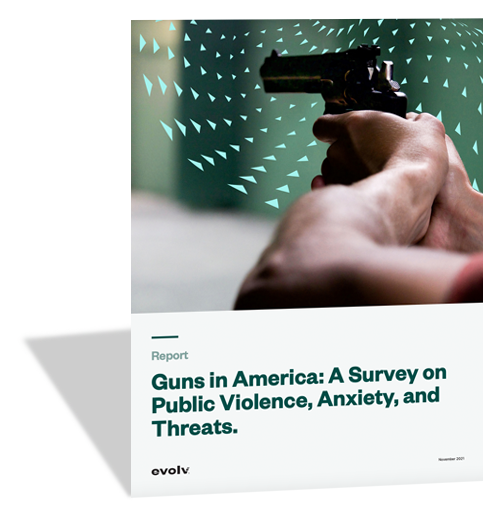
Report: Guns in America: A Survey on Public Violence, Anxiety, and Threats

Download Now

“Guns in America: A Survey on Public Violence, Anxiety, and Threats” is a new report that quantifies not only the impact Americans’ anxiety around guns has on their everyday lives but also demonstrates the choices they make – and the businesses they patronize – are affected by the level of risk or threat Americans perceive those places to have.  

Download this report to learn more about the mental toll gun violence, shootings, and terrorist events are having on Americans across the country. 

Download Now

eBook: Five Ways Data Improves Physical Security

Summary

Access to digital information is changing the world dramatically, and physical security is no exception. Leading venues across sports, entertainment, theme parks, industrial workplaces, schools, healthcare, and places of worship can improve their security posture by leveraging better information about visitor curves, alarm rates, and threats across their venue during specific events … if they know where to find it.

Evolv Express® screens your visitors for weapons threats while they simply walk through at a natural pace. It also captures and presents critical information about visitor flow rates, alarm rates, and threat items in its companion, web-based application, Evolv Insights™— improving the data available for evidence-based decision-making across venue security and operations teams.

Fill out the form below to download the eBook and learn about five ways to utilize data to improve your physical security.

The New Standard for Workplace Safety

One of the first responsibilities of an employer is to provide a safe workplace. It’s just the right thing to do. It’s also a good business decision, and a regulatory requirement (see OSHA Section 5). The COVID-19 pandemic has tested employers’ commitment to workplace safety. Many employers have passed the test and kept their people safe from the virus. However, as the virus yields to gradually rising vaccinations and workers return, they are being greeted by a second, often forgotten pandemic: workplace shootings. 

The COVID-19 pandemic initially seemed to reduce gun violence, including workplace shootings. Based on the tragic headlines below, it now seems clear that the temporary lull is over: 

It feels ominous and tragic to me that we’ve had four workplace shootings in the first two weeks of October. Historically, there has only been about one workplace mass shooting per year. A recent Ontic survey of 300 security leaders at large companies found that nearly a fifth of them (18%) have had to deal with an active shooter event at one of their sites in the first five months of 2021 alone. It feels like something has fundamentally changed in the threat environment. 

What’s driving the change? Experts recently interviewed by NPR theorize that potential shooters have had a lot of extra time to plan attacks during the pandemic and that there are more targets available now that more people are back at work in more locations. I would add a few additional important drivers: the prolonged stress and isolation of the pandemic, rising resistance to mask/vaccination mandates, the spread of extremist ideologies, acute political polarization, widespread social unrest, and widely available firearms. It has all combined to create a tragically perfect storm. The DHS and FBI summarized the threat their May 2021 joint report, saying “The greatest terrorism threat to the homeland we face today is posed by lone offenders, often radicalized online, who look to attack soft targets with easily accessible weapons. Many of these violent extremists are motivated and inspired by a mix of socio-political goals and personal grievances against their targets.” 

Given the current threat environment, how can employers best fulfill their duty of care in providing a safe workplace? The most obvious way to prevent shootings in the workplace is to keep guns out of the building in the first place. Most employers have policies to prohibit guns on private property, but they have largely been unwilling to enforce their policies through weapons screening. Why? Because screening for weapons with old metal-detectors creates a prison-like experience for workers and leaves workers stuck in crowded waiting lines that are just unacceptable in a pandemic recovery environment.  

In an intensely competitive labor market, employers may feel forced to choose between a positive worker experience and a gun-free workplace, and when push comes to shove, they have often chosen worker experience. That choice is tragic because it is based on an outdated understanding of what’s technologically possible.  

AI is transforming every sector of the economy, and physical security is no different. AI-based weapons screening like Evolv Express® makes it possible to have both a great worker experience and a gun-free workplace. Reliable weapons screening that doesn’t require workers to stop and empty their pockets or surrender their bags as they walk through is a game changer.  

I believe this disruptive new technology is redefining the standard for employers’ duty of care to workers. Having a “no guns” policy without any effective enforcement is no longer an option. If proven technology to enforce a no-guns policy is broadly available, operationally feasible, and commercially affordable, it won’t be long before board members are asking why management is taking unnecessary risks. 

Sports stadiumsperforming arts and entertainment venues, and tourist destinations were the first to discover and implement the new standard in weapons screening because visitor experience and safety are fundamental to their operation. Now that the leaders in these industries have made their move to AI-powered weapons screening, the followers are racing to catch up. The same pattern will likely play out in industrial workplaces, citizen-facing government offices, health care facilities, office buildings, and other workplaces.  

Now is the time for employers to reshape their workplace safety strategy to reflect the current threat environment and the technological disruption that is underway. The good news is that investing in meeting the new standard is not going to break the bank or be disruptive to normal operations. We’ve worked hard to innovate not only in technology, but also in our pricing model. Our customers (and their CFOs) are often pleasantly surprised by our subscription-based “security-as-a-service” pricing for Evolv Express. They also love that they can often train existing staff to use our equipment, so there isn’t a huge labor cost hurdle to overcome. As a mission-based company, we want to make it easy for employers to do the right thing for their workers. It’s a win-win-win situation.  

As the pandemic recovery continues and seasonal hiring surges this fall and winter, more workers than ever will be walking into workplaces that are unprepared for the current threat environment. We should all hope and pray for their safety, but we can finally do much more than that. If you are an employer who is ready to do more, let’s talk soon

Download our workplace violence infographic to learn more about how violence in the workplace is persisting and on the rise in the aftermath of the COVID pandemic.

The Future Is Here: Smart, Connected Venue Security with Evolv

Senior security leaders across multiple industries, surveyed in a joint study by Microsoft and Accenture, cited “reactive threat management” and “intuition-led decision-making based on subjectivity” as top challenges in physical security. The technologies predicted in the study to transform these challenges? “Artificial intelligence and signals processing” at the venue’s threshold; the power of analytics to “sift through overwhelming amounts of data”, and Internet of Things-connected sensors and devices to “collect intelligence in real-time.”

These once sounded like the stuff of science fiction: so-called “smart cities” with “smart venues” that screen visitors unobtrusively, only stop potential threats while letting everyone else pass through, and stream business intelligence back to security teams to improve decision-making and enable a more proactive security posture.

Hello world! With Evolv Express AI-powered security screening and its companion analytics application, Evolv Insights, this future is here. In the latest software release launching this month, new capabilities for connectivity and analytics improve five important dimensions of physical security:

1 – Balance Physical Safety with Visitor Experience

Security screening with Evolv Express is powered by advanced sensors, cameras, and artificial intelligence to distinguish weapons threats from everyday items. It moves guests through a venue’s entryways up to 10 times faster than metal detectors: up to 3,600 visitors per hour at normal walking speed. No stopping to empty pockets or hand over bags means screening is less obtrusive, improving the visitor experience. And no stopping or queuing up means Evolv Express is safer than traditional methods, virtually eliminating the threat of “soft target” scenarios for mass casualty events.

As a connected device, dare I even say an IoT device, Evolv Express captures critical information such as visitor flow rates, alarm rates, and threat types detected at every venue entrance, making this data available for consumption and interrogation across multiple business dimensions—date, time, location, entrance, and event type—in its Evolv Insights analytics platform.

To maintain the highest degree of guest experience and physical safety, Evolv Express offers a range of settings, and the new What-If Sensitivity Setting Analysis in the latest release of Evolv Insights lets security professionals use historical data to see how the system would have performed on an alternate setting. This helps security teams refine their concept of operations (ConOps) strategies and further reduce nuisance alarms, improve guard performance, and improve the guest experience without compromising visitor safety.

2 – Know Your Vulnerabilities

New features for Alert Categorization and Analysis in the latest software release advance the system’s ability to report on what threat types are found at a venue. Security teams resolving issues at the Evolv

Express system simply “tag” alerts with a single, one touch icon set to indicate threat items or nuisance items.

Using this information, new dashboards in Evolv Insights let users drill down into where and when each type of alert appeared, across entryways, times, and events. Armed with this knowledge, security leaders can better focus staff training, deploy more experienced staff when and where they will be needed, and improve overall staff preparedness.

3 – Improve Venue Operations

Better data can help teams beyond security improve visitors’ experience—with ticketing, concessions, retail, ushers, guest services, guides, and more—because the better informed these teams are, the more seamlessly they will operate. Information gathered at every Evolv Express system and available in Evolv Insights analytics will help venue operations improve decisions about staff to guest ratios, staff deployment at different locations and times, along with other resource decisions to boost efficiencies and reduce waste.

To better understand how security and operational needs differ across types of events, the latest release of Evolv Insights introduces Event Type Analysis. Different types of events—think rock concerts, sporting events, corporate events, speaker series, and family productions—will likely exhibit very different characteristics across dimensions like threat types and frequency, alarm rates, visitor flow rates at different venue entrances.

Evolv Insights makes it easy to compare event types side-by-side to find commonalities and differences or to compare events of the same type to find and address anomalies, improving planning across many teams throughout venue operations—including security.

4 – Transform Security from Cost Center to Value Driver

Keeping venues secure not only protects people; it safeguards the brand—for venue leadership, their corporate sponsors, and the talent they attract. But security is too often seen as a necessary evil: a cost center rather than a value driver. I found this callout in the aforementioned Microsoft and Accenture study spot on and worth noting… No matter which metric the organization prioritizes, a data strategy will be required to optimize the outcome. An effective strategy will enable physical security to become the core intelligence platform of the organization, transforming from a cost center into a value hub. I could not have said this better myself.

With Evolv, the power of data and analytics at every visitor entrance means security teams can provide a high degree of value to executive leadership by providing transparency and visibility with accelerated, streamlined, reporting capabilities.

Evolv Insights offers both pre-defined and flexible dashboard views that users can save and return to, share with colleagues, print to file, and export to work with adjacent analytics packages. And in the latest release, subscribed users automatically get “pushed” Post-Event Summary Reports, without a separate need to access the Insights application.

5 – Adopt a Proactive Security Posture

When venue teams need critical data about their venue in the moment, wherever they’re located, the latest software release from Evolv offers the MyEvolv Portal mobile application. Teams can now access analytics, scanner monitoring, and management, and proactive communications from any device, including Android- and iOS-equipped smartphones and tablets, to facilitate faster, better decision-making and respond in the moment to security needs across their venue before they become an issue.

Evolv prioritizes connections between venue staff and its security systems both through analytics and through communications technologies like Request Assistance—a discreet, one-touch alert from the operator tablet to additional venue security to help resolve an incident at the system.

The latest software release extends this connectivity and communication with new Remote System Management in the MyEvolv Portal. Available in both the mobile and web-based application, system administrators can now remotely log into Evolv Express systems and interact as if they were co-located with the system for monitoring, troubleshooting, and configuration changes. And whenever critical changes to the system occur, subscribed users receive new Proactive Notifications via text, email, or in the application.

Conclusion: The Digital Transformation of Physical Security is Here

While much has been imagined about the benefits of a future world—with “smart venues” powered by connected products and better data to improve visitors’ experience while making everywhere safer—Evolv brings that future to life today. It enables venue security and operations leaders to access better data for evidence-based decision-making, ensure connectivity between people and security technologies throughout a venue, and improve the guest experience while maintaining the highest standards in physical safety both today—and tomorrow.

A New Standard Sets a New Milestone: Evolv Express Screens More than 100 Million People

Our mission at Evolv is to make the world a safer place to work, learn, and play and has been since we began. Having been with the company since near the beginning, I am thrilled to share the news that we have surpassed the 100 million mark in the number of people that have safely and seamlessly walked through our Evolv Express® systems.  

To safely screen 100 million individuals has taken a lot of hard work on the part of our teams as well as our customers. It is not easy to set a new standard in any industry, and particularly one that is so fundamental to our lives as our physical safety. Evolv has been able to do it with our advanced weapons detection solutions, as this latest milestone proves.  

Only the U.S. Department of Homeland Security’s Transportation Security Administration (TSA) has screened more people than Evolv in the United States. That’s a pretty impressive feat when you consider the company was only founded in 2013.  

We can’t take full credit for reaching the 100 million mark so rapidly and for setting a new standard for security in the 21st century. We have to share the honors and accolades with all of our customers—and particularly our early partners, who had the faith and courage to believe in the boldness of our vision and our ability to achieve our mission. 

When I think of 100 million people, the number is too staggering to comprehend. Instead, I think about many of the individuals that I’ve watched as they casually walked through our digital thresholds, smiling and chatting with friends and family, typically unaware they are passing through an advanced, modern weapons detection system that is keeping them safer.  

I’ve talked to many of these patrons who told me they thought the venue didn’t have any security because they didn’t experience metal detectors stopping them in their tracks and forcing them to get in a slow-moving line, pull out their cell phones, empty their pockets, etc. When I tell them they actually passed through a new type of threshold that uses advanced sensors, cameras, artificial intelligence and other digital technologies to detect weapons, they are typically amazed that such a solution exists—and grateful that the venue’s owners were committed to modernizing security in consideration of the experience and safety of visitors. 

Here’s another thing about the 100 million milestone.  It’s taken a lot of hard work to get here, but it’s only a brief stop along the way. I fully expect to be seeing more of these announcements in the future, new milestones and new achievements, and I won’t be surprised to see the pace accelerate. That’s because the Evolv Express is setting the standard in physical security for a wide range of venues where large groups of people gather—concert halls, sports arenas, theaters, other performing arts locations, casinos, schools, hospitals, tourist sites, places of worship, shopping malls and more. 

As more customers and potential customers recognize that there is a new standard for weapons detection—and it really works—they will realize that they cannot and should not be left behind using 20th-century analog solutions in the 21st-century digital world. I look forward to more milestones as we continue on our journey to make Evolv an unobtrusive yet ubiquitous part of our everyday lives.  

The Digital Transformation of Physical Security

In recent years, “Digital Transformation” initiatives have taken priority across industries. But an article last month in Industry Week cited the “deskless workforce” as the last holdout of digital transformation: and it’s not small. The article estimates that about 80% of the world’s workforce, or 2.7 billion workers, have been “left behind” by digital transformation: that is, the introduction of new technologies intended to enhance “safety, quality, and productivity” for companies.

So how can physical security, arguably one of the most important “deskless” roles throughout our society, be positively impacted by a digital transformation of its own?  

The Reasons to Transform: What’s Missing? 

Thru the years we have certainly witnessed developments in technologies for physical security. The introduction of video management systems, communications devices, and physical access systems (ticketing, badging, biometrics) have all added advancements to the industry.  

But when it comes to detecting weapons, perhaps one of the most critical roles in ensuring physical security, many venues still rely on analog metal detectors. And we are all familiar with how that works: stop while you wait in a slow-moving line. Stop to empty your pockets. Stop to hand over your bag. Then, either get waved through or sent back because you’ve forgotten to put down some metal object you were carrying. Stop to get wanded; or, worse yet, submit to a pat-down.  

This process is more than an annoyance. It may amount to a threat itself. Crowds have proven to increasingly become “soft targets” for mass casualty events—as in tragic events at Mandalay Bay in Las Vegas, and the Boston Marathon bombing. What’s more, the health threats of close-contact crowds have been brought into sharp focus by Covid 19.  

Beyond crowded conditions, metal detectors can also overwhelm the guard resource, causing them to miss real threats in all the clutter they see on a daily basis. The reason lines are so slow-moving, of course, is that we all carry metal items with us every day.   

Metal detectors pass the work of distinguishing metal items from true threats off to guards. They simply alarm on everything, not just weapons, so guards are very used to so-called “nuisance alarms” and therefore, rightly so, don’t trust the system. That means they are left doing the brunt of the work—visually checking each person and bag that alarms. Most of the time, all they find is everyday items: laptops, tablets, smart phones, keys, etc. But this creates fatigue, because it’s easy to overlook what you don’t expect to see, and can result in security teams inadvertently letting weapons through.  

To combat fatigue or to move lines through more quickly, venues may turn off security systems when crowds get overwhelming; they may randomly sample visitors; or, they may opt for no security systems at all—each of which further raises the risk of weapons simply walking through undetected.  

The Way to Transform: What Can Technology Help Do? 

Prioritize the customer experience: The digital transformation of physical security must prioritize guest experience. If the high alarm rate is not indicative of the true number of threats entering a venue –– then a lower alarm rate reflecting the reality that most people are, in fact, not a threat will simultaneously elevate the guest experience and help security teams better pinpoint the true risks at a venue’s entryways. Allowing guests to enter at walking pace, with no interference whatsoever in the experience of visitors who don’t pose a potential threat, provides the best possible user experience both for guests and for guards.  

Let technology do what it does best… and, by extension, let people do what they do best. Technology that can detect weapons – not just metal –to by using AI and advanced sensors to distinguish true threats from everyday items relieves the burden on guards to check people that likely aren’t carrying weapons. And, it can pinpoint for guards where on a person the weapon is expected to be found. This expedites alarm resolution and improves guard efficiency by targeting only visitors who need to be checked and focusing guards only on the locations on their person or baggage to check.  

Ensure data drives decisions. Technology at the threshold of every visitor and/or employee entrance surpasses the ability of metal detectors by counting visitors, recording alarm rates and types, understanding the dates and times when rates are highest or lowest, and even allowing for the comparison of different security outcomes based on different event types. All this data provides venue security and operations teams with real-world evidence for better decision making, to meet the security and experience needs of their guests, better than guesses, gut feel, or manual counting can. Security planning and venue operations can all be data-driven to ensure the right staffing decisions are made at the right locations throughout the venue to both secure guests and elevate the guest – and guard – experience.  

Connect and communicate. With such a critical mission and so many possible security technologies also operating in the space, security technologies should never exist in a vacuum. Rather, they should integrate seamlessly together with other technologies that make up the extended security ecosystem. Options for integrated camera technologies and integrated communications provide an extension of existing security systems and staff to one of the most vital parts of the venue—its entryways. Neither should security technology require expertise that is outside the scope of existing venue resources. Technology should inherently scale—through built-in connectivity that doesn’t require an IT team to install, connect, or service—and through simple, app-like user experiences that guard staff and security leadership alike can quickly learn to operate, reducing the learning curve and training new staff members ASAP.  

Make life better. Why digitally transform if the technology doesn’t make life better for guests, guard staff, and venue leadership? When guests don’t notice security technology, they are less aggravated, with fewer frustrations to take out on guard staff, and they find the venue even more delightful. If guard staff are made more effective and efficient, they can experience higher job satisfaction and lower turnover rates. For venues, offering better customer experience plus enhanced security while reducing employee turnover are just a few of the potential benefits. Better resource use through data-driven decisions, better use of entryway space with fewer security lines and less equipment overall, and the chance to redeploy guard staff to different roles throughout the venue are all further benefits that venues can realize.  

The Imperative to Transform 

Of course, not least of all is the benefit of increased safety to the visitors of venues around the world that choose to embrace the digital transformation of their physical security. Simply put, shorter security lines through more reliable screening technology adds up to safer visitors—and lower false alarm rates mean guards can more easily pinpoint and stop bad actors—making more venues where people and their families love to gather with one another in our community safer.