Q&A with Juliette Kayyem, CEO of Zemcar and National Security and Crisis Management Expert

We had an opportunity to sit down with Juliette Kayyem, national security & crisis management expert.  Here’s what she had to say—smart connections and breaking down thick wall barrier are the key to 21st century security.

For centuries, security has been achieved mostly through building walls between people and places. Setting up barriers. That model no longer works, says Juliette Kayyem, former Assistant Secretary at the Department of Homeland Security and advisor to Evolv. In today’s interconnected world, we simply can’t build enough walls and barriers to guarantee safety. So what to do?

Q:  With the increase in horrific lone wolf attacks on soft targets—not just obvious targets like sports arenas and concert halls, but also nightclubs and restaurants—it feels like there’s no way to guarantee safety. It’s easy to lose hope, to accept this as the new normal. What’s the right response?

A: The most important thing is to secure the flow of people, goods and ideas. We simply can’t minimize the risk of violence to zero. Our goal has to be to make things safer. Our job is to minimize risk, and to remember what kind of society we want to live in.

Q:  So rather than focus on building barriers thick enough to guarantee safety, we should focus on building barriers that are as thin as possible to deliver the best balance of safety and flow. Is that right?

A: That’s right. In the past, we pretty much gave up on the idea of protecting soft targets. Look at how we protect airports. You can move the perimeter a mile back to make the airport safer, but wherever you stop you’re still surrounded by soft targets.

Q:  So a light layer of security on soft targets is better than no security at all.

A:  Of course. Look, there’s no easy fix, but companies have to understand that their obligation is to create a layered defense to protect their customers and employees and other visitors. There’s way too much of a focus on stop versus go in the security industry. That’s what I like about Evolv. Everyone else is selling stop and go. Evolv is about securing the flow. They’re focusing on flow, not making you decide between stop and go.

Q:  Do you think security professionals are really ready to accept this layered approach, or that some venues will be less secure than others? That’s not what their CEOs—or the public, for that matter—wants to hear.

A:  Of course, security professionals don’t like to talk about this publicly. But when you’re alone in a room with them, they almost always talk honestly about the need for layered defenses. Look, we all know there’s not one solution to all your problems. Think of the head of security for an NFL team. He’s got to balance safety with customer experience—because he already hears about it every time a friend of the owner complains about the fact that it took 14 minutes to get to through security. That’s not going away.

Q: What kinds of companies can benefit the most from Evolv’s approach?

A:  I think Evolv’s products are right for markets that have a lot of competitive pressure and are not highly regulated. Think about well-known restaurants. The time will come when it will be impossible for them, and other companies serving the public, not to have some security.

Q: So why were you an advisor to Evolv?

A: I have the luxury to choose whom I get involved with, but I loved these guys the first time I met them. They are a very committed group of people, and it’s important to me to work with people who want to bring people together—rather than push people apart.

Read more here about how CSO’s no longer need to choose between security and convenience.

Three Questions Security Directors Need to Ask Before the Next Soft-Target Event

It’s been more than a year since a suicide bomb was detonated in the foyer of the Manchester Arena. The blast killed twenty-two concert-goers and injured hundreds more. Since then, I have met with security directors from concert halls, stadiums, arenas, sports teams, and convention centers around the world. These security directors are typically asked three questions by their venue owners and managers:

1. How vulnerable are we to this type of attack?

2. What are other venues doing to prevent this type of attack?

3. How can we prevent this type of attack from happening in our venue?

The short answer is, there’s still more to be done.

A typical reaction after the Manchester event was for security directors to reach out to the security consulting industry to help them address these questions. This often included a new or refreshed threat assessment and vulnerability analysis that resulted in identification of security gaps. People, processes, and technology were then evaluated in various combinations to close those gaps.

An initial focus on upskilling people typically includes training to make guards and employees more vigilant and aware of the signs of trouble. This is a quick way to reinforce important skills. Venues will conduct formal internal training, either by bringing in an outside firm or working closely with law enforcement through various programs they offer. Having trained staff is an important part of the overall security plan.

Next, many of these venues step up contact with various sources of intelligence to help them understand and identify the threats to their area, their building, and, if applicable, the people performing at their site. These sources stream in from various federal, state, and local agencies or fusion centers, through a range of companies providing intelligence-as-a-service, and through the venue’s own network of individual contacts. For example, the Joint Terrorism Task Forces in more than 100 U.S. cities and similar international intelligence bodies are a critical component in this fight against terrorism.

The third key piece involves making changes to processes and technology. These may include fortifying the perimeter with bollards, adding “eyes on” such as CCTV cameras, or improving visitor screening operations. Process and technology changes, implemented effectively, can multiply the available forces, enabling significant improvements to both the effectiveness and efficiency of the overall security operation.

Decisions about which security technology should be deployed and what processes to wrap around them are highly dependent on the threats and vulnerabilities of a specific venue. There are some key considerations in this decision:

How vulnerable are we to this type of attack?
A key question is: what threats are we most concerned about? Based on physical layout, crowd concentration, and location, some venues are most concerned with person-borne threats and others are concerned with vehicles used as weapons. The threat of an individual bringing a firearm or explosive device to do harm to a crowd of people is high on most lists. Typically, threats are identified and prioritized within a logical framework including the probability of a given type of event, the impact on the venue and its visitors, and the vulnerability based on current security measures.

What are our operational realities?
One comment we consistently hear loud and clear is that a traditional airport or courthouse “mag and bag” checkpoint security process isn’t a viable solution. Security leaders do not want to create an environment where visitors or fans are required to remove all the items from their pockets and place them into a small white bowl, walk through a screening device, and then re-collect their items and go on their way. A manual search of every bag also significantly slows down the screening process and is intrusive to visitors.

What are the gaps in our security plan?
Firearms and explosive devices concealed on an individual are two concerns high on the list of most security directors. There are thousands of people converging on these venues in a short period of time, often just before the start of a show or beginning of a game. To effectively and efficiently screen each visitor for these types of threats is impractical, if not impossible, using traditional technologies – often a mix of walk through metal detectors, manual bag checks and guards trained to identify known trouble makers. For some venues, it’s canines for explosive detection. Evolv has combined all three of these capabilities into a single high-speed device.

Our formula is simple:

  • Find the threats we care most about: explosive devices and firearms
  • Make the visitor experience as unobtrusive as possible
  • Ensure throughput between 500 to 1,000 people per hour (per security lane)
  • Make it easy for guards or officers to use
  • Ensure it is flexible so that it can be used at multiple locations and in different operational configurations to screen different groups of people

Arenas, performance centers, and stadiums have begun deploying new security screening technologies such as the Evolv Edge, and even more are conducting pilots to understand how best to deploy them. However, too few have taken proactive steps to effectively protect their visitors and fans from today’s threats. Let’s focus on detecting the threats we know are out there.

CSO’s No Longer Need to Choose Between Security and Convenience

The New York Times ran a story the other day about the fact that more than a third of U.S. state capital buildings don’t require visitors to be screened with metal detectors before they enter. The reason, according to people quoted in the story, is concern that such screening would create long lines and other hassles for visitors. As Montana Governor Steve Bullock told the reporter, “I think we always want to make sure that we can figure out ways to keep this the people’s building, and not make it too intrusive to get in to it.”

As you might imagine, I have some thoughts on the topic.

For starters, this idea that statehouses—or any public or private venue—have to choose between security and convenience is a false choice. At Evolv, we’ve developed screening systems that are specifically designed to screen visitors as they pass by at their normal walking speed, without requiring them to empty their pockets or take off their shoes. We have plenty of other ideas for how to weave soft-target screening equipment into the pace of modern life, and assuming we are anywhere close to correct about the need for this type of screening, we won’t be the only company out there innovating.

But the article highlighted an attitude that needs to change for such products to be adopted: the fatalistic assumption that so long as mass violence remains a problem, that we will have to compromise either our security or the freedom of movement that has been the hallmark of free societies. From the sound of it, the reporter and his sources seem to think this “new normal” is inevitable—and don’t seem to have even considered that technology could help solve the problem.

The story also hints at the relative lack of sophistication in the level of debate regarding soft-target protection. For example, why is the metal detector held out as the symbol of effective security? Increasingly, terrorists carry non-metallic weapons and explosives, precisely because it allows them to avoid detection by this century-old technology. Our Evolv Edge® system, as an example, uses millimeter wave sensors that can discern potentially dangerous objects, enhanced by other sensors including a camera for face recognition to spot people who are known to be dangerous. The increasing role of software in the security equipment industry means companies like ours can build modular architectures that can be upgraded with sensors to combat whatever new types of weapons terrorists dream up in the future.

I make these points not to criticize anyone, but to try to pierce the gloomy view that securing soft targets will require major compromises in the years ahead. Based only on the progress we’ve made at Evolv, I can confidently say that public servants like Governor Bullock will not be limited to choosing from between two lousy options.

Why Evolv Edge®, Why Now

All around the world, attacks on soft-targets — churches, nightclubs, shopping districts, train stations, sports stadiums — have become an all-too-common occurrence. We at Evolv Technology aggregate these outrages in our daily newsletter, The Scan, and too many of them share the same maddening story line: a troubled person, often known to authorities as a possible terror threat, walks into a venue unimpeded and causes mass casualties. Government officials bemoan the tragedy, sometimes warning citizens to get used to this “new normal.” Terror organizations are emboldened. Shortly before ISIS spokesman Abu Mohammad al-Adnani was killed by a U.S. drone last summer, he urged lone wolves around the world to action. “The smallest act you do in their lands is more beloved to us than the biggest act done here,” he wrote in ISIS’ online magazine.

We started Evolv three years ago to give security professionals a fighting chance against these anytime, anywhere attacks. Last month, we announced our first hardware product — the first ever body scanning system designed from the ground up for use at soft-target locations. It’s called the Evolv Edge®, and it differs from traditional products in four main ways.

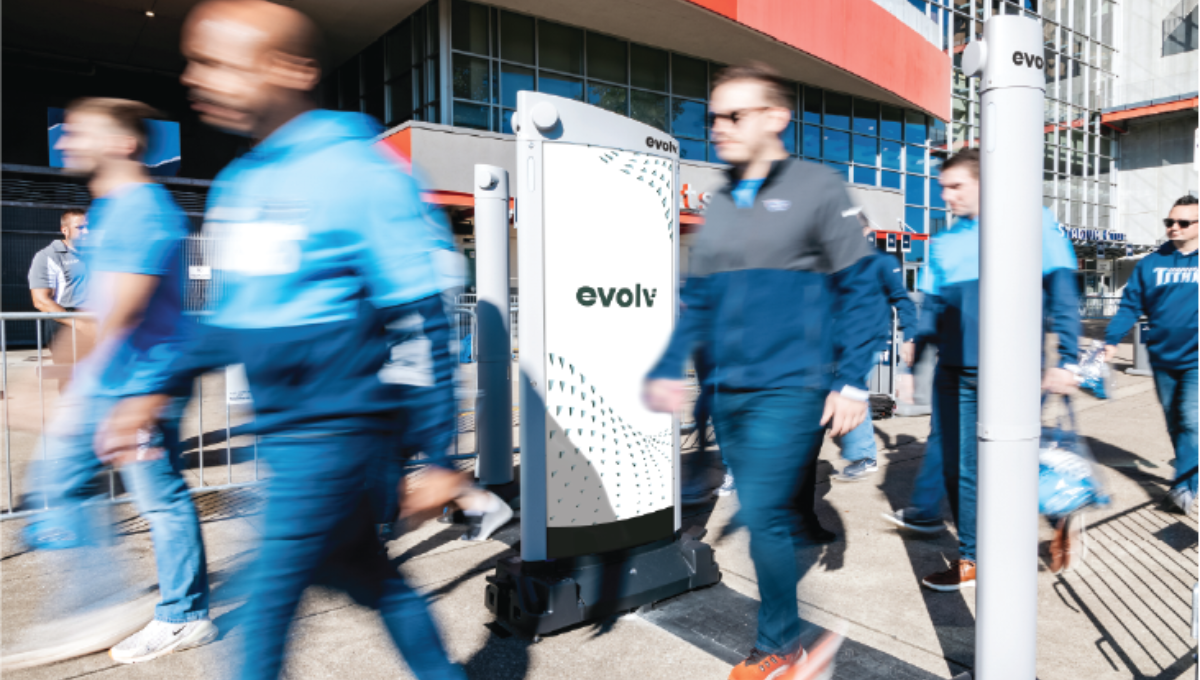
It’s fast. Evolv Edge can check up to 600 people per hour for concealed firearms, non-metallic explosives, suicide vests and other threats, without requiring anyone to empty pockets or take off shoes. So long as people walk at normal speed and go through one at a time, they might not even notice they are being scanned.

The Evolv Edge can be configured to provide real-time alerts when a terror suspect or criminal approaches the system. A camera in the column of the unit captures footage of approaching people. By the time they arrive, the imagery has been compared to official watch lists for possible matches. Customers can also opt to have the matches sent off to a human expert for real time review, to increase the likelihood of a positive ID before interdicting the suspect. The process typically only takes a few seconds more. (We don’t keep any of the imagery or other information we collect on individuals.)

It’s easy to use. No one is looking for another security system that requires extensive training, and is only as good as the operators’ ability to stay vigilant hour after hour. We designed a simple software interface, in which potential problems show up as a red alert on a photograph of the visitor.

Under the covers, the software offers simple but powerful controls that enable users to adjust the system— say, to automatically turn up the scan sensitivity for unrecognized visitors or to turn it down when a badged executive walks through. But our goal was to create a system that any temp security guard can use with minimal training.

Evolv Edge is portable. The system is comprised of two 5’6” towers that weigh a combined 250 lbs. It comes on wheels, so can be easily rolled into place and be up and running in less than 30 minutes. Use it to screen employees and visitors at the main entrance of your facility, or move it to add a random, unobtrusive layer of security in response to heightened threat levels..

Many of us at Evolv Technology are veterans of the security screening business. We built Reveal Imaging Technologies, a leader in checked baggage explosives detection which is now part of Leidos. But to create Edge, we had to throw out much of what we had learned in the past. Rather than bake all of our technical capability into the hardware, we took a much more software-centric approach. That way, Evolv Edge could be reconfigured for a broad set of environments and applications. Rather than obsess over spotting the smallest pen-knife, we recalibrate our priority to focus on the most dangerous threats, but in far less time and with far fewer false positives. And for the first time, we had to worry about aesthetics. After all, Evolv Edge units won’t be tucked away at some nondescript checkpoint, but will reside in office atriums, stadium entrances and in front of restaurants and night clubs. They’ll have to look good.

Judging from the early response to the system, we’ve hit a nerve. We’ve spoken with more than 300 entities, ranging from leading transportation authorities to rock and roll band managers looking for a system they could take on the road to concerts. Some of these parties are anticipating upcoming regulation. For example, governments around the world are considering mandatory curbside screening at airports, to avoid the types of attacks that occurred in terminals in Brussels and Istanbul earlier this year. Other companies are determined to find cost-effective means to prevent the most heinous, mass casualty attacks, both to protect life and limb and because they believe they will increasingly be judged by their ability to keep employees, customers and other visitors safe.

While we recognize we are just at the start of a long journey, we’re confident the Evolv Edge® system is an important first step. We deployed it at the entrance to one of the sections of UK Security Expo last month, and it performed admirably during the two-day test drive. We think of it as a basic building block — a layer that almost any company can use as part of a security system to meet its particular needs.

If you agree that there are too many media headlines proclaiming the tightening of security AFTER an attack, then we should connect.

Mike Ellenbogen is the CEO and Co-founder of Evolv Technology, founded in 2013. Prior to Evolv Technology, he co-founded Reveal Imaging and successfully led the company, achieving double-digit growth in both revenue and profitability since its inception. Through his more than 15 years of contributions, Mike has reshaped the explosives detection industry. Reveal Imaging was acquired by Science Applications International Corporation (SAIC) in August 2010.

3 Ways Artificial Intelligence Will Impact The Airport

Last week, a group of aviation leaders met in Silicon Valley in a forum orchestrated by AAAE to chart a course for the innovation and improvement of airports. I had the honor of joining leaders from Google X, Lyft, and Google Tango on a panel discussion in front of an audience of innovative Airport Directors, CIOs, and government leaders. We talked about strategies for harnessing artificial intelligence to improve the airport today. If you want more background on what modern artificial intelligence means, read this piece by The Economist.

As an airport operator, why should I care about artificial intelligence?
When your plane lands, a human alone does not decide which gate it should go to, just like it’s not a human that sets the price of your ticket. AI is already in the airport — but why does it matter to you as a professional? How does it help with your shrinking budget, and how will it enable you to confront the new threats and opportunities you will face in 2017 and beyond? How can it drive more intelligent utilization of your limited human resources and your infrastructure?

Here are my 3 takeaways from this unique “meeting of the minds” between airport leaders and technologists about where AI can take us in the near future:

Luke and C3P0

1. It’s about man AND machine, not man vs. machine.
In complex, real world environments such as airports, AI can’t do it alone. Today there is often a meaningful gap between what you need AI to do and what it can deliver. How can you tell when AI is falling short? If you are getting false alarms or seeing meaningless answers, you’re in gap territory. For example, try asking Siri a complex question. “Sorry, I didn’t get that.” Or try relying on video analytics to generate meaningful alerts in an airport environment. In both examples, AI is well equipped for about 80–95% of the task, and the remaining 5–20% ends up being your headache. What AI leaders at Google, Amazon, and the like have figured out is that when it comes to mission critical applications, you need a combination of AI and human judgment (“IQ”) in order to close the gap and get you across the goal line. For examples above:

  • Google Maps was built by using Google’s AI to find the streets and intersections in imagery but with Google’s “Team Ground Truth” (human IQ)to fill in the gap on tricky one-way streets and construction zones.
  • When you “smart scan” your receipts for creating an expense report using Expensify, AI can handle the crisp, clean ones, but human IQ is needed for those crumpled up ones that have been sitting in your pocket for hours at the conference.
  • Amazon embraces the AI + IQ formula so much that they created an entire platform for it called Mechanical Turk (which now has over 500,000 “Turkers” who earn a living on it doing “Human Intelligence Tasks” or HITs). Your product recommendations come to you courtesy of a system that is part human and part machine.
  • Evolv Technology is now leading an effort to bring this powerful AI + IQ formula to the physical security domain at airports and other facilities across the world.

So when it comes to AI systems for your complex environment, think about utilizing systems where human judgment gets you the last mile, so that your operators on the front lines don’t have to deal with the false alarms or brittleness of AI-only systems.

2. AI can be used to layer on additional insights, or it can be put to work to get rid of the noise. Start with the latter.
We as humans are tool users, but our layering on of technological tools over decades has caused us to become inundated with noise. We weren’t always flooded with information: From the earliest days of aviation through WW2 and until around 1980, we introduced technological advancements and managed to keep the noise level low. That changed in the 1980s, and now in 2016 we may be at “peak noise,” owing to the fact that we added technologies in an accretive way and caused the noise level rise and rise. If you added up all of the alerts your team receives from all of its tools, it would likely number in the hundreds per person per day. And all but a small sliver of them would be noise.

So what could the near future look like?

  • More black screen than multi-screen. Today’s “nerve centers” (e.g., the Security Operations Center) don’t do much for conservation of attention. How do you transition to a less noisy environment? Start by tallying up the noise your team receives today, and then put it into buckets based on the source and possible cause. That analysis will help guide your search for triage tools, as you can then look for AI that is able to tackle that category of false alarm.
  • The impact of one human staff member increases as the labor force becomes augmented and distributed. We heard a story about an airport in Leesburg, Virginia a couple of weeks ago that was doing a proof of concept for remotely provided air traffic control services. Imagine how powerful a distributed workforce that has AI triage tools at their disposal would be.

3. Embrace agile infrastructure and operations to be ready for the near future.
A challenge with which everyone in aviation is familiar: You do your best to pre-plan infrastructure to last 30+ years and then something happens that invalidates your plans. Fuel prices change and now your fleet of regional jets is no longer economical. A terrorist attack happens and now your checkpoint design is outdated. Uber and Lyft happen and now your parking plans seem uncertain. When you use brick and mortar decisions to drive outcomes, there’s little you can do to respond when you’ve poured your last footer on Christmas Eve and circumstances change. The aviation world has experienced many instances of short-term volatility, but these historical examples may be no match for the breakneck pace of change that will come in 2017 and beyond.

We’re entering into an area of exponential change, a term which means that advances are getting bigger and bigger and happening more and more quickly. It’s a hockey stick curve and it suggests some pretty intense things about our future. The kinds of unpredictable changes that made pre-planning tough before will become constant. So how do you deal with that?

  • Evaluate the use of subscription services for software (SaaS) as well as hardware (HaaS). Rent the technology and encourage the manufacturer to keep the updates coming continually, rather than buying a solution today waiting 5 years to purchase an upgrade to technology that became obsolete 4 years ago.
  • Seek out agile tools that work with your existing infrastructure and can be deployed and upgraded as your infrastructure is being upgraded. For hardware, this means portability and ease of installation. For software, this means compatibility with your existing systems.

The practical AI strategy for the airport of the near future
AI runs the consumer world, and in 2017 and beyond, it will have significant impact on the way you utilize your limited human resources and the effectiveness of your infrastructure and operations. The depth and intensity of the discussion at the AAAE Airport Innovation Forum highlighted the fact that the community is taking a proactive and pragmatic stance on bringing technology breakthroughs into the airport. Use these 3 key principles to launch your own world class, innovative strategy:

1. It’s about man AND machine, not man vs. machine.

2. AI can be used to layer on additional insights, or it can be put to work to get rid of the noise. Start with the latter.

3. Embrace agile infrastructure and operations to be ready for the near future.

For some of us at Evolv, the mission of keeping people safe is personal

Fifteen years ago my college roommate perished as the north tower of the World Trade Center came down. Parents lost their child. A man lost his brother. A wife lost her husband. A son lost his father.

Twenty seven years ago I started my career, working two blocks from the World Trade Center. I lived and played in the shadows of those towers. A close friend and colleague from those banking days escaped the tragedy of September 11 and has spent the past fifteen years rebuilding his firm, honoring the sixty six lives that were lost, and helping the firm’s families.

September 11, 2001 has had a profound impact on how I look at the world and my contributions to it each day.

After a career helping companies use technology to address their business challenges, I am fortunate to be the co-founder of a company who is helping society address one of its biggest problems. I am working with a talented team of people that shares this passion and we’re dedicated to applying technology to help solve this difficult challenge in every place people live their daily lives.

As a team, we have worked in, looked at, and experimented with technology that has become pervasive in many other industries. There are so many different technologies: imaging sensors, human augmented machines, miniaturized compute platforms, artificial intelligence models, microservices-based architectures and augmented reality, to name just a few, that can be applied to making this world a safer place. These technologies can be combined in interesting ways using concepts such as a modular design, internet of things, software as a service, user-centric models and crowd sourcing to deliver compelling solutions.

Our team has spent the past three years together developing an architecture, a set of technologies, and our first product to address the persistent problem of ‘known wolves’ perpetrating harm on members of our global community. To address the continuously changing, pervasive threat, we have developed a system that, we hope, can be dynamic, intelligent, and effective in preventing these types of people from committing those types of acts.

I wake up each day driven by our mission. I don’t want another Steve to be taken from his family. I don’t want another Jon to have to comfort the families of lost colleagues. I don’t want my children to be concerned if they should go to a ball game or ride the train or enter an office building. I don’t want them to live that kind of life.

Why the Rio Olympic Security team faces the most complex threat set ever

The narrative leading up to the Rio Olympics to date has been troubling. From Zika to corruption, safety and security have now emerged as one of most concerning areas. The same games that are meant to celebrate the world, united by Olympism are happening at a time when mass casualty attacks like those in Brussels, Orlando, and Nice are becoming the new normal. We refuse to accept that and wanted to share some thoughts on the unique challenges we see for the dedicated security team committed to protecting the athletes, volunteers and fans who will spend the next fourteen days in Brazil.

How difficult is it to keep 600,000 people safe over 19 days?
These 2016 Summer Olympics will be secured by 85,000 personnel protecting 10,500 athletes, 70,000 volunteers and about 500,000 fans watching 306 events over 19 days across 32 different venues in four different geographic areas with football matches in five additional cities. These people will enter an array of venues from large stadiums to small arenas, outdoor ranges, beaches and the open water. This is where the challenge begins.

So how can you efficiently and effectively screen this volume of people coming in and out of the games?
Let’s use the largest single location to illustrate the security challenge.

Rio Olympic Stadium

The Barra Olympic Park (picture above) spans almost 300 acres, and is home to nine stadium venues hosting thirteen different sports, with an aggregate capacity of 95,000 fans.

On the fifth day of competition at Barra, 329,000 fans will attend 21 different events starting at 8:30am and ending after midnight. This is the equivalent of having sold out games at Fenway Park (Red Sox), TD Garden (Bruins/Celtics), Citi Field (Mets), Yankee Stadium, Madison Square Garden (Rangers/Knicks) and Met Life Stadium (Jets/Giants) on one consolidated campus, all in the same day.

Fans, athletes, volunteers and employees will be coming and going all day long. They will be arriving on buses, via subway, private vehicles, by bicycle and on foot. The Barra Olympic Park peninsula borders water on two sides and a very busy traffic area on the third. This is one tough perimeter to secure. Checkpoints will be set up around the perimeter to screen people and their bags. Given the volume of people throughout the day and the breadth of belongings they will have with them, this poses an enormous security challenge for any guard force. Add visitors speaking many different languages who may be new to Olympic-style security screening and the lines are likely to be very slow. One more variable: people will be bringing all sorts of personal items that local guards have not experienced before in their training. Imagine their thinking is this a threat or not? Is this on the prohibited list?

Let’s consider the security challenge faced by the Rio Olympics security organization. First and foremost, these games are once in a lifetime for Brazil (and is the case for many Olympic hosts). Therefore, there is no ‘permanent’ security force that secures all of those venues with those crowds on a regular basis. Second, looking for ‘abnormal behavior’ in a sea of chaos is virtually impossible. Thousands of people from hundreds of countries, moving around day and night over nearly three weeks creates a constantly changing environment. There is nothing normal about it that can provide a baseline for security personnel to assess unusual behavior against. Techniques to gather intelligence, identify suspicious behavior, and employ counter surveillance strategies are exponentially more complex.

In addition to its athletes, each nation brings trainers, coaches and other support staff. Is it time to think about each nation contributing large numbers of security personnel to the games? Should we have a transnational security organization that moves from one international sporting event to the next? Or can we use technology to reduce the complexity and be a force multiplier?

Given today’s threat landscape and the complexity of the modern Olympics, do we need to fundamentally rethink how we secure the games?

The world is full of soft targets and we’re defining a new approach to protecting them

We are focused on the mission of keeping people safe. Here’s a quick look at how we see our challenge, our opportunity and our vision for the future of screening at soft targets around the globe.

A dynamic adversary

Another mass casualty event at yet another soft target. Riyadh, Bangladesh, Istanbul, Orlando, Brussels, Paris and San Bernardino.

Questions emerge: Were the terrorists lone wolves or known wolves? Were they inspired or directed? How can we improve protection? Should we push the perimeter out? Are we creating new soft targets with new checkpoints?.

We’ve spent the past three years talking with hundreds of professionals about securing their people and their facilities from active shooters and suicide bombers. These professionals provide protection to stadiums, transportation hubs, subways and rail, office buildings, special events, hotels and entertainment venues, military facilities, critical infrastructure such as chemical and nuclear facilities, and landmarks. They do this in the U.S., Canada, Europe, Asia, and the Middle East. The needs may differ among them, but their mission is the same: keep their people and places safe.

Defining a new approach

We have accumulated, synthesized and prioritized the needs of this global group of security professionals to define an entirely new approach to physical security. We have researched, evaluated, built and tested a wide range of sensors, software, and analytical approaches to detect the physical security threat. We have studied and analyzed the operational realities of keeping soft targets safe. We’ve looked outside the physical security industry for innovative approaches and technologies to bring to bear on the physical security mission.

Enter Evolv

One thing is crystal clear: We need to provide better security without disrupting people’s everyday pace of life.

This should be accomplished with the latest sensors, software, and analytics, combined to provide a seamless screening experience, letting the public easily pass through while trapping those intending to do us harm. Our product is emerging from development, none too soon to help protect the next set of soft targets.

Our Products

The most effective security processes incorporate means to adjust sensitivity based on risk level. Our products enable risk-based adjustment as a core capability built into the technology. These adjustments can be made for a specific individual, location or time of day. Settings allow for different detection sensitivity and threat sets, based on intelligence, site-specific factors or a randomness protocol.

Our technology is designed to enhance the look of your location, not detract from it. Products are easily deployed at access points, lobbies, and entrance ways with little to no infrastructure modifications. Our design approach is to minimize the impact on your location by carefully designing the product and the ways it can be used.

Randomness is an important component in an effective security protocol to counter surveillance activities or to disrupt planned operations. Our screening products can be rapidly relocated and set-up to enable unpredictable screening at different locations throughout your facility.

Today’s security environment demands multiple layers, both visible and discreet. Results are typically fused at a command center, providing a more complete picture of the security situation. Our products improve situational awareness by inserting real-time multi-sensor data into the overall picture. In addition to providing screening results at the unit and to the command center, real-time information can be served to mobile security officers or others connected to the operation.

– Real-time video surveillance
– Facial recognition and known wolf matching
– Firearm and explosive detection

We have designed our products from the ground up to detect and prevent threats that can cause mass causalities. From sensors to software to networking, they are focused on keeping your people safe while allowing free flow and movement. We use a combination of sensors, built on active millimeter wave, that inform automated detection algorithms to provide a fully automated ‘red light’ or ‘green light’ decision. Detection settings can be adjusted based on the latest threat level. Evolv products are designed for high detection rates with minimal false alarms, to focus on the threats and minimize the impact on your visitors.