How the Digital Transformation of Physical Security Impacts a Venue’s Stakeholders

When considering major organizational changes, like the digital transformation of physical security at a venue, security and operational leaders must ask themselves who this change will impact, and how.

Of course, as part of the evaluation of an organization’s physical security, reducing risk is paramount. All changes that impact stakeholders from across a venue must be evaluated through this lens.  

This blog considers the perspective of five groups impacted when a venue introduces touchless physical screening for weapons detection—visitors, security leaders, operations, guard staff, and the public at large—and how the results of such a change are experienced by each group. For more information on the benefits to these stakeholders, read the new eBook: Five Ways Data Improves Physical Security.

The Impact on Visitors

New physical screening technologies first and foremost impact guests, employees, and other visitors who walk through the doors of a venue. With Evolv Express®, rather than waiting in long lines for walk-through metal detectors, visual bag checks, or wanding technologies, people entering a venue can simply walk through the system at a natural pace.

Touchless screening preserves the dignity, health, and safety of visitors, while targeted visual alerts delivered onscreen for guard staff return focused information about where on a person or in their bag the potential threat could be located, accelerating alarm resolution and further reducing the burden on visitors.

The Outcomes: Reducing the need to stop, divest of personal belongings, and turn over bags improves the guest experience, as evidenced by the change from 4.0 to 4.6 out of 5 ratings for guest experience at the Georgia Aquarium following the introduction of Evolv Express systems—a change the team there attributed to the replacement of walk-through metal detectors in their lobby with Evolv Express systems.

The Impact on Security Leaders

Security leaders at your venue prioritize security ConOps (concept of operations) approaches that ensure the highest degree of safety for visitors while maintaining the best possible guest experience. And while “managing by walking around” can tell these leaders a lot about what’s working and what isn’t, traditional methods like walk-through metal detectors and wanding simply don’t make an accounting of their own success—or lack thereof.

In contrast, Evolv Express keeps a count of each visitor that walks through and each alarm that is triggered, and it provides operators with the means to tag each alert upon resolution in order to identify which types of threats are encountered most. Evolv Insights provides visibility into these metrics across every day, time, and type of event at a venue: down to highly granular, five-minute intervals.

The Outcomes: The objective data accompanying Evolv Express has helped one performing arts venue find 85 knives and 20 handguns in just one month of operation with 9000 visitors.

At another popular performing arts venue with Evolv Express, Pittsburgh Cultural Trust, the team was able to improve their ConOps with a smaller security footprint (by 60%), improved staff use through redeployment to other parts of their venues (by 50%), and by eliminating the need for guests to stand outside in the rain—improving guest experience and security together through better data-driven planning.

They talk about this success in these terms: “Based on analytics for past events, we can make better staffing decisions—from the number needed to predicting when surges will occur. Knowledge is power and the more I can get from data, the better I can do my job and ensure the safety of our guests.”
– Chief Security Officer at Evolv Customer Pittsburgh Cultural Trust

The Impact on Venue Operations

With clearer front entryways, no more security bottlenecks, faster ingress by visitors into their venues, and comprehensive analytics for visibility into traffic at every entryway, venue operations teams can also benefit from Evolv Express and Evolv Insights.

Faster “mean time to beer” is one such positive outcome—getting people to their seats faster can boost sales and make for happier visitors that have more time to spend on concessions and merchandise. But better data can also help these vendors make better staffing and resourcing decisions, improve operational efficiencies, reduce waste, and maximize profitability. It can give guest services teams the evidence they need to gauge staffing needs and keep visitors flowing through areas typically congested after guests have passed through security—like ticketing, usher services, guides or docents, and so on.

Outcomes: The Georgia Aquarium uses information gathered from Evolv Insights, the companion analytics application to Evolv Express, to understand who is coming through their entrances when, and to tailor programs accordingly. What’s more, up to 50% of the front lobby space at their aquarium has been reclaimed from security lines and walk-through metal detectors to be repurposed as exhibit space, creating a more welcoming, positive experience for their guests.

In their own words, “With the Express systems, we know exactly how many guests enter and at what time of the day… Our marketing department can leverage this information to determine programs and spend. Our operations team uses the data to make broader staffing decisions.” – SVP of Hospitality and Operations, Georgia Aquarium

The Impact on Guard Staff

Guard fatigue can exacerbate risks at venues that use walk-through metal detectors and other manual methods of checking visitors. When everyday metal objects can cause these systems to produce so many false alarms, it becomes easier for guard staff to miss seeing weapons when they are there. Knowing a system alerted, but not knowing where on someone’s person to look, is another risk introduced by traditional, analog methods that can lead to guards missing threats.

Add to these stresses the long lines, crowded queues, and high-touch scenarios, and customers can quickly become frustrated with guard staff—and guards with customers. It’s no wonder, then, that turnover rates can be high, pay low, staff inexperienced, and onboarding time a burden for important guard roles at public venues.

The Outcomes: The Georgia Aquarium reported reduced staff attrition following the introduction of Evolv Express. And reduced turnover adds up to time and budget saved in onboarding and training. Also useful for onboarding and training: information about what threat and benign items the venue experiences the most—to ensure guards will know what to be on the lookout for when the system does alarm—along with information about what event types see the most threat items and where. This information can help security leaders train, staff, and install the most experienced guards in the right areas at the right times.

The Impact Beyond Your Four Walls

Safer, more secure venues make an impact not only on the brand but also on the community in which a venue operates. Stopping would-be perpetrators before they have an opportunity to harm people will improve the safety of venues and safeguard those in their care. Even before the threshold, would-be perpetrators often see security equipment and turn right around, either leaving their threat items outside the venue or not choosing to enter and do harm to others.

And as visitors, employees, VIPs, and other members of the surrounding community begin to realize the ease of entry, the high-quality experience afforded to guests, the reduced impact on guard staff, and the resulting improved physical security afforded to all who enter the venue, it’s just possible that the impact of a digital transformation will extend beyond those four walls. The ability to lead new initiatives in physical security throughout an industry and across a community might just set off a chain reaction of venues seeking to also improve the security of those around us—other families, concertgoers, art enjoyers, employees, sports fans, artists and athletes, future artists and future athletes—and we may all, together, begin to build a safer world.


Pittsburgh Cultural Trust Modernizes City’s Theaters with Evolv Express

During the COVID-19 pandemic, mass shootings in the United States increased. In fact, shootings doubled in July 2020. And for the entire 2020, gun violence and gun crime led to the highest death toll in over 20 years with more than 19,000 people killed, according to the Gun Violence Archive

As COVID-19 slowly moves into an endemic state and we get more comfortable going out, we’re also more acutely aware of the potential for an active shooter to be present. Before the start of an event or performance, our ability to spot the venue’s exit signs has become second nature.  

Meanwhile, in the event community, the downtime during the pandemic prompted many theater owners to reconsider how they would manage the safety screening process when patrons returned. The Pittsburgh Cultural Trust is among them. A nonprofit arts organization, the Trust promotes economic and cultural development in downtown Pittsburgh. 

When its event venues were closed due to the pandemic, the security team at the Pittsburgh Cultural Trust used the time to assess the screening process throughout its various properties, which span the city’s 14-block entertainment district. Prior to COVID-19, they welcomed more than two million people at over 1500 events annually. 

The security team decided it was time to address their time-consuming, labor-intensive screening process that consisted of magnetometers and wands. Specifically, while long queues and tables for checking bags reflect today’s safety protocols for entering public places, they interrupt the magical experience of going to the theater. Not to mention the impact the entire safety screening process has on staff, requiring them to spend more time on alert and less time greeting patrons. (The delays can also affect profit from the theater’s concession stands.) 

Based on their analysis, the security staff at the Pittsburgh Cultural Trust realized that its processes were not designed for the future safety and comfort of guests. That future is one that requires advanced weapons detection and screenings – without compromising the patron experience. Further, they realized that safety screenings are not just about the process of screening patrons. When you add data and artificial intelligence to the process, you get a more comprehensive security picture for an entire venue. For example, integrating data from foot traffic and scans can provide insights that inform threat category analysis, alarm statistics, and visitor arrival curves. This data helps security better manage and mitigate  all potential threats before patrons arrive. 

After evaluating Evolv technology, Pittsburgh Cultural Trust selected the Evolv Express Single-lane and Dual-lane Systems, along with Evolv Cortex AI and Evolv Insights for both employee and guest screening. Now, entering one of their theaters is fast, easy and safe. Guests move quickly through the kiosks (no more waiting outside in the rain!), while staff spend more time moving the flow of foot traffic, creating great customer experiences, and taking care of other non-security related tasks. In the future, The Pittsburgh Cultural Trust will integrate the Evolv Express systems into its security operations center for a comprehensive view into physical and cyber security threats. 

Pittsburgh theater goers now have even greater confidence in the safety measures that have been put in place as they return to the venues.  

To learn more about The Pittsburgh Cultural Trust’s strategy behind the reopening of its theaters, read the full case study.  

I’m a CFO with decades of experience scaling complex, global financial teams. Here’s why I joined Evolv.

I have spent my career helping companies grow their business from a financial perspective, and for the last decade I have built world-class finance teams, scaled complex business operations, and executed strategic transactions. And today, I could not be more excited to be joining Evolv Technology as Chief Financial Officer.  

As a lifelong sports fan (go Patriots!) and a former U.S. Olympic Development & NCAA Division I soccer player, I’m also very aware of the significant role that live sports and public spaces play in our culture. For my entire adult life, I’ve had to empty my pockets or open my bag more times than I can count to get in to watch some of my favorite sporting events.  

Even more frustrating, sometimes these long and cumbersome lines would cause me and my family to miss the beginning of the game or create anxiety as we waited to enter – far from the ideal experience you want as you are about to start enjoying a game. 

I also serve on the board of directors of Project GOAL, an organization that uses the power of soccer to help youth in underprivileged communities achieve economic success. Having a front row seat to witness the way that sports can have a positive impact on youth and enable them to succeed in the world has been one of the highlights of my career. 

That is what was so attractive to me about the opportunity to join Evolv. Not only is the company doing well by being at the forefront of solving a problem that has affected the experience at one of my favorite pastimes (professional sports), but they are also doing good by helping to make everywhere a safer place to work, learn, and play. 

The company’s GiveEvolv initiative was also a compelling reason for me to join the company. Just as I have done with my work at Project GOAL, I look forward to helping the company ensure that all students – no matter where they go to school – can be safe from gun violence.  

With more venues, workplaces, and schools recognizing the duty they have to keep their patrons, employees, and students safe from violence, there could not be a more exciting time to join and help scale the business to make this technology accessible to everyone. The company has set a new and higher standard for what security screening should be, and I could not be more excited to roll up my sleeves and help to deliver on our mission to democratize security.

School Shootings: Imagine Never Having to Say, “All Clear” Again

The opening of the school year always holds so much promise. This year especially, it was brimming with even more hope as students officially returned to the classroom after learning online throughout the pandemic. As students slowly return to normalcy, they face another reality of being back in the classroom – school shootings. 

In September of 2021, there were 55 school shootings across the country. This is more than double the total of shootings for most full years, according to the K-12 School Shooting Database managed by the Center for Homeland Defense and Security. 

This fact is not easy to write. And it’s not clear what’s more jarring – the increase in school shootings, or the reality of needing a national database to track and manage the incidents.   

After a shooting, once the school and campus have been thoroughly checked to ensure additional threats of danger are no longer imminent, students, teachers and administrators are given the “All Clear” by law enforcement.  

Yet as well all know, “all clear” isn’t a signal to return to normal as the emotional toll and disruptions in learning are significant. In fact, safety protocols often call for the school where the shooting took place to be closed for several days. Oftentimes, out of an abundance of caution, nearby schools close on the day of the shooting.  

In the aftermath of the recent shooting at Timberview High School in Texas where four people were injured, ten nearby schools were put on lockdown that day. Timberview High School remained closed for six days. During that time, as counselors prepared for reopening, an evaluation of campus safety and security protocols was undertaken.  

How a gun gets into a school is always one of the first questions. At Timberview, like many schools, there are no metal detectors. However, every campus in Timberview’s school district has law enforcement officers.  

Arguably, even when a school can afford to install metal detectors (many can’t), guns still find their way into school due to a variety of factors. For example, the rush at the morning bell and a long queue can prompt security to temporarily turn off the detector. Or the detector is set off by any metal, including laptops, leading to a time consuming process of searching individual students.  

Still, there are ways to apply technology to proactively identify and address potential threats of gun violence in school. A recent opinion piece written by renown homeland and national security expert and analyst Charles Marino and published in The Hill says this, “As an additional line of defense, there is no doubt that technology can help detect, disrupt, and deter someone that has their mind set on causing a mass casualty event…’  

‘Unfortunately, since neither universal background checks nor an assault weapons ban will eliminate the active shooter threat from ever happening again, it is time to focus on the role that available and affordable technologies can play in helping to mitigate and respond to shooting attacks in supermarkets, office buildings, houses of worship, schools, airports and anywhere else where innocent lives may be at risk.” 

Reinforcing Marino’s point, available and affordable technologies can make a difference. This is why we started the GiveEvolv program. GiveEvolv provides need-based grants of Evolv Express® weapons detection systems to K-12 schools in the United States that otherwise would be left vulnerable to gun violence.  

As we head further into the school year, campus shootings continue to make headlines. Learning is disrupted. Enforcing safety protocols has unfortunately become second nature for too many. We all know the short- and long-term repercussions and they are worth repeating – the physical and mental impact of a school shooting is devastating. Hearing “All Clear” offers only temporary relief because it signals that yet another incident has occurred. Imagine never having to hear those words again on campus.   

If you are a school administrator or know one that may benefit from the GiveEvolv program, you can learn more about applying for a grant here

The New Standard for Workplace Safety

One of the first responsibilities of an employer is to provide a safe workplace. It’s just the right thing to do. It’s also a good business decision, and a regulatory requirement (see OSHA Section 5). The COVID-19 pandemic has tested employers’ commitment to workplace safety. Many employers have passed the test and kept their people safe from the virus. However, as the virus yields to gradually rising vaccinations and workers return, they are being greeted by a second, often forgotten pandemic: workplace shootings. 

The COVID-19 pandemic initially seemed to reduce gun violence, including workplace shootings. Based on the tragic headlines below, it now seems clear that the temporary lull is over: 

It feels ominous and tragic to me that we’ve had four workplace shootings in the first two weeks of October. Historically, there has only been about one workplace mass shooting per year. A recent Ontic survey of 300 security leaders at large companies found that nearly a fifth of them (18%) have had to deal with an active shooter event at one of their sites in the first five months of 2021 alone. It feels like something has fundamentally changed in the threat environment. 

What’s driving the change? Experts recently interviewed by NPR theorize that potential shooters have had a lot of extra time to plan attacks during the pandemic and that there are more targets available now that more people are back at work in more locations. I would add a few additional important drivers: the prolonged stress and isolation of the pandemic, rising resistance to mask/vaccination mandates, the spread of extremist ideologies, acute political polarization, widespread social unrest, and widely available firearms. It has all combined to create a tragically perfect storm. The DHS and FBI summarized the threat their May 2021 joint report, saying “The greatest terrorism threat to the homeland we face today is posed by lone offenders, often radicalized online, who look to attack soft targets with easily accessible weapons. Many of these violent extremists are motivated and inspired by a mix of socio-political goals and personal grievances against their targets.” 

Given the current threat environment, how can employers best fulfill their duty of care in providing a safe workplace? The most obvious way to prevent shootings in the workplace is to keep guns out of the building in the first place. Most employers have policies to prohibit guns on private property, but they have largely been unwilling to enforce their policies through weapons screening. Why? Because screening for weapons with old metal-detectors creates a prison-like experience for workers and leaves workers stuck in crowded waiting lines that are just unacceptable in a pandemic recovery environment.  

In an intensely competitive labor market, employers may feel forced to choose between a positive worker experience and a gun-free workplace, and when push comes to shove, they have often chosen worker experience. That choice is tragic because it is based on an outdated understanding of what’s technologically possible.  

AI is transforming every sector of the economy, and physical security is no different. AI-based weapons screening like Evolv Express® makes it possible to have both a great worker experience and a gun-free workplace. Reliable weapons screening that doesn’t require workers to stop and empty their pockets or surrender their bags as they walk through is a game changer.  

I believe this disruptive new technology is redefining the standard for employers’ duty of care to workers. Having a “no guns” policy without any effective enforcement is no longer an option. If proven technology to enforce a no-guns policy is broadly available, operationally feasible, and commercially affordable, it won’t be long before board members are asking why management is taking unnecessary risks. 

Sports stadiumsperforming arts and entertainment venues, and tourist destinations were the first to discover and implement the new standard in weapons screening because visitor experience and safety are fundamental to their operation. Now that the leaders in these industries have made their move to AI-powered weapons screening, the followers are racing to catch up. The same pattern will likely play out in industrial workplaces, citizen-facing government offices, health care facilities, office buildings, and other workplaces.  

Now is the time for employers to reshape their workplace safety strategy to reflect the current threat environment and the technological disruption that is underway. The good news is that investing in meeting the new standard is not going to break the bank or be disruptive to normal operations. We’ve worked hard to innovate not only in technology, but also in our pricing model. Our customers (and their CFOs) are often pleasantly surprised by our subscription-based “security-as-a-service” pricing for Evolv Express. They also love that they can often train existing staff to use our equipment, so there isn’t a huge labor cost hurdle to overcome. As a mission-based company, we want to make it easy for employers to do the right thing for their workers. It’s a win-win-win situation.  

As the pandemic recovery continues and seasonal hiring surges this fall and winter, more workers than ever will be walking into workplaces that are unprepared for the current threat environment. We should all hope and pray for their safety, but we can finally do much more than that. If you are an employer who is ready to do more, let’s talk soon

Download our workplace violence infographic to learn more about how violence in the workplace is persisting and on the rise in the aftermath of the COVID pandemic.

The Future Is Here: Smart, Connected Venue Security with Evolv

Senior security leaders across multiple industries, surveyed in a joint study by Microsoft and Accenture, cited “reactive threat management” and “intuition-led decision-making based on subjectivity” as top challenges in physical security. The technologies predicted in the study to transform these challenges? “Artificial intelligence and signals processing” at the venue’s threshold; the power of analytics to “sift through overwhelming amounts of data”, and Internet of Things-connected sensors and devices to “collect intelligence in real-time.”

These once sounded like the stuff of science fiction: so-called “smart cities” with “smart venues” that screen visitors unobtrusively, only stop potential threats while letting everyone else pass through, and stream business intelligence back to security teams to improve decision-making and enable a more proactive security posture.

Hello world! With Evolv Express AI-powered security screening and its companion analytics application, Evolv Insights, this future is here. In the latest software release launching this month, new capabilities for connectivity and analytics improve five important dimensions of physical security:

1 – Balance Physical Safety with Visitor Experience

Security screening with Evolv Express is powered by advanced sensors, cameras, and artificial intelligence to distinguish weapons threats from everyday items. It moves guests through a venue’s entryways up to 10 times faster than metal detectors: up to 3,600 visitors per hour at normal walking speed. No stopping to empty pockets or hand over bags means screening is less obtrusive, improving the visitor experience. And no stopping or queuing up means Evolv Express is safer than traditional methods, virtually eliminating the threat of “soft target” scenarios for mass casualty events.

As a connected device, dare I even say an IoT device, Evolv Express captures critical information such as visitor flow rates, alarm rates, and threat types detected at every venue entrance, making this data available for consumption and interrogation across multiple business dimensions—date, time, location, entrance, and event type—in its Evolv Insights analytics platform.

To maintain the highest degree of guest experience and physical safety, Evolv Express offers a range of settings, and the new What-If Sensitivity Setting Analysis in the latest release of Evolv Insights lets security professionals use historical data to see how the system would have performed on an alternate setting. This helps security teams refine their concept of operations (ConOps) strategies and further reduce nuisance alarms, improve guard performance, and improve the guest experience without compromising visitor safety.

2 – Know Your Vulnerabilities

New features for Alert Categorization and Analysis in the latest software release advance the system’s ability to report on what threat types are found at a venue. Security teams resolving issues at the Evolv

Express system simply “tag” alerts with a single, one touch icon set to indicate threat items or nuisance items.

Using this information, new dashboards in Evolv Insights let users drill down into where and when each type of alert appeared, across entryways, times, and events. Armed with this knowledge, security leaders can better focus staff training, deploy more experienced staff when and where they will be needed, and improve overall staff preparedness.

3 – Improve Venue Operations

Better data can help teams beyond security improve visitors’ experience—with ticketing, concessions, retail, ushers, guest services, guides, and more—because the better informed these teams are, the more seamlessly they will operate. Information gathered at every Evolv Express system and available in Evolv Insights analytics will help venue operations improve decisions about staff to guest ratios, staff deployment at different locations and times, along with other resource decisions to boost efficiencies and reduce waste.

To better understand how security and operational needs differ across types of events, the latest release of Evolv Insights introduces Event Type Analysis. Different types of events—think rock concerts, sporting events, corporate events, speaker series, and family productions—will likely exhibit very different characteristics across dimensions like threat types and frequency, alarm rates, visitor flow rates at different venue entrances.

Evolv Insights makes it easy to compare event types side-by-side to find commonalities and differences or to compare events of the same type to find and address anomalies, improving planning across many teams throughout venue operations—including security.

4 – Transform Security from Cost Center to Value Driver

Keeping venues secure not only protects people; it safeguards the brand—for venue leadership, their corporate sponsors, and the talent they attract. But security is too often seen as a necessary evil: a cost center rather than a value driver. I found this callout in the aforementioned Microsoft and Accenture study spot on and worth noting… No matter which metric the organization prioritizes, a data strategy will be required to optimize the outcome. An effective strategy will enable physical security to become the core intelligence platform of the organization, transforming from a cost center into a value hub. I could not have said this better myself.

With Evolv, the power of data and analytics at every visitor entrance means security teams can provide a high degree of value to executive leadership by providing transparency and visibility with accelerated, streamlined, reporting capabilities.

Evolv Insights offers both pre-defined and flexible dashboard views that users can save and return to, share with colleagues, print to file, and export to work with adjacent analytics packages. And in the latest release, subscribed users automatically get “pushed” Post-Event Summary Reports, without a separate need to access the Insights application.

5 – Adopt a Proactive Security Posture

When venue teams need critical data about their venue in the moment, wherever they’re located, the latest software release from Evolv offers the MyEvolv Portal mobile application. Teams can now access analytics, scanner monitoring, and management, and proactive communications from any device, including Android- and iOS-equipped smartphones and tablets, to facilitate faster, better decision-making and respond in the moment to security needs across their venue before they become an issue.

Evolv prioritizes connections between venue staff and its security systems both through analytics and through communications technologies like Request Assistance—a discreet, one-touch alert from the operator tablet to additional venue security to help resolve an incident at the system.

The latest software release extends this connectivity and communication with new Remote System Management in the MyEvolv Portal. Available in both the mobile and web-based application, system administrators can now remotely log into Evolv Express systems and interact as if they were co-located with the system for monitoring, troubleshooting, and configuration changes. And whenever critical changes to the system occur, subscribed users receive new Proactive Notifications via text, email, or in the application.

Conclusion: The Digital Transformation of Physical Security is Here

While much has been imagined about the benefits of a future world—with “smart venues” powered by connected products and better data to improve visitors’ experience while making everywhere safer—Evolv brings that future to life today. It enables venue security and operations leaders to access better data for evidence-based decision-making, ensure connectivity between people and security technologies throughout a venue, and improve the guest experience while maintaining the highest standards in physical safety both today—and tomorrow.

The Boston Marathon Bombing: A Moment of Fear and Clarity

The Boston Marathon marks its 125th event anniversary on Monday. It’s the world’s oldest annual marathon – an event that now attracts more than 30,000 participants and upwards of 750,000 spectators each year. At its centennial in 1996, close to 36,000 people finished the race. That day, more than a million friends, family, and race fans converged along the 26.2-mile route from Hopkinton, MA to the Boylston Street finish line to celebrate this Boston institution and its dedicated participants.     

Then, crashing into this venerated race in 2013 was something that shocked our nation. It also personally impacted me in a way that would set the course of the rest of my working life. Just 45 minutes before the first bomb detonated, my wife Jane had finished the race and I and my three kids ages 11, 9, and 5 were at the finish line to celebrate with her. We shared lots of excitement, hugs, photos, and well wishes. On the ride back home, Jane was describing the course challenges and highlights when her mobile phone started pinging with text after text. It wasn’t until we were back home and watching the TV that we realized how close we’d all been to the madness that killed three and injured 264 that day. 

One of the injured that day was John, a good friend who worked on Boylston Street. He stepped out of his office for a few minutes to watch the race finishers. Down the street to his left, the first device went off. Then, the second device detonated close to him. I went to see John at Mass General and found him—a big, strong rugby player with wounds up and down his body. He recovered, but today still carries shrapnel in his body. Madness.  

I call it madness because it is. Two young men had researched propaganda on the internet about how to assemble and detonate bombs, then strategically did just that in the Back Bay. They took lives, damaged the psyches and bodies of hundreds, altered families forever, and once again reminded the whole world that the face of terror is as close as where we live, work, eat, shop, play, and go to school. We don’t ever see it coming. And that’s the madness.  

Jane, my kids, and John lit a fire  

The Boston Marathon bombing and active shooter tragedies in San Bernardino, Pulse Nightclub, Fort Hood, Sandy Hook Elementary, the Las Vegas music festival – and many more – forever changed those who were just going about their daily lives. This was happening in too many towns, in too many locations, to too many people.    

For me, the combination of stories from that terrible day became a driving force to do what I know how to do in business – go find the best technology, work with the best people, and solve a really hard problem. It was a needle in a haystack problem: how do we screen hundreds and even thousands of people as they continue walking without ever stopping while simultaneously identifying those few who could pose a threat? The concept is simple. Putting it into practice is hard.         

Partnering to reverse a terror epidemic    

Fast forward eight years from the 2013 Boston attack to today. In this time, I’ve been fortunate to co-found Evolv with Mike Ellenbogen. We’ve introduced a technology solution that is working to take the terror epidemic head on by identifying and extracting the few bad actors ready to do harm – from the 99.99 percent of good people who just want to enjoy life, attend events, and move freely and safely at the pace of life.   

We describe it as a secure and seamless screening experience. Essentially, we’ve fused advanced technologies including sensors, machine learning, cloud analytics, and a human centered design approach. Now, visitors to any public venue can keep moving – with no security lines, bag checks, or metal detectors to slow them down. Our Evolv Express® solution makes it easy for security personnel to spot guns, knives, and explosives more easily and with better accuracy. As of last month, our customers have screened more than 100 million visitors and stopped more than 10,000 weapons from entering public attractions, stadiums, casinos, hospitals, schools, entertainment venues, government facilities, houses of worship, and hotels. Only the U.S. Department of Homeland Security’s Transportation Security Administration (TSA) has screened more people than Evolv in the United States. 

Actively listening to those who know   

My role has been to partner with hundreds of venue owners and operators, guest experience professionals, and security leaders from a wide range of industries in the U.S., Europe, and Asia. I ask every single one the same questions: what threats are you most concerned about, how are you detecting them today, and ideally how would you like to prevent them from entering your facility in the future? It’s ongoing, global field research that continues to make our threat detection solutions better and better.  

I work with an incredible team. We all wish we lived in a world that didn’t need Evolv. But that’s not reality. That said, each of us is gratified and humbled to help make the world a safer place, one venue at a time.  And we’re just getting started.     

What matters most 

Jane, my three kids, and John are never far from my mind. They fuel what I’m about every day. The terrorist actions of the Boston Marathon and all the other horrible terrorist events only produced a stronger counteraction. These events inspired each of us at Evolv to equip security leaders, venue managers, and law enforcement with the technology they need to stop the madness from ever happening again. 

Sarasota Agricultural Fair Association Deploys Evolv Technology in the Aftermath of a Shooting

On March 20, 2021, during the second day of the Sarasota Agricultural Fair, a gun went off inside the fairgrounds. An incident response plan was put into action and the park was ordered closed for the safety of visitors. The next day, a 15-year-old suspect was arrested for sneaking a handgun into the fair and shooting an 18-year-old acquaintance during an altercation.

And, just like that, a community that was once again gathering and celebrating together following a year of cancellations and isolation, was facing tragedy and more closings.

Re-opening would require enhanced security

To reopen the fair and welcome visitors back safely, the team needed to evaluate the Fair’s overall security posture and identify what gap led to a handgun entering the premises. During the assessment, it was discovered there was a breakdown with the bag checking process. Security checks would need to be enhanced and protocols would need to be changed.

A local Evolv account executive saw the news report and had an Evolv Express system on the site within days for the team to evaluate and test. They needed something that could handle the stream of visitors – 7,000 would pass through that gate over an eight-hour period; at peak times, waits at the security lanes were as long as 15 minutes.

Today, with Evolv, the security team is able to sustain consistent results through peaks and valleys, which is critically important when screening for weapons. They have also eliminated lines and reduced costs.

For more about how Evolv helped welcome visitors back to the Sarasota Agricultural Fair safely, see the full case study.

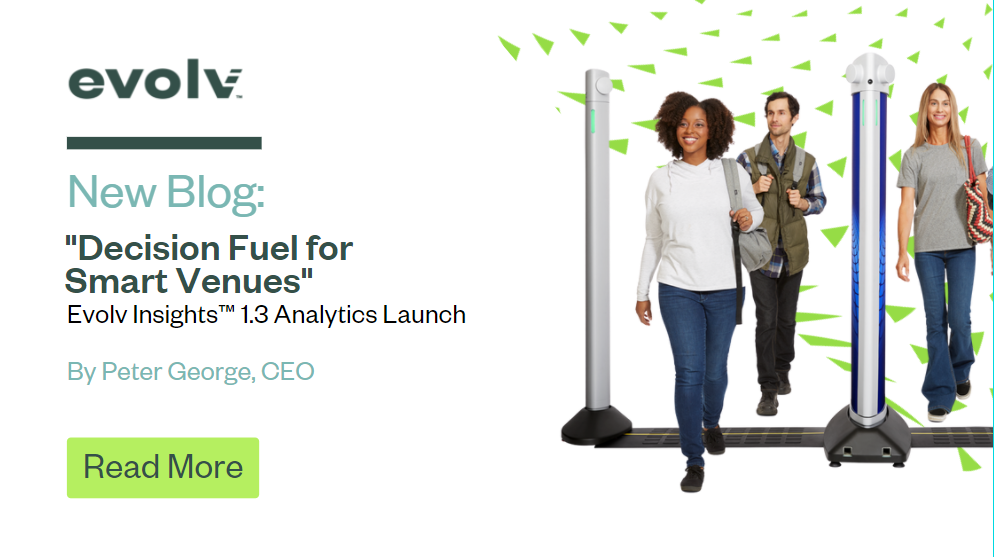
Decision Fuel for Smart Venues

Today we announced the latest advancements of Evolv Insights analytics, a crucial part of our Express product. These advancements will be generally available on October 8th, but first I’d like to offer a bit more context for why we are investing so much in data and analytics, and how we expect these investments to pay off for our customers. 

The analytics enhancements we announced today represent important progress toward our Digital Threshold vision. As someone coming into physical security from the cybersecurity world, I am very attuned to the power of data, and the importance of refining data to help operators make better decisions. I’ve always liked what Clive Humby, architect of the Tesco Club Card loyalty program, said in a speech he gave back in 2006

“Data is the new oil. It’s valuable, but if unrefined it cannot really be used. It has to be changed into gas, plastic, chemicals, etc to create a valuable entity that drives profitable activity; so must data be broken down, analyzed for it to have value.” 

The refining process of generating useful analytics and accurate machine learning models turns raw data into the high-octane decision fuel that a modern business requires. This is especially true for facilities working to transform themselves into modern “smart venues.” Delivering breakthroughs in visitor experience and operational excellence is not easy. It requires vision, good instincts, and a constant supply of refined decision fuel. 

As a weapons screening system, our Express product illustrates the power of data, analytics, and machine learning in the hands of smart venue managers. To illustrate, let’s consider the goal of zero-wait time on arrival, or, as one stadium operations manager put it, minimizing the “mean time to beer.”  

No one loves being stuck in a line outside a venue, but few people realize how vulnerable they are standing in an unprotected crowd. That crowd is a soft target that could attract a threat actor. And every minute people are stuck in a line is a minute they are not spending at concessions or retail within the venue (e.g. “high mean time to beer”). It’s a lose-lose situation, whereas achieving zero-wait is a win-win: a better, safer visitor experience and more revenue for the venue. 

Getting to zero wait time starts with accelerating the weapons screening process, and that’s a data and machine learning problem. Our Express systems process a huge amount of data through our CortexAI models as they perform real time weapons screening. The fact that most visitors don’t have to stop and hand over their bags and dump their pocket contents is a huge step toward the zero-wait goal, but more insight and decisions are required to hit the goal. 

Even with screening that is 10X faster, it is still necessary to have the right number of lanes open in the right places with the right number of staff. That’s a data and analytics problem. Our systems precisely measure the number of visitors and the exact time of their arrival. This makes it possible to plot arrival curves by event type. Analytics like these can be crucial decision fuel for managers as they consider the staffing levels and equipment placement required to achieve zero-wait. 

Achieving zero-wait through AI-powered weapons screening and arrival curve analytics is just one way to make a venue truly smart. The analytics upgrade we announced today also allows security staff to use historical weapons screening data to retroactively simulate alarm rates and entry throughput based on different sensitivity settings. Being able to go back in time and ask “what if” allows smart venues to make intelligent decisions to maximize throughput at any given risk tolerance. This is high-octane decision fuel that’s only possible on a digital native platform like CortexAI in Express. We’re incredibly excited to help customers start using it as part of their smart venue digital transformation. 

Today’s announcement continues our steady progress in analytics, and there is more to come. We are looking at ways to integrate with more types of smart venue systems and incorporate more third-party data, always with the goal of providing even more powerful decision fuel to make venues and facilities smarter, safer, and more efficient.  

If you are an analytics-minded person in the venue and facilities industry who is inspired by the potential of what I’ve described in this post, we would love to hear your feedback and ideas. Please get in touch and let us know what’s on your mind.  

A New Standard Sets a New Milestone: Evolv Express Screens More than 100 Million People

Our mission at Evolv is to make the world a safer place to work, learn, and play and has been since we began. Having been with the company since near the beginning, I am thrilled to share the news that we have surpassed the 100 million mark in the number of people that have safely and seamlessly walked through our Evolv Express® systems.  

To safely screen 100 million individuals has taken a lot of hard work on the part of our teams as well as our customers. It is not easy to set a new standard in any industry, and particularly one that is so fundamental to our lives as our physical safety. Evolv has been able to do it with our advanced weapons detection solutions, as this latest milestone proves.  

Only the U.S. Department of Homeland Security’s Transportation Security Administration (TSA) has screened more people than Evolv in the United States. That’s a pretty impressive feat when you consider the company was only founded in 2013.  

We can’t take full credit for reaching the 100 million mark so rapidly and for setting a new standard for security in the 21st century. We have to share the honors and accolades with all of our customers—and particularly our early partners, who had the faith and courage to believe in the boldness of our vision and our ability to achieve our mission. 

When I think of 100 million people, the number is too staggering to comprehend. Instead, I think about many of the individuals that I’ve watched as they casually walked through our digital thresholds, smiling and chatting with friends and family, typically unaware they are passing through an advanced, modern weapons detection system that is keeping them safer.  

I’ve talked to many of these patrons who told me they thought the venue didn’t have any security because they didn’t experience metal detectors stopping them in their tracks and forcing them to get in a slow-moving line, pull out their cell phones, empty their pockets, etc. When I tell them they actually passed through a new type of threshold that uses advanced sensors, cameras, artificial intelligence and other digital technologies to detect weapons, they are typically amazed that such a solution exists—and grateful that the venue’s owners were committed to modernizing security in consideration of the experience and safety of visitors. 

Here’s another thing about the 100 million milestone.  It’s taken a lot of hard work to get here, but it’s only a brief stop along the way. I fully expect to be seeing more of these announcements in the future, new milestones and new achievements, and I won’t be surprised to see the pace accelerate. That’s because the Evolv Express is setting the standard in physical security for a wide range of venues where large groups of people gather—concert halls, sports arenas, theaters, other performing arts locations, casinos, schools, hospitals, tourist sites, places of worship, shopping malls and more. 

As more customers and potential customers recognize that there is a new standard for weapons detection—and it really works—they will realize that they cannot and should not be left behind using 20th-century analog solutions in the 21st-century digital world. I look forward to more milestones as we continue on our journey to make Evolv an unobtrusive yet ubiquitous part of our everyday lives.