A Different Way: Reopening Performing Arts Venues in a Lingering Pandemic

As a native Bostonian who loves the arts, the incredible performances at the Wang Theatre and Shubert Theatre feel like they have always been part of my life. I’ve enjoyed countless musicals, symphonies, ballet, and concerts at these iconic hometown venues. Their pandemic shutdown was a sad moment for me, but my feelings were nothing compared to the seemingly bottomless crisis experienced by all the talent, staff, and management who make these venues such magical places. That’s why I am so incredibly excited to see these theaters reopening this weekend using Evolv Express® as a key part of their health and safety plan. Working with the Boch Center, which manages both venues, to make this happen has been incredibly satisfying. 

Performing arts centers have always been a core segment of our business, starting with our early success in New York at Lincoln Center and later at the Phillips Center, the Kravis Center, the Fox Theatre, the Paramount Theatre, and many others. It feels great to finally have our technology protecting visitors at the Wang and Shubert on our home turf here in Boston.  

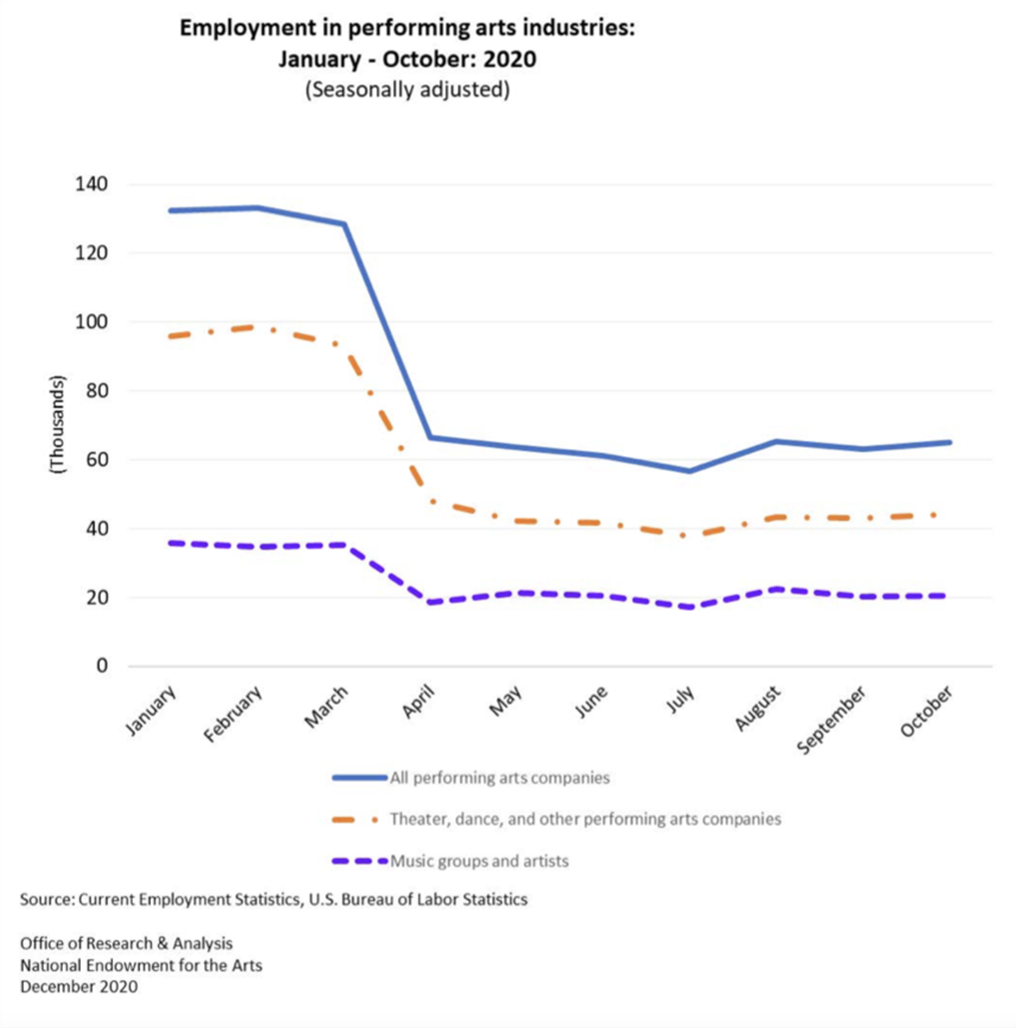
According to the National Endowment for the Arts, the performing arts sector in the United States normally accounts for $13 billion dollars of economic value add and employs over 120,000 people across over 8000 businesses. But that all came crashing down with COVID-19. Performing arts centers were forced to close indefinitely and slashed their employees by half or more, with the remaining staff often on reduced wages. When they finally were able to reopen in the pre-vaccine period, severe restrictions hobbled their operations. They used their core creative talents to cope as best they could, but everyone knows that a full return to normal is the only way to get the industry back on its feet. Even now that full reopening is finally becoming possible, the landscape feels changed and there is still a lot of uncertainty. 

The security challenge for performing arts venue is tricky in the best of times, and the pandemic has obviously made it even more complex. These venues often have a very limited number of narrow entrances opening directly onto city streets with crowds arriving rapidly right before showtime. We’ve all been there: rushing down the street from some theater district restaurant to get to the venue at the last minute. Using walkthrough metal detectors and manual bag inspections during the last-minute rush typically leaves huge crowds on the streets outside the building, creating an incredibly vulnerable soft target.  

The pandemic only increased the threat of crowded entrances at theaters. Few visitors are OK with being jammed in close with people they don’t know and whose vaccination status has not yet been verified. It’s unsafe, unpleasant, and unacceptable, especially when it’s happening in a space that is all about having great experiences. The incongruity of it all is not lost on visitors, many of whom are still sorting through their pandemic anxieties.  

In my conversations with the Boch Center team and other customers, it has become clear that they are concerned about these issues. Re-opening with the old procedures is just a non-starter. Returning arts patrons are looking for visible signs that the venues are safe. Giving them the same old entrance melee just doesn’t feel right, especially in an industry that is all about experiences. Joe Spalding, CEO of the Boch Center told me that he knew they needed to have people return in a different way, and we’re incredibly happy that Evolv Express is now part of that new way, along with new air filtration systems, vaccination verification, and other best practices.  

The federal government has stepped up to help the performing arts with $75 million in new funding to the National Endowment for the Arts in the 2020 CARES Act and an additional $135 million in the March 2021 American Rescue Plan. This money is already flowing into performing arts venues to help fund investments in technology that both facilitate a safe reopening, including new security screening technology. It’s money well spent because a feeling of safety and security is vital to getting the economy, and our lives, back on track.  

Both of the Boch Center properties in Boston are opening this Saturday 18 September with Jason Isbell and the 400 Unit at the Wang Theatre and Manuel Turizo at the Shubert Theatre. If you are in Boston this weekend, come join me at one of these venues. I’ll be helping with the deployment of our Express systems. If you see me, just wave as you walk right in without stopping, emptying your pockets, or surrendering your bag, and enjoy the show, safely! 

GiveEvolv: A Step Toward Ending Gun Violence in Schools

Today we announced the formation of GiveEvolv, a new charitable organization that provides need-based grants of Evolv Express weapons detection systems to K-12 schools in the United States that otherwise would be left vulnerable to gun violence. I would like to share the backstory of GiveEvolv and explain why it is so important to our mission. 

The threat of violence in schools is personal for me. My daughter is a second-grade teacher. Every tragic headline about an attack on a school sends my mind racing with “what if” scenarios that never fully fade from my mind. This issue haunts me as a dad, as a citizen, and as the CEO of a company focused on keeping weapons out of all the places where they are not welcome. 

For years I, like most of us, felt powerless to do anything to protect my daughter and all the other innocents who learn and work in schools. So it was incredibly satisfying when I joined Evolv and saw our Express weapons detection successfully deployed in a few South Carolina schools. However, that satisfaction also came with a tinge of frustration. Why? Because I knew that many vulnerable school districts wouldn’t be able to afford our current Express product.  

We designed and priced Express with commercial facilities like stadiums, industrial workplacescasinos, and tourist destinations in mind. We knew from our research that while some larger school districts would have the budget and the scale to use Express, many simply would not have the budget for our advanced technology. We don’t regret making the tough call to focus on segments where we could reliably deliver win-win outcomes, but leaving most schools vulnerable has continued to weigh on all of us at Evolv. 

When we started getting inbound interest from SPAC partners early this year, one of our most important criteria was alignment with our mission of making the world a safe place to live, work, learn, and play. All the potential SPAC partners said the right things about their commitment to our mission. However, NewHold was unique in proposing that their partners dedicate a portion of their personal proceeds in the transaction toward charitable expansion of access to our technology. The fact that they were willing to put a portion of their personal income from the transaction on the table was inspiring, and our executive team decided to follow their example. The result is GiveEvolv. 

After we agreed on the core concept, we quickly settled on educational institutions as the initial beneficiary of GiveEvolv grants. We chose schools for two reasons. First, the threat is heartbreaking, and the impact is horrific. I’m not going to review all the incidents in this decade. Suffice it to say that since the Columbine High School shooting in April 1999, more than 256,000 students have been victims of gun violence during school hours. The second reason we chose education was that the resources to address the threat to schools are heartbreakingly scarce. Without help, we knew that advanced weapons detection technology would not come to many schools for years. 

Every school has policies prohibiting weapons on campus, but their ability to enforce their own policies is incredibly limited. Schools that can afford to install conventional walk-through metal detectors risk creating a prison-like environment that makes students feel like criminals. But more importantly, metal detector screening does just that. Detects metal.  It does not differentiate between a weapon and a laptop.   Not only does this provide a prison-like experience, but it slows students from getting into schools, creating security threats for those waiting in line.  And, worse yet, we’ve heard some security staff admit that when the morning bell is about to ring and the security line is backed up out the door, they just turn the metal detectors off and wave all the students in without any screening at all. Vulnerable students, teachers, and staff deserve much better.  

I’ve previously written about our vision for democratizing security. We intend to make high throughput weapons detection screening truly pervasive across all the places where people gather. GiveEvolv helps jumpstart our progress toward that vision. We won’t be able to give Express grants to every vulnerable school immediately, but we do believe we can make a real impact for many vulnerable schools and then expand over time. 

I believe that parents and schools will be more willing and able to invest in weapons screening at schools once they see how effective and unobtrusive it can be. I also hope to bring down costs and simplify deployment of our products to the point that every school can enjoy the security and peace of mind that advanced weapons screening. I think we’ll all sleep better when that day comes. 

We are still hammering out details of the GiveEvolv grant approval process. If you would like to nominate a school, you can sign up here.

The Digital Transformation of Physical Security

In recent years, “Digital Transformation” initiatives have taken priority across industries. But an article last month in Industry Week cited the “deskless workforce” as the last holdout of digital transformation: and it’s not small. The article estimates that about 80% of the world’s workforce, or 2.7 billion workers, have been “left behind” by digital transformation: that is, the introduction of new technologies intended to enhance “safety, quality, and productivity” for companies.

So how can physical security, arguably one of the most important “deskless” roles throughout our society, be positively impacted by a digital transformation of its own?  

The Reasons to Transform: What’s Missing? 

Thru the years we have certainly witnessed developments in technologies for physical security. The introduction of video management systems, communications devices, and physical access systems (ticketing, badging, biometrics) have all added advancements to the industry.  

But when it comes to detecting weapons, perhaps one of the most critical roles in ensuring physical security, many venues still rely on analog metal detectors. And we are all familiar with how that works: stop while you wait in a slow-moving line. Stop to empty your pockets. Stop to hand over your bag. Then, either get waved through or sent back because you’ve forgotten to put down some metal object you were carrying. Stop to get wanded; or, worse yet, submit to a pat-down.  

This process is more than an annoyance. It may amount to a threat itself. Crowds have proven to increasingly become “soft targets” for mass casualty events—as in tragic events at Mandalay Bay in Las Vegas, and the Boston Marathon bombing. What’s more, the health threats of close-contact crowds have been brought into sharp focus by Covid 19.  

Beyond crowded conditions, metal detectors can also overwhelm the guard resource, causing them to miss real threats in all the clutter they see on a daily basis. The reason lines are so slow-moving, of course, is that we all carry metal items with us every day.   

Metal detectors pass the work of distinguishing metal items from true threats off to guards. They simply alarm on everything, not just weapons, so guards are very used to so-called “nuisance alarms” and therefore, rightly so, don’t trust the system. That means they are left doing the brunt of the work—visually checking each person and bag that alarms. Most of the time, all they find is everyday items: laptops, tablets, smart phones, keys, etc. But this creates fatigue, because it’s easy to overlook what you don’t expect to see, and can result in security teams inadvertently letting weapons through.  

To combat fatigue or to move lines through more quickly, venues may turn off security systems when crowds get overwhelming; they may randomly sample visitors; or, they may opt for no security systems at all—each of which further raises the risk of weapons simply walking through undetected.  

The Way to Transform: What Can Technology Help Do? 

Prioritize the customer experience: The digital transformation of physical security must prioritize guest experience. If the high alarm rate is not indicative of the true number of threats entering a venue –– then a lower alarm rate reflecting the reality that most people are, in fact, not a threat will simultaneously elevate the guest experience and help security teams better pinpoint the true risks at a venue’s entryways. Allowing guests to enter at walking pace, with no interference whatsoever in the experience of visitors who don’t pose a potential threat, provides the best possible user experience both for guests and for guards.  

Let technology do what it does best… and, by extension, let people do what they do best. Technology that can detect weapons – not just metal –to by using AI and advanced sensors to distinguish true threats from everyday items relieves the burden on guards to check people that likely aren’t carrying weapons. And, it can pinpoint for guards where on a person the weapon is expected to be found. This expedites alarm resolution and improves guard efficiency by targeting only visitors who need to be checked and focusing guards only on the locations on their person or baggage to check.  

Ensure data drives decisions. Technology at the threshold of every visitor and/or employee entrance surpasses the ability of metal detectors by counting visitors, recording alarm rates and types, understanding the dates and times when rates are highest or lowest, and even allowing for the comparison of different security outcomes based on different event types. All this data provides venue security and operations teams with real-world evidence for better decision making, to meet the security and experience needs of their guests, better than guesses, gut feel, or manual counting can. Security planning and venue operations can all be data-driven to ensure the right staffing decisions are made at the right locations throughout the venue to both secure guests and elevate the guest – and guard – experience.  

Connect and communicate. With such a critical mission and so many possible security technologies also operating in the space, security technologies should never exist in a vacuum. Rather, they should integrate seamlessly together with other technologies that make up the extended security ecosystem. Options for integrated camera technologies and integrated communications provide an extension of existing security systems and staff to one of the most vital parts of the venue—its entryways. Neither should security technology require expertise that is outside the scope of existing venue resources. Technology should inherently scale—through built-in connectivity that doesn’t require an IT team to install, connect, or service—and through simple, app-like user experiences that guard staff and security leadership alike can quickly learn to operate, reducing the learning curve and training new staff members ASAP.  

Make life better. Why digitally transform if the technology doesn’t make life better for guests, guard staff, and venue leadership? When guests don’t notice security technology, they are less aggravated, with fewer frustrations to take out on guard staff, and they find the venue even more delightful. If guard staff are made more effective and efficient, they can experience higher job satisfaction and lower turnover rates. For venues, offering better customer experience plus enhanced security while reducing employee turnover are just a few of the potential benefits. Better resource use through data-driven decisions, better use of entryway space with fewer security lines and less equipment overall, and the chance to redeploy guard staff to different roles throughout the venue are all further benefits that venues can realize.  

The Imperative to Transform 

Of course, not least of all is the benefit of increased safety to the visitors of venues around the world that choose to embrace the digital transformation of their physical security. Simply put, shorter security lines through more reliable screening technology adds up to safer visitors—and lower false alarm rates mean guards can more easily pinpoint and stop bad actors—making more venues where people and their families love to gather with one another in our community safer.  

New Product of the Year Award…More Industry Recognition

Each year, Security Today presents awards for the best new products across a variety of categories. The winners are chosen by an independent group of experts. For 2021, I am proud to say, Evolv has been named as the 2021 New Product of the Year in the Pedestrian Security Entrances category. 

This is yet another important industry-wide recognition of our mission to create a safer world and set a new standard for physical security in the 21st century. Evolv Express® is the first and only weapons detection security screening system powered by advanced sensors and artificial intelligence to deliver a safer, fast, and friction-free experience for patrons. 

When you think about the category in which we were selected, Pedestrian Security Entrances, the first images that probably come to mind are metal detectors—and the long lines and laborious processes of patrons pulling out their phones, emptying their pockets, and walking one at a time through a threshold that is obtrusive and not at all welcoming. As we still grapple with a global pandemic, these images seem not only incongruous and out of touch; they’re frankly a security threat. 

Unfortunately, this outdated 20th-century metal detection technology has been the standard for Pedestrian Security Entrances for a long time—not because it is particularly effective, but because developing a better, modern replacement based on advanced software and digital technology has not been an easy task.  And being able to meet the standards of the professionals we work with using artificial intelligence and advanced sensors to detect weapons, took herculean efforts. The product works. That’s easy to say but difficult to back. We can. 

And now, more than ever, we need it. There were 452 mass shootings in the U.S. to date in 2021, according to the gun violence archive, surpassing 417 in all of 2019.  More venues and employers that never considered security screening technology are looking for solutions.  Airport and prison security is not the answer for the performing arts, casinos, schools, tourist sites, and places of worship.   

We’ve done the work, put in the time, collaborated with the best security professionals in the business (our customers) and we have built and delivered a new standard for weapons detection in the digital age. Not only can visitors walk right through at the pace of life, but they are better protected, and security professionals can redeploy their efforts to more pressing security concerns vs invasive bag checks.  

It is an honor to see our work and our vision capture the attention of industry leaders such as Security Today and its readers. As Security Today noted, their New Product of the Year Award “honors the outstanding product development achievements of the security equipment manufacturers whose products are considered to be particularly noteworthy in their ability to improve security.” 

Congratulations are in order to our dedicated team of engineers, who live their mission daily by transforming security to enhance everyone’s life. One more notable step on our journey to make the world a safer place to live, work, and play.   

Evolv Express Participates in U.S. Air Force Flightline Security Challenge

Earlier this year, we were humbled to be awarded a contract with the U.S. Air Force (USAF) to explore opportunities to bolster national security through the deployment of our advanced weapons detection security screening systems. This contract was facilitated by AFWERX, a U.S. Air Force program designed to foster a culture of innovation within the USAF. Encompassing multiple programs, including the Air Force commercial investment group, AFVentures, the AFWERX is intended to circumvent bureaucracy and engage entrepreneurs in Air Force programs. 

I’m delighted to share that earlier this month Evolv was selected to participate in the AFWERX Flightline Security Challenge. The AFWERX initiative to revolutionize flightline operations is made up of three tracks targeted at leveraging the best technology and services to create an integrated USAF Flightline while improving security, driving resiliency and increasing agility. These three challenges are running concurrently but are focused on the separate topics below: 

  • Airfield Maintenance and Repair 
  • Flightline Security 
  • Aircraft Maintenance Operations 

Evolv is excited to participate in the Flightline Security Challenge today in Las Vegas. At the challenge, we’ll be demonstrating how Evolv Express® provides automated threat detection and visitor screening for flightlines. The best solutions from the Flightline Security Challenge will be invited to the showcase for Revolutionizing USAF Flightline Operations, where all teams will have the chance to collaborate with each other. Selected teams also have the opportunity for private meetings with evaluators and leaders across the Air Force and Department of Defense. 

We’re honored to be collaborating with the U.S. Air Force in its mission to protect our nation. By combining our team’s expertise in risk mitigation with innovative threat detection and weapons screening technologies, Evolv’s systems far exceed what’s possible from analog technologies and legacy approaches. We look forward to bringing these benefits to even more Federal and DoD customers. 

Communicating Our Mission to Wall Street and the World

Opportunities don’t come along very often to join a company that is setting a new standard for its industry. Rarer still is a company whose mission is devoted to making people safer as they go about living their daily lives. As the new Vice President of Investor Relations for Evolv, it feels as if I am coming on at an important flex point in the company’s development.

We have just completed our initial public offering and are now listed on NASDAQ as “EVLV.” We have an opportunity to be more visible and to invest in doing the things necessary to take the company to the next level. You can feel the energy of the company, and the excitement, just by talking to our people and to our customers. We hope to generate the same enthusiasm and passion among our investors.

One of my most important roles is to make sure we are accurately communicating to Wall Street and the investment community the fundamentals of what we are doing, how we are doing and, in a broader sense, why we are doing it. That “why are doing it” aspect comes down to the mission and, frankly, that is one of the main reasons why I am here.

I am a mission-focused person, whether it’s working with the Boy Scouts of America, the Boston Chapter of the National Investor Relations Institute or every job I’ve ever had during my 20-plus-years as a leader of finance-driven investor relations programs for ground-breaking, category-leading technology companies. One of the first things that resonated with me when I spoke to the management team at Evolv is that this is a company that is doing truly important work.

These days, unfortunately, it is hard not to think about safety when entering an arena for a sporting event or a concert hall or, really, just about any venue where people gather. When you get in line at the metal detector to get inside, or hand your phone to a security guard, or put your valuables in a plastic container, it is a constant reminder of why these things are necessary.

However, when you think about it, the idea that these “precautions” are based on decades-old analog technology and standards feels so obsolete and out of place—particularly when you consider how dependent we are upon digital technologies for so many other aspects of our lives. You would think that our physical safety would be priority number one in the digital age. Fortunately the team at Evolv has – and does – prioritize physical safety.

The concept of a solution designed specifically to detect weapons and deliver a friction-free experience for patrons is setting a standard for safety that is innovative and necessary. The fact that the team at Evolv could not only conceive of this idea, but could actually build it, is somewhat awe-inspiring. The opportunity to be part of that team and communicate what we are doing to Wall Street and beyond is a source of pride and excitement. It’s a mission that this mission-focused guy can truly believe in.

How Evolv Express 3.0 Is Transforming Venue Security

As the world reopens, physical security is top of mind for venue leadership and visitors alike. Venue security relies on a combination of people, processes, and technologies to prevent harmful weapons from entering. Different venues take different approaches to creating, maintaining, and improving security screening based on the unique needs of the organization and its visitors.  

But every venue has a common challenge: ensure a welcoming guest experience while preventing potential weapons threats from entering. To help address this need in the many ways venues implement security, Evolv recently launched its latest software update for Evolv Express®, Version 3.0. This version introduces new capabilities to advance threat detection, enhance existing venue security response time and protocols with integrated communications, and improve usability and mobility with an intuitive user experience and a wireless tablet option.  

Changing the Status Quo 

Balancing guest experience with the mandate to keep everyone safe is critical when making decisions about security personnel, processes, and technologies. While metal detectors are extremely good at alarming on any object that could be a threat, their user experience is less than ideal. They require people to separate from their bags and personal items, which result in repeat scans, and creates long lines. And in this post-pandemic era, requiring guards to handle personal items, or even wand and pat-down guests, can result in potentially unsafe personal contact. Certainly not the personal experience we all seek. 

In short, manually assessing everyone entering a venue is a burden on everyone involved, aggravating the very people that venues are trying to welcome in. Worse still, it creates new threats. Beyond just the health concerns of crowded lines and close personal contact, guards can become fatigued with manual checks due to so many false-positive alarms, putting them at higher risk of letting potential threats through. And long, tedious lines in unsecured areas create crowds that could become a soft target themselves: exacerbating the very threat conditions that venues are trying to avoid.  

Better Detection Improves Safety 

Balancing venue security with guest experience should never be a compromise. Evolv Express accelerates the way guests move through security checkpoints by leveraging advanced sensors, artificial intelligence (AI) algorithms, and camera technology to detect and visually pinpoint a potential weapon on a person’s body or baggage. It allows visitors to flow seamlessly into a venue at a normal walking pace while focusing guards’ efforts on quickly and efficiently resolving potential threats.  

The Evolv Express technology continuously improves with new releases, and the 3.0 release introduces yet another update to the detection algorithm. This update helps to refine false positive rates (“nuisance alarms”) without compromising the system’s ability to detect even the smallest weapons. 

Security Ecosystem Integrations Shorten Response Time 

Evolv Express is designed to integrate seamlessly with other venue technologies to ensure security teams are supported in their work using processes and protocols already in place. Unlike analog machines and manual methods, Evolv Express is designed to extend a venue’s security eyes and ears to the entryways with features like front-and-rear-facing cameras with available integrations into an existing Security Operations Center (SOC) or Video Management System (VMS).  

To these existing integration capabilities, Evolv Express Version 3.0 adds the newly-released “Request Assistance” feature. When a guard at an Evolv Express system needs to reach out across the existing extended security ecosystem—whether it’s for help from other team members, supervisors, or adjacent teams like law enforcement—Request Assistance adds a one-touch feature on the Evolv Express tablet that leverages your existing security processes and systems to send communications discreetly and instantaneously via SMS text or email. It automatically includes the location of the system requesting assistance, along with the option for a customized message from the team member in need.  

Request Assistance is easily configured in the MyEvolv portal by a system administrator to ensure that personnel staffing critical positions at a venue will be able to leverage existing security protocols for critical communications to get the help they need and better secure entryways, and guests, quickly.  

Usability Accelerates Threat Resolution 

Each Evolv Express tablet provides a targeted search capability when a potential threat is detected via an indicator on an image of the alerting individual, which shows the location of the threat from different vantage points and allows for the detection of multiple threats on the person or their baggage as they walk through the system. This visual alert only targets individuals with potential threats on their person—not everybody walking through—to streamline the work of your security personnel, allowing them to focus their efforts only on addressing and resolving potential threats.  

Visual alerts are delivered via a tablet user experience, and Evolv Express 3.0 introduces wireless tablets to add new options for system setup and ease of deployment. Wireless tablets create easier set-up and tear-down, increasing system mobility while improving the visual profile of the entryway. They also add new options for the physical configuration of systems, with easy ways to pair additional tablets when needed as visitor flow rates increase. Plus, an updated user experience on wired and wireless tablets for Evolv Express 3.0 modernizes the look-and-feel of the interface.  

Advancing Security with Each New Release 

In addition to continual improvements to threat detection, new integrations with adjacent security technologies, and an enhanced user experience, Evolv Express includes access to the web-based MyEvolv portal and Evolv Insights™ analytics. Insights automatically collects and surfaces metrics related to visitor arrival curves and alarm rates by location, date, and time all in one unified dashboard. By leveraging analytics to improve planning—along with new advancements in threat detection, integrated communications, and usability in Evolv Express 3.0— venues can transform the way they protect visitors from potential security threats.

The Exhilarating Mission of Customer Success

When I joined Evolv a few months ago, I was immediately struck by how absolutely customer-centric the company is. Evolv has served its customers obsessively, which, in my experience, is what successful companies do, especially when they’re in start-up mode since every new customer becomes a potential reference to help land the next one. Now, as the company scales, we must focus on retaining that same level of intimacy and service that has become a very important differentiator for us.  

How will we do it?  Well, for starters, we’re building a new team of customer success managers who will work proactively and in partnership with our customers to ensure their success. It starts when we install the Evolv Express®, getting them onboarded, trained, leveraging all product capabilities, and guiding them through new releases or adjacent features as we continue to set a new standard in weapons detection screening. Our team is responsible for making sure customers are aware of what our systems can do and how they can best take advantage of them at their own venues.  

Another key priority for the Customer Success team is to formalize our “Voice of Customer” program. We’ll be regularly interviewing customers to solicit deep qualitative feedback on a number of topic/relationship areas to drive continuous improvement across Evolv. Customer feedback will inform product innovation, new solutions, relationship management and more. 

Now that I’ve settled into the job, I can tell you without hesitation that Evolv’s mission is my mission too—to transform security to enhance everyone’s life. There is something energizing in knowing that when I get up and go to work every day I, my team, and everyone at Evolv are truly helping to keep people safe. I’ve been fortunate to visit several customer sites already and have been inspired seeing Evolv Express “in action”: 

  • Going to a theme park or amusement park and seeing the smiles on kids’ faces and families going in and being confident that they are going to have a safer experience because of our product. 
  • Hearing firsthand from security guards about how Evolv Express makes their jobs easier, eliminating the need to physically handle bag after bag while delaying patrons from getting into their facility. 
  • Walking into a museum or venue with a high level of aesthetic beauty and realizing that our unobtrusive system at the entrance does not detract from that visitor’s first impression. 
  • Meeting the individual sponsors and champions across the Evolv customer base who chose Evolv because they have devoted their lives to safety and being awed by the passion and commitment they bring to their work. 
  • Feeling really proud seeing our system at NASDAQ, keeping employees and visitors like Evolv safe when we officially listed as “EVLV” on July 19th 2021. 

Throughout my career, I’ve always taken pride in customer engagement. I love being with customers, seeing and hearing directly how we are, and can, deliver value. I also love the behind-the-scenes work in building a strong operational framework of people, process, and technology to support our customers and their security and visitor experience objectives. Evolv has, and will, take an “outside-in” approach to fulfilling our mission.  

A sense of shared purpose is palpable throughout the company. Before I was hired, I was fortunate to spend time with our CEO Peter George and our founders, Anil Chitkara and Mike Ellenbogen. They are inspirational in their authenticity and long-term, baked-in desire to get this right. It makes you want to get up and go to work every day. It’s particularly exhilarating to realize that we are still near the beginning of fulfilling our mission of making the world safer, one customer at a time.  

Setting a New Standard For Safety, Security and User Experience

Would you rely on a standard developed in the 1970s for gas-powered cars as the basis for operating a modern electric car? How about a 1970s standard for land lines to manage your smart phone? Seems pretty ridiculous to rely on decades-old standards to define, inform and keep up with today’s pace of innovation and the varied ways technology has shaped lives over the past 10 years, let alone the past 50. 

Yet, when it comes to our safety when we gather in groups in public places, the only “standards” our industry has available to measure the effectiveness of our security technology was developed in the 1970s for uses that just don’t apply in today’s world and for today’s threats. Not only that but these standards are also based on old analog technology—walk through metal detectors—that are even older than the standards themselves and are incapable of meeting today’s needs for modern weapons detection.  

So, you see why I put the word “standards” in quotation marks. In reality, there has never been a security and safety standard that was designed specifically to meet the needs of today’s modern venue—able to specifically and accurately detect weapons while delivering a free-flow, touchless and friction-free experience to visitors, employees, and other patrons. There weren’t many 80,000 seat stadiums in the early 1900s when metal detectors were first deployed. For decades, security professionals have been hindered by static, outdated technology as they try to react to a new threat environment in today’s dynamic world. 

Until now, of course.   

Today’s standard for physical safety and security must address an era in which soft targets, weapons proliferation, and a global pandemic have dramatically and permanently changed the security landscape. A modern solution must detect weapons, not just metal. It must go beyond security—meeting the concerns and expectations of visitors for a touchless, seamless experience, whether attending a sporting event, concert, mall, school, workplace, or any other places where people gather. 

Eight years ago, when we started Evolv, it was clear that the tools organizations were using for security and safety at their points of entry were obsolete at best, and dangerous at worst. Metal detectors were originally designed primarily for applications such as courts and prisons to prevent a small number of visitors from walking in with small contraband, such as razors or pocketknives.   

The standards developed in the 1970s were based on this old technology and established by the National Institute of Justice for courts and jails, and then adapted by the US FAA, Transportation Security Administration, and other regulators for aviation security. There were no cell phones in the ’70s, no proliferation of assault weapons, no steady drumbeat of gun-related violence.  

Relying on those standards and that technology just doesn’t meet today’s security needs. It forces people to queue in long lines, which creates another potential target for attackers. It forces them to hand their personal belongings to strangers, which is anathema to a safe and pleasant experience with COVID now a daily part of our lives. Worse, the standards are designed to detect metal, not weapons, which requires everyone to dump their pockets and virtually every bag to be searched. Because they weren’t willing to create a line around the block, many organizations avoided using metal detectors and just relied on a visible guard presence, handbag checks by security personnel or, often, no security at all.  

A new standard for detecting weapons at modern venues is needed and was one of the reasons we started Evolv. As I say perhaps far too often, some things have to be believed in order to be seen. We believed we could build a new system that could discriminate weapons from the innocuous everyday objects we all carry while allowing the free flow of people. We could see a new standard because we believed it could be built and, in fact, we could be the ones to build it. 

Evolv Express® is the culmination of years of hard work to develop what I consider to be “wicked smaht” (pronounced in a Boston accent) software, leveraging technology advances that would have seemed like science fiction back in the 1970s. These include advanced video analytics, machine learning, artificial intelligence, sensors, and more.  

It has taken us the better part of six years to perfect the technology. With the help of our early customers and our talented team, the Express is the product that fulfills the original vision we had for Evolv. Our system sets a new standard for physical security because it delivers what venues need, now and into the future, including: 

  • Digital technology hardware and software systems that replace obsolete metal detectors with modern weapons detectors. 
  • Free-flow, frictionless screening, with a touch-free experience for patrons in a post-COVID environment. 
  • Simplified deployment, management, upgrades, and operations. 
  • The opportunity for organizations and security leaders to improve security, increase safety, deliver a great user experience and significantly reduce security costs—all at the same time.  

The world is a very different place than it was in the 1970s when the existing “standards” for physical security were adopted. A new standard is needed to adapt to this new world and the current threat environment. We believe the Evolv Express is the next industry standard. Why? Because it fulfills our core mission of making the world safer.  

The Road to Now

One of the best aspects of being part of the Evolv leadership team is the chance to work closely with our founders, Mike Ellenbogen and Anil Chitkara. In light of our recent listing on the NASDAQ exchange, I felt it’s an appropriate moment to sit down with Mike and Anil to get their perspective on their road to now.  

Dana: Why did you start Evolv back in 2013? 

Mike: Evolv is my third startup in the physical security space, so I am deeply aware of the challenges and technical limitations associated with preventing active shooter and terrorist attacks. Many of our original Evolv team members have been together now through three startups in physical security. The 2012 Sandy Hook school shooting and the 2013 Boston marathon bombing directly affected people close to both Anil and me. Those events really crystalized for us that the world needs a fundamentally better way to prevent these types of attacks, and that there was currently no good solution. We looked at the situation and said, “We know how to solve these types of problems and we’re in a unique position to make a real impact. If not us, then who?” It just felt like it was time to get the band back together.  

Anil: It’s personal to me. I have been close — painfully close — to multiple terrorist events, and I decided that I needed to turn my energy to making the world safer from future attacks. My close friend and college roommate, Steve, was on the 101st floor of the North Tower on 9/11. He had just gotten married and had a son. Twelve years later I was on Arlington Street in Boston with my three young children waiting for my wife to cross the finish line of the 117th Boston Marathon. She finished, we drove home and found out that 45 minutes after we left that the first explosive device had detonated. A close friend wasn’t as lucky. He was seriously injured and still has shrapnel in his neck. So, as Mike said, we started Evolv to stop these types of senseless acts. We saw that they were happening in more types of locations in more towns and cities, harming more and more people. We just knew there had to be a better way to prevent them from happening.  

Dana: What problem did you set out solve? 

Mike: There are plenty of technologies that help minimize the response time after an event has already started: video analytics, gunshot detection, etc. But this after-the-fact type of solution doesn’t address the real problem. The world needs a way to prevent the bullets from flying in the first place. At the time, the only available solutions to try to stop attacks like the Boston Marathon bombing were old school metal detectors. This technology is over 100 years old and was never designed for today’s visitors and spectators, with all of the items we normally carry — like smart phones and tablets — or for today’s venues. If you’ve ever stood frustrated in a security line, cursing the slow security screening process, you understand the problem. We saw the need for a frictionless process that can identify threats without slowing down visitor flow, ideally without even breaking stride. Our goal was to help any venue, with or without government mandates, to create a safer environment for their visitors without negatively affecting the visitor experience. 

Anil: Old metal detectors and manual security checks were widely used after 9/11. These approaches treated everyone as a threat, forcing them to stop, empty their pockets and bags, and submit to a search. We wanted to pivot the paradigm. The vast majority of people are not a threat – so why not let them pass through without ever stopping and only stop those few who need a closer look? Why can’t most people be screened as they walk through at the normal pace of life without ever stopping? That’s what we wanted to deliver. 

Dana: Why did you think you were the right people to solve it? 

Mike: This isn’t a problem space that you just decide to get into and a couple of weeks later you fully understand it. A couple of kids in a dorm room aren’t going to figure it out. The physics is very, very challenging. The math is hard. There are all kinds of subtle environmental issues that cause huge problems in the real world but don’t exist in the lab. We have a unique team of very talented people with the depth of experience to anticipate many problems and the context to cleverly solve new problems as they come up. We’ve also been able to leverage the latest advances in sensors and machine learning that hadn’t been available or applied to this problem space before. Our prior success in this market also gave us excellent access to capital from really smart, deeply connected? committed? investors. Even with all these advantages, we had to work the problem really hard from many angles for a long time, but in the end, we cracked it. 

Anil: Building on what Mike said, we really benefited from having a multidisciplinary technical team with an intimate understanding of different venues and their operational requirements. I don’t know of any team that has collectively spent more time on the front lines, shoulder-to-shoulder with security professionals as they conduct screening operations. We knew the challenges the staff were struggling with, and we knew what they wanted and needed. There are just as many subtle process issues as subtle technical issues of the kind Mike mentioned. We combined our knowledge of all these issues with our background in user experience design to solve for both the visitors being screened and the security staff operating the system. We’ve got hundreds and hundreds of lessons from operating in so many different environments in the real world.  And we continue to incorporate these experiences into our product and our team’s approach with our customers. 

Dana: Why wasn’t it solved before? 

Mike: Most companies in our space wait for a clear market with a well-defined specification, usually from some government agency, before they’ll consider committing the time, resources and capital to develop a new product. There is no established “firearm detection standard” or “IED detection standard” out there to start from. We recognized that there are thousands of venues, from schools to stadiums to workplaces, that want to a create an environment that’s safe from threats to the crowd.  Most of them aren’t really worried about objects that might be considered threats in a prison environment, or even an aviation environment. They are primarily concerned about firearms in the US and other similar threats to the crowd outside the US. These concerns have been well-known and almost universal for decades, but the venue operators had broadly rejected security metal detectors because they are awful.  There are few products in the world so universally hated as walk-through metal detectors. Users made a value judgement and decided it wasn’t worth creating a line that trails around the block in order to screen visitors for weapons. Most just went with the lowest common denominator – guards looking in visitors’ bags or perhaps a cursory hand-wanding. We were willing to create the detection system we thought people were really looking for, even though there wasn’t a specification available to reference. It was definitely the harder path, but we believe it was ultimately the right path. 

Anil: I think we looked at the problem very differently than others in this space. We didn’t want to find metal, we wanted to find weapons. In fact, we wanted to ignore personal items such as cell phones, keys and belt buckles. Once you look at the problem from a different lens, you start to think about the technology direction differently. The hardest part of the problem was to build a robust, resilient system that was adaptable to operate in a multitude of environments with different types of visitors carrying a wide range of personal items. A family going to a theme park is carrying different personal items than a worker going into a warehouse, a kid going to school, or a couple going to the opera.  We focused on understanding three key factors: stream of commerce coming through, the environmental factors at the site, and operational variables for different security approaches. We then built a system that would be robust, resilient and flexible to meet these varied situations.   

Dana: What were the major challenges? 

Mike: One of the biggest challenges was being able to identify threats without slowing down the visitor flow, ideally without even breaking stride and with people walking together, even side-by-side. This requires being able to isolate individuals and find threats almost instantly, which is hard when you also need detection to be both more precise and more accurate than existing systems. Another related problem was providing a welcoming, non-threatening visitor experience while also creating a clear visual deterrent. Having an industrial design that unsettles threat actors by conveying that there is some serious tech under the hood without making it scary to harmless visitors was a tricky balancing act. And finally, there is the simple fact that we had to raise tens of millions of dollars of capital to adequately fund R&D and production. We had to innovate at the edge of the possible in both bits and atoms, and that’s just harder and more expensive than developing other types of products. That said, there’s nothing I enjoy more than being together with a group of smart people tackling tough problems like these. 

Anil: It’s hard. It’s just really, really hard. Because the system is detecting and preventing weapons from entering facilities, it needs to operate at extremely high-performance levels. It can’t be right just some of the time. Additionally, we look at the security system as a combination of technology plus people (security staff) and process. These elements all need to work hand-in-hand. And people are fallible and inconsistent. It’s insanely difficult to maintain the same level of vigilance for every person coming through over a two-hour shift. With lines forming, anxious visitors, under hot sun or in driving rain — it’s just hard. We used advanced technology to automate the mundane, repetitive tasks so the security staff can focus on the most important tasks that require human attention. They need to address those few people who may be a threat with focused attention and follow their prescribed protocols.  It took lots of iteration to get that balance right. 

Dana: So, is this what you’d call a deep tech problem? 

Mike: This is absolutely a deep tech problem. First, you have to understand the physics and develop the sensors that enable the system to discriminate between innocuous everyday items and real security threats. Then you need to design a hardware and software architecture that can work consistently, anytime and anywhere, while screening up to 3,600 people per hour, or one person per second. That’s essentially as fast as people can stream through a set of double doors. And then once you have the data and can keep up with the flow, you need to process the information and make a decision while visitors are still within a stride of the threshold. This requires a combination of advanced embedded software and machine learning. Anyone with a titanium hip or knee will appreciate the system’s ability to ignore these implants and other everyday items while automatically detecting actual threats. 

Anil: What Mike said. It’s deep tech that requires a cross functional, highly integrated approach.  I don‘t even understand the math on our whiteboards or the signal chain through the system.  But it works, and it works really well. 

Dana: Where do we stand relative to accomplishing the Evolv mission? 

Mike: When we started Evolv, we envisioned a world where people were safe in all the places we live, work and play. We’ve taken a big step toward that vision, but it feels like we’ve only just scratched the surface so far. There are plenty of venues that want to create a safer environment for their visitors, fans, employees, students and guests but are just now starting to learn that Evolv exists. We need to do more to get our story out there. We’re also thinking deeply about other ways to apply our core technology to prevent gun violence, active shooter and terrorist events in different types of applications and spaces. There are plenty more technology and business problems to solve on the road to fully realizing our vision. We know we have a long way to go, but we’ll get there eventually. 

Anil: Evolv has taken a major step toward making the world a safer place. Many of our customers were not using any security screening technology before we deployed our products at their locations. We’ve kept thousands and thousands of weapons out of places where they aren’t welcome. We’re now screening over 11 million visitors a month, and that number continues to grow rapidly. But the fact is, there are still shootings and bombings. There are fatalities and injuries that can be prevented. We’ve got to accelerate and scale everything we do to match the scope of the problem. Our story has just begun.