Simplicity is in the Details: Addressing the Deep-Tech Challenges of the Digital Threshold

A conversation between Evolv Technology’s Founder and Head of Advanced Technology Mike Ellenbogen and Chief Scientist Alec Rose.

Evolv Technology started as a small team with a clear mission: return confidence and peace of mind to people visiting public spaces by changing the paradigm of how security professionals can assure venues are safe from the most serious threats without compromising visitor experience. While this mission was created during ongoing and escalating terrorist threats and attacks, it was well before our current global pandemic environment. But it has never been more relevant or more prescient. According to the recent Harris Insights poll, “Consumer Sentiment – Advancements in Security Screening,” the pandemic has only served to heighten consumer, employee, and visitor expectations and safety and security awareness when it comes to work, travel, shopping, entertainment, and general interactions.

It is this core mission that has attracted innovative people like Chief Scientist Alec Rose to Evolv. According to Alec, he was “doomed from the get go” when it came to math and, later, physics. He grew up with a math teacher mother and electrical engineer father and solved “fun mental math problems” from a young age. His path to Evolv, and developing complex algorithms to solve the basic idea of keeping people safe while they do their ordinary things, seemed destined.

I sat down with Alec to understand what drives him to solve the big deep-tech challenges of the space we call the digital threshold.

Mike Ellenbogen: What brought you to Evolv?

Alec Rose: I always found math fun and interesting, but I needed a real problem to apply it to. Physics was that pathway because it’s about fitting the simplest possible model to a complex problem. I definitely see myself as a physicist—I love it and am always looking for a new piece of the puzzle to learn and new tools to apply. I studied physics in college. From there I got my electrical engineering PhD degree at Duke, although even then I did everything I could to take all my courses out of the physics department to stay close to math and theory.

At Duke, I worked with Professor David Smith who was developing metamaterials for millimeter wave imaging. You and Anil (Evolv co-founder Anil Chitkara) had been following David and his work and started Evolv to essentially commercialize this work. Through this, I met you both. One thing led to another and I became Evolv’s Director of Advanced Development in 2013 and then Chief Scientist in 2020. The evolution of my role here has allowed me to blend my desire to distill a complex problem down to the simplest possible model, with the goal of keeping people safe in a non-intrusive way.

Mike: How are you able to blend these to address the deep-tech challenges of the digital threshold?

Alec: I’ll never forget one of the first things I learned in my college Intro to Physics class. We were presented with a seemingly complex problem: what happens when a horse gets struck by lightning? To break it down, our professor instructed us to start with the assumption that the horse is a giant metal sphere, because we know how to solve for this simplification. There’s no need to get bogged down by the microscopic details. Instead, always try to distill the problem down to its simplest form to get a tangible, actionable answer. I use this as a guiding principle every day at Evolv.

My graduate work was in electromagnetics and specifically the area of metamaterials, which is essentially a toolbox of solutions for creating artificial composites to solve different problems. If we wanted to bend light a particular way, if we wanted to make a particular antenna, there was a tool in the toolbox for that. I initially joined Evolv to be the “metamaterial specialist.” But I wanted to go beyond that because I was always driven by that horse analogy—to distill the most critical problems we are faced with in the digital threshold down to their simplest form and solve for that.

My path at Evolv expanded from metamaterials, to millimeter wave imaging, to reconstruction techniques within imaging—how do we consume and analyze reams of radar data, for example, to create a semblance of a person and the guns that a person might be carrying? From there, my focus quickly moved to the world of automated threat detection and computer vision. While much of my focus is now on algorithms, sensors, and their interface, as well as machine learning, I never stray too far from electromagnetics.

Mike: Venue and facility thresholds are the spaces where someone goes from being an outsider, an unknown, to a person who’s either a trusted employee, or a welcomed fan or patron. From your perspective, what are the core technical challenges that you’re drawn to in this threshold area? What are the real problems that have to be solved there?

Alec: I’m very interested in the role of the guard at the threshold. They’re often the first person that anybody meets when entering a venue. Not only are the guards responsible for spotting a gun or a bomb but they’re often asked general information questions. They suffer fatigue just like anybody else. It’s easy to blame them for long lines or missed threats. I want to make the process more synergistic with the guard. How do we make it easier for them to quickly and unobtrusively scan for, or monitor for, a threat? And all while reducing false alarms. If you lower the false alarm rate, guards are less stressed because they’re chasing fewer phantoms. And visitors are less stressed because fewer are getting stopped.

Mike: Why are there so many false alarms?

Alec: Unlike the electronic articles surveillance systems that most retailers use, we don’t have control over the shape, size, or materials of the things that need to be stopped from crossing the threshold. The possible space of threats is gigantic and it’s inevitable that in trying to protect against all of these possible threats, overlaps with some common items that people might carry will occur, creating a false alarm.

Mike: How do these overlaps occur?

Alec: The signature we look for on certain threats can be very similar to the signature on something quite benign. For example, the steel barrel of a rifle can look very similar to the steel pole of an umbrella. Since we want to catch all possible rifles while trying to let through all possible umbrellas, there’s going to be some overlap. You’re going to stop some people with umbrellas, to make sure you’re not letting through any rifles.

Compounding this, the materials used in threats can be similar to those used in everyday items; a similar amount of steel and a similar shape can show up in a gun as well as inside your laptop. At the same time, the venues and their customers are incredibly varied and very fractured. They don’t all have the same types of people coming through, they’re not all carrying the same type of “clutter,” such as bags, mobile phones or thermoses. The person coming to work at an office building is carrying something very different than the person entering a sports stadium. And each has a very different expectation of being stopped and searched based on the type of venue.

Mike: Drawing on your roots, how do you distill this into a solvable math problem? What is “the shape of this horse?”

Alec: We’ve moved well past the “if you have a hammer, everything looks like a nail” approach of traditional metal detectors that…detect metal. If we open up parameters, we can then consider not just how much metal, but what kind of metal? What shape is it? The extremely low frequency (ELF) electromagnetic waves at the lower end of the spectrum interact with metal objects and reveal what looks like just a blob to the untrained eye. But that blob still has color and shape. These two dimensions end up being immensely important to algorithms for separating consumer electronics from firearms.

And yes, this definitely harkens back to identifying the simplest possible model that can extract usable information from a very, very complex problem. How do we represent analog signals alongside digital data in the same rich way, in the right formats and with enough precision, so that they can be analyzed? In this case, the complex problem is the interaction between the system and all the possible combinations of metal objects that somebody could be carrying.

When someone walks through the Evolv system, we collect over half a million measurements across all of the different sensors and frequencies. How do we boil this vast amount of data down to actionable, real-time intelligence that the security guard can use to detect threats, make a visitor feel welcome, and not create false positives? We use a physics model called magnetic polarizability tensors (MPTs) that synthesize these half a million data points and dimensional data streams we’re constantly collecting, and represent them in six physically intuitive and computationally useful numbers. We can then teach a computer what these six numbers represent by giving it lots of examples. The computer can start drawing relationships between threats of interest and the clutter items that people carry. The guard can then use this “well-digested data” to have a clear profile of the person walking through the system.

Mike: Many solutions to problems work great in the lab, but not in the real world, where everything is dynamic and varied. How do you solve for the commercial environment?

Alec: It’s true, venues come in all shapes, sizes, ages, and infrastructures. But a commercial product needs to work in all of these environments, without exception. If we only focus on the cool things that we can do in a lab, we actually miss some of the more fun challenges of making something work in the real world.

For a security system to work, assuming it’s comprised of sensors and algorithms, the sensors need to be able to listen to their environment and adapt to temperature, to nearby metal or nearby electronics emitting in similar spectrums. Successful products actually build an algorithm that’s smart enough to listen to the environment and continuously adapt. Sensors and algorithms have to constantly verify their assumptions and be able to dynamically change in real time.

Using the Evolv system as an example, we made it sensitive to one part in 10,000 of our signal strength. When a system is that sensitive, it means anything that blows it around or moves sensors in the middle of the scan is going to present some interesting challenges. You run into this in wall scanning or synthetic aperture radar in drones, where you need to always know where your sensor is located, relative to whatever you’re imaging. It’s an incredibly difficult problem.

Mike: And then, of

Alec: As I said earlier, the goal is presenting that data from sensors and algorithms in an integrated, “well-digested” way to deliver something actionable in real time. Once the data is collected and stored, it needs to be analyzed for this actionable information, which is where machine learning takes over to look for patterns.

Additionally, not all sensors are built the same, or talk to each other very easily. You then need to create an orchestration layer to coordinate all of these different sensor streams in real time, and make sure they’re processed, that the sensors all turn on together, that they’re all collecting together, that none have failed.

Mike: Given your path to date from those early math problem-solving sessions, what do you hope will be the impact of your work?

Alec: I want to synthesize the actions that need to happen at the digital threshold down to a visitor experience that’s as unobtrusive and ubiquitous as it is at any store. My goal is to have sensors and scanning everywhere, but they are just part of the daily fabric keeping people safe while they do their ordinary things

Mike: That’s a goal we all hope for. Thank you, Alec.
Digital Threshold News: Episode 5 – Resilience is a Competitive Necessity: Learnings from 2020 and Considerations for 2021

2020 was a year of learning for security and risk practitioners, in fact, the blueprints they started the year with quickly became obsolete. At the end of the year, it’s time to look back on what the industry learned and what 2021 will bring with the final episode of the year of Digital Threshold Live.

Host Anil Chitkara, Evolv Technology Co-founder and Head of Corporate Development, welcomed two guests from Teneo, a global CEO consulting and advisory firm, Courtney Adante, President and Security Risk Advisor, and Jonathan Wackrow, Managing Director and Global Head of Security. Adante and Wackrow shared what they learned during this unexpected year and how that will shape risk and security postures in 2021. 

2020: New and Emerging Risk Required Agility and Creative Solutions

No matter what industry, size, or level of success, most organizations were not prepared for a pandemic. Even when more information about COVID-19 became available, and there were shifts in work, Adante commented, “We were building solutions on the fly. This mode of operating will likely continue into 2021.”

Wackrow agreed, “Everyone has a plan until they’re punched in the face, and everyone got punched in the face. Those that have been successful, identified threats with the virus and pivoted quickly with a model of resilience and flexibility.”

COVID-19 wasn’t the only risk in 2020. Civil unrest around social and criminal justice reform, a faltering economy, rising crime rates, mental health issues, cyber-attacks, and natural disasters also commanded attention in 2020. Those same challenges will carry into 2021. 

How Do Organizations Move Forward with Risk Management?

Adante and Wackrow discussed risk monitoring and intelligence, and their importance. They are leveraging data analysis and expert critiques to add context while concurrently teaching their clients how to do this.  

Wackrow said, “In thinking about threat domains and how they impact your organization, it’s not only about consequences and severity, but how are you going to respond? You don’t want to be in a reactive model.”

A New Domain for Security: Health Security

In the realm of security, prior to a pandemic, the branches were physical and cyber. Now companies realize that health security also has to be part of that conversation. It becomes a new pillar requiring subject matter expertise, and is not something traditionally part of the security component. “We’re seeing hiring of chief medical officers outside of healthcare, in airlines and real estate developers. Businesses are now prioritizing this expertise,” Adante added. 

This new part of security is changing the role of the Chief Security Officer (CSO).

The New CSO

Traditionally, a CSO has been about gates, guards, and guns. 2020 has disrupted this idea, and the role will never be the same. The CSO has three areas now: physical, cyber, and health. The CSO isn’t necessarily the expert on all these things, so that’s causing three shifts.

First, CSOs will have to think about risk management and strategy, along with its alignment with business operations and strategy. 

Second, they’ll need to form collaborative relationships with leaders in HR, information security, and operations. 

Third, there are now new issues on the plate, with physical locations mostly being empty. “New issues in security are now part of the story with the ‘work-from-home’ model. Those aren’t going away and may become bigger,” Adante said. 

Resiliency: What Does That Mean in 2021?

The last question for security and risk leaders is to think about what resiliency means in 2021. It’s not about business continuity. Most businesses had those before the pandemic. They were very IT-focused. Companies need to integrate the three pillars of security — physical, cyber, and health to create a more sustainable version of resiliency. 

You can view the OnDemand version of the webcast by clicking on the video below.

On January 14, 2021, we’ll host the sixth episode Post-CES Retrospective: Breaking it Down – The Hits, the Misses and the Seminal Moments with Bilal Zuber, Partner at Lux Capital and Evolv Investor, register here. We hope to “see” you there. In the meantime, consider us as a security resource, click here to contact us.

To view our OnDemand version of Episode 5 or register for future episodes of Digital Threshold Live, click here.

Don’t have time to watch? Click here to listen to the podcast.

Digital Threshold Live Episode 4 Blog – Why Technology Convergence in the Digital Threshold Matters

The continued acceleration of the digital transformation has unleashed seemingly limitless possibilities for technological applications, from the widespread global standpoint all the way down to the personal level. The emergence of artificial intelligence (AI) presents incredible opportunities in many arenas, including the practical application of physical security.

Anil Chitkara, Evolv Technology Co-founder and host of Digital Threshold Live, was joined by Mahesh Saptharishi during episode No. 4 to discuss the technological possibilities at the intersection of sensors and AI. Saptharishi is the CTO of Motorola Solutions and leads innovation of mission-critical communications, as well as video and command center software.

Saptharishi provided a detailed and thorough perspective on the synergies of machine learning, AI, big data and analytics and how each plays a necessary part in the digital threshold and the creation of state-of-the-art physical security systems.

“Machine learning are the core algorithmic capabilities that power AI,” Saptharishi said. With regards to physical security, “when cameras, or when systems, see things, detect objects or respond to what the objects are doing in the scene, that is artificial intelligence, but that ability to detect and the ability for that system to adapt to the environment is powered by machine learning algorithms.”

Episode 4 Highlights and Provides Insights on the Security Threshold

Saptharishi explained that AI has come a long way in the past 10 years as computing power and speed have taken major strides – in large part due to the evolution of gaming GPUs. 

“I think storage becoming cheaper, network bandwidth becoming cheaper, the ability to collect data becoming more practical – that acted as a fuel that powered all these algorithms to develop further and actually reach their performance potential and become practical through the processor technology that has come out,“ Saptharishi said.

This has been instrumental in AI development. One such real world application is AI understanding audio and speech patterns, as well as analyzing video. Utilizing improved GPU technology, these computations can now be done in real time. What once was done with multiple computers can now be done from your phone.

Chitkara asked about the human impacts of AI and whether this technology is replacing people or helping them.

To a degree, AI can replace or augment existing jobs done by humans. 

“But, that said, humans are not static entities in terms of how we apply our intelligence,” Saptharishi said. When AI replaces certain tasks, people can focus on other areas where AI does not apply presently or perhaps cannot perform in the same way a human would. 

For example, AI can assist law enforcement by helping search for people on video or by calling the attention of the officer to a particular situation that would require human judgement on whether or not intervention is applicable.

Saptharishi also explained the process of developing AI for particular applications. It starts by identifying the human factor opportunities. By shadowing individuals as they progress through their normal tasks, the development team can determine tasks that can be automated or assisted through technology. 

This can greatly increase the productivity of the individual. With the automation of sensory actions, people can do things earlier, faster and also allow for more response time to particular situations, as technology has assisted in collecting information in an expedited manner.

In terms of security and technology, Saptharishi noted some key trends that have emerged.  One trend is the combination of sensing modalities to create more powerful solutions. Other trends are the increased utilization of cloud connectivity and the integration of public safety, private security and enterprise security.

Chitkara and Saptharishi also discussed the security threshold and the factors that make AI successful for this application.

“Along with this notion that you need a high throughput solution, the threshold cannot become a bottleneck,” Saptharishi said. 

The technology threshold needs to be as seamless as possible and not become an overwhelming burden to the flow of people. Secondly, the threshold needs to identify a person along with the right context. Is this person permitted to enter? Along with that identity permission, is this person bringing along something that is not permitted, such as a weapon or an illness?

“The days of somebody sitting in front of a security operations center, watching a video wall, hoping that they can detect something that is potentially suspicious or requires attention – I think those days are starting to reduce,” Saptharishi said.

You can view the OnDemand version of the webcast by clicking on the video below.

On October 17, 2020, we’ll host the fifth episode, Resilience is a Competitive Necessity: Learnings from 2020, Considerations for 2021 with Courtney Adante, President of Security Risk Advisor, and Jonathan Wackrow, Managing Director & Global Head of Security at Teneo; register here. We hope to “see” you there. In the meantime, consider us as a security resource, click here to contact us.

To view our OnDemand version of Episode 4 or register for future episodes of Digital Threshold Live, click here.

Don’t have time to watch? Click here to listen to the podcast.

The Role of AI in the Future of Experiences and Security

The potential of machine learning and artificial intelligence in helping organizations and spaces reconsider their entry experience is vast – but it’s important to dive into exactly how those innovative solutions fit into the process of design and into real, actionable technology ready to make good on that promise.

On this episode of Digital Threshold Live, Dr. Mahesh Saptharishi, CTO, Motorola Solutions, joined host and Evolv Technology Co-founder Anil Chitkara to explore how AI is set to transform the future of experience and security.

First, it’s helpful to define some terms. As Saptharishi put it, machine learning encompasses the core, algorithmic capabilities that power AI, with AI being the resulting execution. “Big data” can be thought of as the volume, velocity, and variety of data that hits an AI system, while analytics is the outcome of that data and its use to answer some fundamental questions.

In terms of entrance control and security, AI can excel in the same capacity it does across many applications – in doing mechanical tasks in a more efficient manner.

“What AI today is very good at is taking mechanical tasks that are perhaps complex in and of themselves, but really mechanical in nature, and being able to do it in a way that is more efficient than humans would be able to do,” Saptharishi said. “Think of it as counting the number of people who enter a building. It used to be that someone at the door stood with a clicker and kept clicking, counting the number of people who came in. That is something that’s perhaps done more effectively by a sensor plus an AI solution of some sort.”

In optimizing the use of AI, humans can be freed up to accomplish more innovative and creative tasks, all while processes and operations become more efficient. It begins, Saptharishi, with “what-if” questions.

“Identify the bottlenecks, identify the inefficiencies in what is done today, take that customer journey, and optimize the job to be done through the course of design,” he said. “And, through the course of design, ask a set of what-if problems.”

About Evolv Technology

Founded in 2013, Evolv Technology is the leader in human security solving the security screening problems of today with the most innovative technology and thinking. Evolv makes it possible for venues of all kinds to keep visitors and employees safe from concealed weapons, pandemic health threats and intruders.

Digital transformation is unlocking efficiency and value everywhere as organizations reimagine archaic processes and technology, better equipping themselves with interoperable and flexible capabilities. Within the Digital Threshold vision, venues and facilities can intelligently use data to create a frictionless experience for guests and employees. The result is an entry process that enhances the overall experience instead of diminishing it as it so often does today. Making weapons screening faster and more precise is part of the Digital Threshold vision, but it’s just the beginning.

The Role of AI in the Future of Experiences and Security

The potential of machine learning and artificial intelligence in helping organizations and spaces reconsider their entry experience is vast – but it’s important to dive into exactly how those innovative solutions fit into the process of design and into real, actionable technology ready to make good on that promise.

>>

5 minutes with Peter George – The rise of physical security screening technology

null

The pandemic has made one thing clear for security professionals across the globe, there is no going back to the old analog, invasive security screening methods we’ve used for decades such as metal detectors, hand wands and pat downs.

Evolv Technology CEO, Peter George, recently talked with Security Magazine where he called upon his decades-long track record in the cybersecurity industry to discuss how physical security is entering that same digital transformation.

In this interview, you’ll hear Peter discuss why the future of people screening must be touchless and digital in order to deal with the realities of today’s threats from weapons and viruses, and, while it’s impossible to specifically predict every new threat, digital technology makes it possible to reduce the window of exposure and minimize disruption. That’s what Evolv’s Digital Threshold vision could deliver, creating Agile Readiness.

Read the full interview.

The Rise of the Digital Threshold

The New Normal

Throughout this global pandemic period I’ve had many conversations with leaders responsible for people screening at live sports and entertainment venues, workplaces, schools, houses of worship, and outdoor theme parks across America. We’ve all felt a pandemic anxiety. Along with our heroic first responders, few feel it more acutely than these men and women responsible for helping people safely gather in a time when the act of gathering itself has become a mortal threat. Their entire world was shut down and is now in the process of reformatting and rebooting.

Most of the security leaders I am talking with are struggling with how to reopen safely, attract visitors, and stay open indefinitely. One thing I know for sure: there will be no going back to the old screening procedures. Why? Because three waves of change are combining to crest and crash down on the thresholds of their venues at the same time. The future of people screening will be quite different indeed, but it will be much, much better—at least for those who learn to adapt.

So, what are these three waves of change? They are the Normalization of Pandemics, Armed Anxiety, and the Digital Transformation of Physical Security. Let’s look at each in detail.

Wave 1: Normalization of Pandemics

Pandemic viruses turn unwitting visitors into weapons. COVID-19 has weaponized people in a way never seen before. Everyone now knows that packed crowds and human contact multiply the danger. Visitors and employees are looking at every venue and workplace with new eyes and formulating an internal risk score based on what they see. They are highly sensitized and are looking for evidence that the operators “get it” and have taken action. They don’t always know what they should expect, but they absolutely will expect security screening to be visibly different. COVID-19 has changed the risk profile of gatherings forever. A pandemic-aware security posture is the new normal.

Traditional high-touch entry screening is obsolete. Helping visitors feel safe in the new environment while delivering a financially sustainable entry throughput is just not possible with old metal detectors, manual bag inspections, and the resulting crowds. Along with new regulations and mandated protocols that venues must abide by, visitors and employees now also want to see a very orderly, safe, and socially-distanced people flow. A touchless visitor experience is part of the new normal.

A pandemic-aware security posture is not some passing fad. There have been six serious pandemics in just the last two decades: SARS, MERS, avian flu, swine flu, Ebola, and now COVID-19. Will there be more? Absolutely. Every physical security team must now develop the ability to adapt to future pandemics that are certainly on the way. Ongoing pandemic readiness is part of the new normal.

Evolv Technology customers, such as Six Flags and Hersheypark, have adapted to the pandemic by rolling out a new comprehensive health and safety plan for reopening their amusement parks. In the case of Six Flags, they’ve added thermal imaging for identifying guests with elevated body temperature and Evolv’s touchless security screening as part of their social-distancing procedures. We believe this is the beginning of a new trend of multi-threat screening that is changing venues and guest experiences forever.

Wave 2: Armed Anxiety

Research shows that there are as many as 393 million privately owned guns in circulation in the United States. The recent pandemic has spurred a new surge in gun purchases. More guns were sold in the first eight months of 2020 than were sold in all of last year. While most crime has significantly declined during the pandemic, shootings and killings remain at pre-pandemic levels.

Soon after pandemic lockdown orders started to lift, there was a venue-targeted active shooting incident in Arizona, and other active shooter incidents in Kansas and Texas. In 2020 the U.S. is on track to have an all-time record year for mass shootings, having reached the 2019 total of 417 on September 2, with four months still left to go.

The fact that shooting incidents persist amid the pandemic is unsurprising when we consider the historic levels of depression and anxiety that people are experiencing right now. The CDC reports that 40% of U.S. adults reported struggling with mental health or substance abuse during the pandemic—with the prevalence of anxiety being three times higher and depression four times higher than the same period last year.

The combination of an unprecedented number of weapons and unprecedented levels of anxiety and depression creates an unprecedented danger. Even though people are not gathering at scale today, that will change someday soon. Any gathering or workplace could be the next target. Any employee or visitor could suddenly erupt into the next violent threat. It could happen anywhere at any time.

Wave 3: The Digital Transformation of Physical Security

Outside the physical security world, businesses in every industry are unlocking efficiency and value by digitizing old manual and analog processes. They are re-imagining their organizations and operations in a future defined by software, data, sensors, mobility, networks, machine learning, automation, and analytics. It isn’t change for the sake of change; it’s change to allow the business to perform better in the modern world and be ready to respond more quickly to change in the future.

Anheuser-Busch InBev is using machine learning to help bars create more accurate orders, resulting in better customer satisfaction. Walmart is using shelf-scanning robots to optimize inventory performance. Black & Decker is using networked sensors to track the movement of materials in factories to increase labor efficiency and quality.

Is digital transformation worth the effort? Yes, with the greatest rewards going to those who start early and do it right. Across all industries, digital leaders clearly outperform the laggards in their industry in both growth and profitability according to recent Bain & Company research:

After comparing financial results for five categories of companies based on their degree of digital maturity, Bain found that revenues for the digital leaders grew 14 percent over the past three years, more than doubling the performance of the digital laggards in their industries. Profitability followed a similar pattern—83 percent of the leaders increased margins over that period while less than half of the industry laggards did so.

Unfortunately, physical security stands out as a laggard in digital transformation—especially when compared to the modern cybersecurity best practices that I am used to. Consider the findings of Accenture and Microsoft in their recent survey of physical security leaders:

“We found that although security leaders see the opportunity to enhance risk management with digital capabilities, the industry is at various levels of maturity, and at worst is a decade behind. Respondents identified “reactive threat management” and “intuition-led decision-making based on subjectivity” as the two leading challenges facing physical security operations today. These challenges—operating reactively and improving decision-making—make it difficult to be proactive. This puts your people, brand and reputation at risk.”

It’s not surprising that physical security managers are worried about “reactive threat management” and “intuition-led decisions” when their security screening technology hasn’t fundamentally changed since the 1920s and is completely devoid of digital data. Old analog metal detectors, hand wands, and manual bag inspections are artifacts of a pre-digital age. Weapons screening sometimes feels like the land that time forgot.

Today’s lack of modern technology in physical security operations has created an undue reliance on security staff. The security officers are burdened with an ever-growing list of tasks: watch out for bad behavior, answer guest’s questions, handle minor incidents, and clean up the physical space, in addition to the core screening role of manually checking everybody entering for prohibited items. There are simply too many things for any one security guard to manage.

Things could not be more different in the cybersecurity part of the business. Because cybersecurity was born inherently digital, cybersecurity professionals are immersed in oceans of digital data and refined pattern recognition based on cutting edge artificial intelligence. They have deep and meaningful analytics and real-time threat intelligence that help them adapt to new threats, in real time, and continuously tighten their perimeter.

The Rise of the Digital Threshold

How long will it be until we close the gap between the digital haves in cyber and the digital have-nots in physical security? It’s already happening. A new vision and technology architecture are emerging. We call this vision the Digital Threshold. The Digital Threshold vision applies the proven patterns of digital transformation and cybersecurity to everything that happens in the space people cross as they enter and exit modern venues and facilities.

Within the Digital Threshold vision, venues and facilities can intelligently use data to create a frictionless experience for guests and employees. The result is an entry process that enhances the overall experience instead of diminishing it as it so often does today.

Making weapons screening faster and more precise is part of the Digital Threshold vision, but it’s just the beginning. What if the entry experience could also seamlessly integrate digital health screening and health credential processing into the screening process? What if electronic ticketing, VIP identification, and BOLO alerts could also be part of the same seamless flow? And what if the Digital Threshold generated useful analytics that enable data-driven decisions about system adjustments and people flows? All of this is part of the Digital Threshold vision that not only addresses the current environment, but also creates the ability to adapt and flex to handle future needs as necessary.

The Digital Threshold as a Technology Architecture

The Digital Threshold is more than just a vision for frictionless entry experiences—it’s a digital technology architecture of components that work together to realize the vision. These components include Sensors, Analytics, and Actions, all on top of the AI Platform.

Sensors

In the Digital Threshold vision, sensors work together to spot multiple threats and to supply useful insights about visitors. Each sensor fills in a different part of the picture. Data from magnetic field sensors make it possible to see the difference between a gun and a smartphone. Thermal imaging cameras provide the raw data that makes it possible to spot people with elevated body temperature—a sign of potential infection. Visible light cameras could gather the imagery needed to count visitors, estimate visitor demographics, and identify visitors as employees, VIP season pass holders, or known threats. Microphones, biometric and credential readers, and other types of sensors could supply added insights about who and what is coming through the Digital Threshold.

As threats evolve and new sensors emerge, the Digital Threshold sensor array can expand as needed. Rather than sending visitors through an obstacle course of standalone technologies, the Digital Threshold allows venues to touchlessly screen for multiple threats in a single concept of operation (CONOP).

AI Software Platform

Digital Threshold sensors produce a flood of raw digital data that must be stored, organized, and turned into meaningful information. That’s where the AI software platform comes in. It’s the brains of the Digital Threshold vision.

AI uses machine learning to spot complex patterns in data. More data and more kinds of data make machine learning models more precise over time. Having multiple digital sensors makes it possible to bring everything together in a way that increases situational awareness.

The core value of the Digital Threshold vision is embodied in software. The hardware is almost incidental and will someday come in many different forms. Instead of installing new hardware to improve accuracy, the machine learning models could be upgraded just like the software on smartphones. This completely changes the game of system upgrades. As the Digital Threshold gets smarter over time, rolling out new capabilities becomes a matter of clicks, not forklifts.

At Evolv, we call our AI software platform the Evolv Cortex AI™. From the beginning we designed Cortex AI to be upgradable and extensible across a wide variety of threats. It’s the brain of all our products and an early expression of the Digital Threshold vision.

Actions

When the AI software platform identifies a problem, imagine if the Digital Threshold action flow engine could spring into action to orchestrate the appropriate response. It’s about much more than beeps and alarms. Imagine if visitors could see a temporary “Slow Down” message when sensors detect crowding that violates social distancing requirements. If a potential weapon is spotted, the visitor might be visually directed to a weapon screening resolution station on the left, while a person with elevated body temperature could be directed to a health screening station on the right. Season ticket holders might be greeted with a “Welcome Back!” display.

Whatever the situation, the Digital Threshold could guide visitors and guard staff with a suitable programmed response. The key word is programmed. Because it would be a software workflow engine, actions could be changed and customized over time without a hardware upgrade. It’s software-defined physical security that could prove to be just as revolutionary as software-defined networking.

Analytics

Because the Digital Threshold feeds on digital data, it could become possible to generate an ever-growing number of useful analytics to help plan and execute a frictionless experience. For example, based on the type of event, day of the week, forecast weather, and current tour of a specific performer, a Digital Threshold-equipped venue manager could potentially answer questions like the following:

  • What time did the arrival rate peak before last week’s event?
  • What is the mix of families and demographics of individuals coming through different entrances?
  • Is entrance throughput consistent with our social distancing guidelines?
  • Which doors seem to attract the most VIPs?
  • What are the demographic characteristics of our visitors by entrance?
  • What is the alarm rate at each entrance?
  • What are the top threats detected at each entrance?

Once the data is in an analytics platform, there is almost no end to the questions we might answer. Remember the Accenture and Microsoft research finding that physical security managers were worried about “intuition-led decisions?” Having powerful analytics could be a huge step down the path to data-driven decision-making. These analytic insights not only keep people safely moving based on their risk profile but also allow for venues to monetize the visitor experience more effectively.

Toward Agile Readiness

These four components of the Digital Threshold come together to transform the screening process to both block today’s known threats and quickly adapt to future threats as they emerge. I call this the state of “Agile Readiness.” Modern venues with agile readiness can quickly flex and surge into whatever comes next.

While it is impossible to specifically predict every new threat, digital technology makes it possible to reduce the window of exposure and minimize disruption. It’s about generating, harnessing, and trusting data to make the most important decisions about safety instantaneously. It’s about maintaining a security posture that engenders trust and confidence among employees and visitors. It’s security that is obvious but low-profile, strong but not invasive, fast but not cumbersome. That’s what the Digital Threshold vision could deliver, creating Agile Readiness.

Software Eats the World of Physical Security

Web pioneer Marc Andreessen has famously claimed that “software is eating the world” and I completely agree with him. The most interesting thing about cars these days is the software that makes them more efficient and safer. The most interesting thing about a watch these days is the software that makes it a fitness and health tracker and an extension of my phone rather than just a timepiece. The hardware of modern technology is still important, but more often only as a vessel for the innovative software it contains.

At Evolv, we are bringing the “software eats the world” phenomenon to security screening, and it’s already creating incredible value for our customers. Our early implementation of the Digital Threshold vision is successfully devouring the old security screening technologies, and it shows no signs of slowing down. It’s also empowering security teams to do an even better job of keeping people safe while optimizing financial and staff resources.

The software platform supplies the brain and connective tissue to integrate capabilities of new emerging technologies that transform the new visitor or fan experienceIt becomes the security platform to seamlessly integrate biometrics, video analytics, crowd intelligence, health posture data, electronic ticketing, and on-demand liability wavers to allow for a frictionless visitor, employee, and fan experience in a post COVID-19 world.

We have made substantial progress in realizing the Digital Threshold vision in the Evolv product line. Customers are telling us we have it right, but in many ways, we are just getting started. There’s a lot of room left to apply artificial intelligence to physical security, including new types of sensors to consider and analytics to create. It’s an extremely exciting time.

Addressing the realities of pandemics and armed anxiety while also developing the potential of digital transformation will require a new approach. We must reimagine these challenges and opportunities in a whole new light, unbound by legacy technologies or preconceived, outdated ideas. Armies of people using old ways of working simply cannot keep the public safe. The old solutions don’t scale wide enough or deep enough to address these threats everywhere they can appear. Much like we’ve seen in other industries, technology can fundamentally bend the curve back in our favor and return peace of mind. And peace of mind is what we all want and deserve, now more than ever.

One Chance to Get it Right

I believe that the realization of the Digital Threshold vision is inevitable, and the time to get started is now. I also believe that the transition will create winners and losers. Facilities that embrace and adapt to the digital future will earn lasting trust and long-term viability and loyalty. Facilities that are slow to adapt may never recover from the resulting loss of business and trust.

If you’d like to join us on the journey toward the Digital Threshold, consider attending our new Digital Threshold Live webcast series. We’ll be speaking with leading experts to explore the business drivers, technologies, and human dimensions of the Digital Threshold vision.

Demand Surges for Evolv Technology’s Touchless Security Screening System as World Reopens from Pandemic

WALTHAM, MA – July 9, 2020Evolv Technology, the pioneer in human security, today announced unprecedented demand for its touchless security screening system, Evolv Express®,  as the global economy reemerges following shutdowns caused by the Coronavirus.

The company also unveiled the Thermal Imaging Package for Evolv Express. Available immediately, the new optional capability allows venues to screen each visitor or employee for elevated skin temperature followed by touchless weapons screening. This integrated health and weapons screening concept of operation (conop) is an industry first that optimizes use of facility space and resources.

COVID-19 has forever redefined security screening. Pre-pandemic procedures relied predominantly on metal detectors, hand wands and invasive bag inspections. This approach has quickly become obsolete. It is far too slow and overly reliant on manual effort, which results in unsafe crowding at entrances and risky physical contact. Adding a separate, standalone step for temperature screening slows the process even more. In short, a fundamentally new approach is required.

Evolv is leading the digital transformation to touchless security screening, one that addresses the ‘new normal’ threat of pandemic disease as well as concealed weapons. Using artificial intelligence software and powerful sensors, the company’s products facilitate social distancing while minimizing person-to-person interaction – requiring no stopping, no emptying of pockets or removing bags. People simply walk through naturally, alleviating long lines at entrances while greatly reducing interaction between visitors and security staff. To date, Evolv’s systems have been used to screen more than 50 million individuals in an expedient, respectful manner.

“I’ve had dozens of conversations recently with leaders responsible for security screening at many kinds of venues and facilities. All of these professionals agree on one thing – there’s no going back to the old invasive, analog approach,” said Evolv Technology Chief Executive Officer Peter George. “The future is touchless and digital. It’s a post-pandemic re-imagining of security screening that leverages modern technologies to deal with the realities of today’s threats and health and safety concerns, while being able to quickly address the threats of tomorrow. Evolv is proud to be leading the way by partnering with multiple major outdoor recreation venues as they reopen.”

As part of its phased reopening efforts now underway, Six Flags is using Evolv Express to screen park guests and employees upon their arrival to eliminate invasive bag checks and crowded entrance lines. This represents a cornerstone of the world’s largest theme park operator’s extensive new safety measures. With 26 parks across the United States, Mexico and Canada and more than 50,000 employees, Six Flags has entertained millions of families with world-class coasters, themed rides, thrilling waterparks and unique attractions for 58 years.

Evolv Express can screen up to 3,600 people per hour – 10 times more than legacy approaches such as metal detectors. As a result, in addition to enhancing visitor experience, organizations can improve the performance of their security teams while reducing labor costs.

New Thermal Imaging Package for Evolv Express

With COVID-19 being the most pressing global safety concern, the Evolv Thermal Imaging Package for Evolv Express is now available to help organizations identify potential carriers of the virus. Optimizing use of space by being physically integrated with Evolv Express, the package comprises a thermal sensor and the Evolv TempCheck™ application. This adds the elevated skin temperature detection capability to Evolv’s Cortex AI™ software platform, which allows visitors to be screened for potential signs of health risk.

As the industry’s only integrated touchless health and weapons screening solution, individual visitors and employees are screened first for elevated skin temperature, followed immediately by weapons screening. Enhancing conop procedures, venue personnel can direct those with elevated readings to secondary screening. As a result, venues reduce the risk that their guards, visitors and employees are exposed to individuals presenting signs of virus infection. With this optional add-on package, venues can screen 800-1,300 people per dual-lane Evolv Express.

The Evolv Thermal Imaging Package for Evolv Express is manufactured in the U.S., complies with the National Defense Authorization Act (NDAA) and meets Food and Drug Administration guidelines. Additional information is available here.

About Evolv Technology  

Evolv Technology is the leader in human security – providing touchless security screening that ensures safety without sacrificing the visitor experience. The company’s products spot concealed weapons and potential virus infection threats using advanced digital sensors and modern artificial intelligence that is incredibly accurate, discrete and delivers three to five times more throughput than older technologies. Evolv Express® has earned such industry accolades as the 2020 Edison Awards™ and Campus Security & Life Safety magazine’s Secure Campus 2020 Awards. A member of the International Association of Amusement Parks and Attractions, Evolv’s customers include hundreds of top entertainment venues, stadiums, large-scale events, cultural landmarks, corporations, hospitals, schools and airports around the globe. Led by a team of security industry thought leaders with a track record for delivering first-to-market products, the company holds more than 100 patents. Evolv’s investors include Bill Gates, Florida Governor Jeb Bush’s firm, Finback Investment Partners, DCVC (Data Collective), General Catalyst Partners, Lux Capital and SineWave Ventures. For more information, visit https://evolvtech.wpengine.com.


###


PR Contacts:

Evolv Technology
Julie Zomar
media@evolvtech.wpengine.com
(781) 374-8100


CHEN PR for Evolv
Jennifer Torode
jtorode@chenpr.com
(781) 672-3119

Taking the Temperature on Thermal Imaging

Let’s take a moment and ponder several numbers…. 15,300, 775 and 2,581,230.

Bold enough to imagine the next number in the sequence?

Careful – these are not prime numbers; not the number of stars in some distant galaxy; they have no higher order relation to each other, nor a discernable pattern. Given the lack of information, venturing a guess at a fourth number in the sequence is a fool’s errand.

In fact, what they do represent are the number of 2019 non-suicide gun-related deaths in the United States; the number of 2003 SARS global deaths, and the YTD number of COVID-19 cases in the United States. All unpredictable, crossing time/global /threat boundaries, and somewhat random. Even with the daily non-stop drum-beat coverage of COVID-19 cases, hospitalizations and deaths, the “experts” are no closer to estimating what the final tally will be for 2020 US cases or the economic impact it will impart. (Data from July 2020)

The broader observation is that we live in a world of uncertainty with a variety of threat vectors. Some are known, while others are lurking behind a future unsuspecting corner.

The Coronavirus caught the world off-guard and it continues to affect every part of our lives. After months of the most substantially reduced business, education and social activities we’ve ever seen, we’re reemerging into a ‘new normal’, or quite possibly, the ‘now normal’.

Against this backdrop, safety is the top focus. For individuals and organizations alike, risk of exposure to the virus and defending against its spread are paramount. We’re all trying to come up with game plans and calling line of scrimmage audibles as we go. Recently, we hosted Evolv Advisor and Crisis Response Expert, Juliette Kayyem, in our “Adaptive Recovery” Webinar, where she provided guidance and insight as she walked through her Adaptive Recovery Framework to discuss reimagining recreation, education and the workplace.

Evolv has always been about keeping people safe as they live, work, learn and play. Our touchless security screening systems have redefined what’s required in modern physical security and have protected more than 50M people from guns, knives and bombs.

Today, COVID-19 is the biggest threat on virtually everyone’s mind. It “weaponizes” people. By doing so, it’s changing the very fabric of our society and challenging our social norms.

Perhaps unsurprisingly, there is a surge of interest for thermal imaging as a front line of defense. Screening people for elevated temperature to identify potential carriers of the virus seems like one of several logical steps. There is a range of technologies and products available from multiple providers. In fact, I recently heard a reference to more than 150. Suffice to say, there is no shortage from which to pick.

Given the proliferation of options and “entrepreneurs”, it is critical to understand what thermal imaging can provide…and what it can’t. It can be a valuable component to a multi-layer security screening approach, but it’s not a silver bullet. Here are some insights to help your organization as you consider deploying thermal imaging.

  • Almost all solutions are as a proxy for the person’s body temperature. It is a preliminary screening and should be paired with a more comprehensive health screening station (venue defined) for “alerted” individuals.
  • It is important to vet the claims about accuracy and detection capability.

Later this month, Evolv TempCheck™, part of our new optional thermal imaging package for Evolv Express®, will become generally available. You might ask “Why Evolv?”

This optional package represents another proof point for our ability to quickly and easily provide customers with new capabilities to address the threats we face today and to move quickly to address those we’ll face in the future. It creates an enduring product, one that is flexible enough to grow with you over time, instead of becoming obsolete, where you tuck it away in a corner or closet.

Here is a sneak peak of what you can expect…a physically integrated capability that’s a powerful add-on option to the Evolv Express touchless security screening system. One that’s mindfully integrated into the Evolv Express concept-of-operations (conop) to enhance the touchless visitor experience while optimizing venue footprint requirements and security staff resources.

Each visitor can be screened for elevated skin temperature in an average of 2-3 seconds, followed by immediate, frictionless, and touchless weapons screening. With this optional add-on package, venues are now provided an integrated health and weapons screening touchless conop, and the ability to screen 800-1300 people per hour per dual-lane Express, optimizing facility space and resources.

As noted earlier in this blog, the threat vectors are varied, complex and unpredictable. Evolv’s unique multi-sensor, software-centric platform allows us to add additional sensors and AI-driven applications to respond to this expanding threat landscape and assist our customers as their world and operational requirements change.

# # #

Reimagining Recreation

In late May, Evolv hosted the “Adaptive Recovery” Webinar with Juliette Kayyem, former Assistant Secretary at the Department of Homeland Security. Juliette spoke about crisis management using her Adaptive Recovery Framework for managing an organization’s reopening and recovery across a variety of different sectors of the economy. At that time, planning was underway for schools to eventually reopen and for workplaces and recreation entities to reopen. This blog post has been excerpted from Juliette’s discussion on the webinar and expanded on.

Click here or on the image below to download the full webinar.

null

A month has now gone by, and while many organizations have put their plans into action, others continue to prepare for their reopening in the coming weeks and months. Many states have begun to lighten their restrictions, allowing restaurants, businesses and stores to reopen. And, even some theme parks and aquariums are opening their doors. Regardless of where you are on your reopening timeline, Juliette’s sage advice is worthy of embrace:

Here’s What We Learned for the Recreation Sector.

The bad news is while the virus is new, crisis management isn’t. The good news is we have expertise and experience in crisis management. This pandemic is nothing if not a crisis. 

First things first …. don’t think about opening up as a moment in time or a threshold to cross; think of it as an organic process. Here’s why. In times of crises, like hurricanes or tornadoes, there is a moment of “boom” and the enemy is gone, response and recovery begin – a specific moment or crossing a threshold if you will. In this crisis, the enemy isn’t gone and in fact and unfortunately, will be around for a while – – this is a “rolling boom” hence the need to continually adapt.

Key Questions to Ask Yourself.

As security, operations and guest experience managers, the reality is we’ll have to continue to adapt to the virus in real-time and over time. That means planning, re-planning, embracing new governmental requirements, responding to new outbreaks and eventually, hopefully, administering a vaccine.

But the common thread through the multitude of plans is risk reduction, a balancing act based on three elements:

Where Does this Leave Us?

Two things we know for certain:  social distancing and touchless security/venue features will allow you to come back more quickly and ensure patron safety.

Specifically, for entertainment and recreation entities, here are a number of areas you can focus on as you plan your reopening, or continue to adjust over time. We’ve outlined changes based on your customer’s journey, from the time the individual approaches your venue or facility until they are inside and enjoying themselves!

Communication & Planning Prior to Arrival

Planning their Visit

One of the best ways to provide peace of mind, entice visitors to your venue and ensure they are well informed is by providing clear communication to them in advance. Use your website, create a video, use social media accounts, e-newsletters and email reminders to communicate the importance you have put on the cleanliness of the venue and the care around staff interaction with guests, as well as the considerations you ask of your guests to adhere to guidelines for the safety of all.  And, don’t forget your employees. Consider implementing an employee health survey they take before arrival to work.

Paperless Ticketing

Go Mobile. When possible, implement paperless ticketing utilizing an app or email to provide patrons/guests with a scannable QR code or barcode for entry. A significant reduction in the use of paper tickets will eliminate surfaces from which germs can be spread. Don’t forget, additional benefits to implementing paperless ticketing is guests will no longer forget their tickets at home or have to stand in will-call lines. And, there is less fear of stolen tickets.

Stagger Arrival Times

If possible, a great way to help avoid crowds in the parking lot, on the trams or buses to the park entrances and at the park or venue front gates is to stagger arrival times. Just like the airlines provide boarding zones, and golf courses are now staggering tee times, you could implement entrance times or zones in advance to help keep the flow moving at a steady pace instead of bottlenecking anywhere on premise.

Contactless Guest Screening at Arrival

Ensuring the safety and health of guests and staff has required a number of measures to be put in place.  These include asking patrons and guests to assess the risk they have coronavirus and could infect others, screening for elevated body temperature, and screening to detect and prevent weapons from entering.

Temperature Screening

How might you institute temperature screening to mitigate risk of allowing someone with a high fever with potential contagions into your venue? Will you use handheld temperature reading devices or larger touchless ones? Who will be overseeing the thermal read-outs and making the judgement calls on whether the numbers are accurate? Do you need to hire dedicated medical staff to manage this function?

null

What will you do when someone is found with an elevated temperature? It will be extremely important to have a policy and procedure in place and have properly trained your staff on how to react. You’ll also want to consider including language in your Venue Guidelines document or website that addresses what happens if a person is found with an elevated temperature, especially as it pertains to refunds and what to do with the rest of their party.

Touchless Weapons Screening

Many of you already had weapons screening in place to safeguard your venue, but prior to COVID-19 did they create long lines and force contact between guards and fans or guests? We have now entered a new phase of venue security where both weapons and health screening is important, meaning the systems used “yesterday” such as traditional metal detectors, pat downs and manual bag checks will no longer be the systems capable of screening for threats of “today” or “tomorrow”.

null

Consider a touchless security screening solution that can screen people and their belongings in real-time as they walk through your doors without long lines, and without invasive search procedures. You should look to technology that will grow with you over time, adapting to new threats and allowing you to add-on additional features and sensors for cost savings and increased security in the future.

Spaced Seating

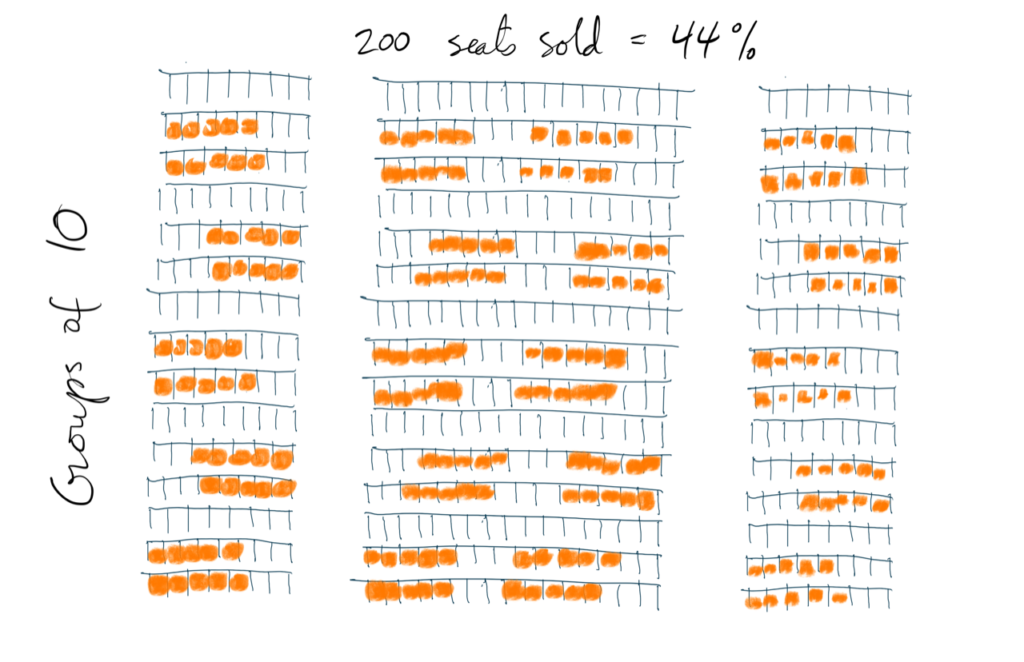
Being able to boast that you sold out every seat will be a thing of the past for a while. It’s time to get creative. What can you do to change your seating structure to reduce the intensity of interaction and limit number of interactions? Can you sell every other or every third ticket? Do you have sections for parties of 6 to make it easier for groups to stick together without having to readjust your entire new seating chart? There are plenty of diagrams you can consider and put in place depending on attendance levels and venue layout.

null

If you’re an outdoor venue with “lawn seating”, you might want to put up ropes or mark off seats with tape or chalk to help enforce distancing.

For theme parks and attractions, it will be easy to manage seating positions of park guests on rides by training staff to control the seating placement, and the IAAPA has identified some guidelines to help you think about capacities that allow for physical distancing.

Touchless Concessions

Across the country restaurants have had to reinvent themselves. In many states, eating in a restaurant is still prohibited, so restaurants have had to think outside the box on how to serve customers and keep revenue flowing. Some have opened up outdoor dining sections taking over parking lots, lawns, city streets and sidewalks, and many now offer take-out or delivery to ensure people can have their favorite gourmet food but eat in the comfort of their own home. For some restaurants, that means they are now accepting credit cards, PayPal or Venmo for the first time ever; some are offering a contactless self-ordering system and table service; others are having patrons scan a QR code for their food or drinks menu, make reservations or even connect to a restaurants payment tool. And, once self-serve, salad bars in restaurants and grocery stores are now open again with one distinct change, employees are now dishing out the patrons’ selections.

null

You can use some or all of these lessons learned from restaurants across the country to update your concession stands. Start with how to limit or erase lines. Do you allow certain sections to go to certain concession stands? Do you add more pop-up food stations to create more places to purchase food? Or better yet, do you launch/create an app for virtual queuing where the fan or guest selects the concession stand they’d like to purchase from and add themselves to that line, when it’s their turn, they are signaled to walk over to the concession? Or best of all, why not use an app in combination with waiters/waitresses; the fan or park guest downloads the app, orders their food and pays online, a waiter/waitress brings the food right to their seat.

Next, make sure you go touchless. Bring those condiment carts behind the counter and have your staff serve them. And, don’t forget about menus. If you usually hand out laminated menus reused with each guest, it’s time to throw them out unless you plan to sanitize them after every use. Although some venues have opted to print one-time-use paper menus, the cost to you and the environment will add up.  Think about implementing an app or QR codes for ordering.

Hygiene Stations & Touchless Amenities

Keeping areas clean is paramount to stopping the spread of germs. Have you asked yourself how often railings, door handles, counters and bathrooms should be cleaned? Do you need to hire additional janitorial staff to ensure these areas are maintained? Do you have pop-up handwashing and/or hand-sanitizing stations throughout your venue or park? Do you remove all drinking fountains and install water bottle refill stations that are managed by staff and sanitized between each use?

What about your faucets, toilets and paper towel dispensers…are they automatic, or do they involve the turning of a handle? While some of these would be costly renovations after already losing revenue these last few months, you can choose a variety of ways to make your venue or facility cleaner and keep the presence and spread of germs to a bare minimum.

The Moral of this Story…

No matter how much you prepare in advance of reopening, one thing is for certain – you will need to watch, measure, evaluate and be ready to make adjustments as necessary.

Adhere to your local government guidelines and embrace the physical and technical adaptations you can make, to build confidence among your returning visitors, patrons and fans and ensure a safe and fun time for all.

###

Evolv Technology Takes Home the Gold in 2020 Edison Awards Threat Defense and Security Category

Evolv Express® Also Earns Platinum and Gold Designations in Secure Campus Awards 2020


WALTHAM, MA – March 25, 2020 – Evolv Technology, the leader in free-flow weapons detection, today announced that Evolv Express® was named the Gold winner in the Threat Defense and Security, Applied Technology category in the prestigious 2020 Edison Awards™. A global panel of more than 3,000 leading business executives selected winners that represent “game changing” products and services combined with innovation and leadership in concept, value, delivery and impact.

Evolv Technology is the leader in human security dedicated to making the world a safer place to live, work, learn and play by helping protect innocent people from mass shootings, terrorist attacks and similar violent acts. This recognition comes on the heels of Evolv Express being honored by Secure Campus 2020 Awards for outstanding campus security services and product, earning Platinum status in the Perimeter Protection category and Gold status in the Screening Equipment category.

Imagine walking into a stadium, tourist destination, warehouse, performing arts venue or school without emptying your pockets or bag, knowing everyone inside was thoroughly screened for weapons. Evolv delivers security and freedom of movement with a discrete tool that seamlessly screens people and their belongings in real-time, instantly differentiating personal items from weapons. Evolv Express, the first-of-its-kind AI-based, free-flow weapons-detection system, works at the pace of life to accommodate thousands of individuals and groups per hour. Capable of screening more than 3,600 people per hour, Evolv Express eliminates the long lines common with legacy weapons screening such as metal detectors, while drastically reducing the need for secondary screening that is accompanied by personal intrusions such as hand wands and pat downs.

More than 50 million people to date have been screened by Evolv in a rapid, undisruptive manner while preventing more than 5,000 weapons from entering a range of public and private facilities. Evolv is used for visitor and employee screening at top entertainment venues, schools, international airports, stadiums, corporations, hospitals, large-scale events and national landmarks worldwide. Customers include Big Night Entertainment, Pittsburgh Symphony Orchestra, The Biltmore Estate, Gillette Stadium, L.L. Bean, Oakland International Airport, Spartanburg School District Six in South Carolina and many others across the globe.

“Evolv has redefined weapons-screening and threat detection by making security human again,” said Evolv Chief Executive Officer Peter George. “Behind Evolv Express is a team of incredibly talented security industry thought leaders and innovators who are committed to keeping people safe as they go about their daily lives. We could not be more honored to be named a winner in the threat defense and security category by the Edison Awards, which are recognized across the globe.”

“After a thorough review, the Edison Awards Judges recognize Evolv Express,” said Frank Bonafilia, Executive Director of the Edison Awards. “It’s a game-changing innovation standing out among the best new products and services launched in their category.”

About Evolv Technology

Evolv Technology is the leader in human security. The company is dedicated to making the world a safer place by helping to protect innocent people from mass shootings, terrorist attacks and similar violent acts. Evolv’s AI-based, free-flow weapons-screening and threat detection systems work at the pace of life to accommodate thousands of individuals and groups per hour – screening 50 million people to date in a rapid, undisruptive manner while preventing more than 5,000 weapons from entering a range of public and private facilities. Evolv’s customers include hundreds of top entertainment venues, schools, international airports, stadiums, corporations, hospitals, large-scale events and national landmarks around the globe. Led by a team of security industry thought leaders with a track record for delivering first-to-market products, the company holds more than 100 patents. For more information, visit https://evolvtechnology.com/.

About the Edison Awards

The Edison Best New Product Awards™ is the world’s most revered Innovation Award dedicated to recognizing and honoring the best in innovation and innovators since 1987. For more information about the Edison Awards complete program and a list of past winners, visit www.edisonawards.com.

###

PR Contacts:

Evolv Technology
Julie Zomar
media@evolvtechnology.com
(781) 374-8100

CHEN PR for Evolv
Jennifer Torode
jtorode@chenpr.com
(781) 672-3119